

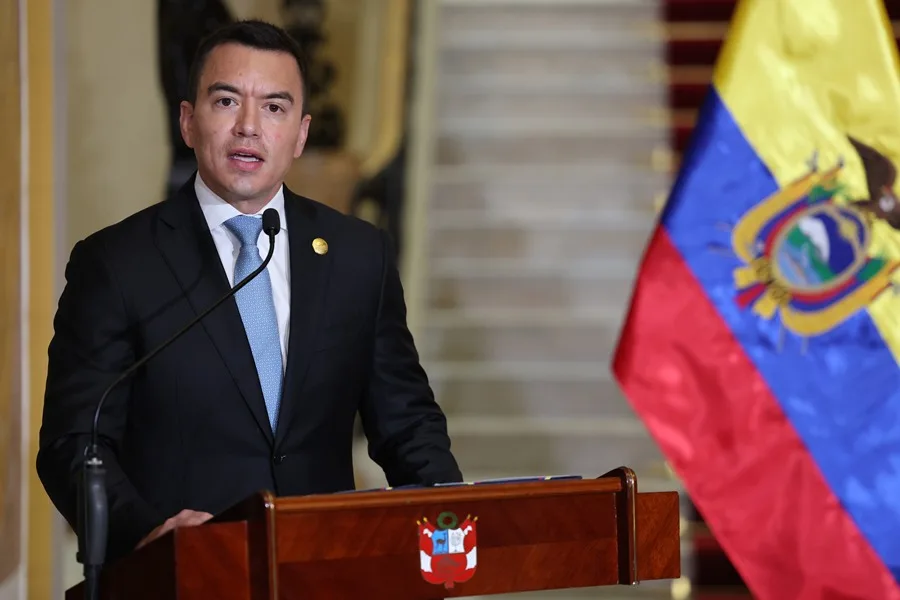
Ecuador began its fourth period of nighttime curfews early Sunday across five of its 24 provinces, including Guayaquil, to curb high crime rates ahead of the local elections.
The restriction runs from 00:00 to 05:00 local time (05:00 to 10:00 GMT) from November 1 to 10 in Guayas, Manabí, Los Ríos, El Oro and Esmeraldas, all in Ecuador’s coastal region, where drug-trafficking-related crime is concentrated and which include cities with some of the continent’s highest homicide rates.
Only emergency teams are allowed to circulate during the measure, according to President Daniel Noboa, who said the aim is to protect the civilian population from the “special operations” police and military will carry out to raid properties and catch suspected members of criminal gangs.
RELATED: Ecuador Health, Education Can Be Funded by Debt Under Noboa Decree
This is the fourth curfew decreed by Noboa in 2026, after those in March, May and September, amid a security crisis that led Ecuador to register a record 9,283 homicides in 2025, with a rate of more than 50 killings per 100,000 inhabitants.
The measure applies four weeks before local elections on Sunday, November 29, when Ecuadorians will vote, among others, for prefects and mayors for the next four years; the ruling party seeks to take control of the country’s main cities, such as Quito and Guayaquil.
The new curfew also covers one of the longest holiday weekends of the year in Ecuador, running from October 31 to January 3, with the commemoration of All Souls’ Day and the independence of Cuenca.
Is Ecuador’s nighttime curfew delivering the security results the government promised?
The measure took effect on September 17 across Guayas, Manabi, Los Rios, and El Oro, restricting movement from midnight to 5 a.m.
In its first three days, authorities reported 258 security… pic.twitter.com/N16wwWyw1P
— teleSUR English (@telesurenglish) September 21, 2026
These curfews come under the successive states of emergency Noboa has decreed partially or totally since 2024, when he declared “war” on organized crime by classifying the country as being in an internal “armed conflict” and labeling criminal gangs as terrorist groups. Under states of emergency, some fundamental rights are suspended, such as the inviolability of the home and communications, as well as, eventually, freedom of movement through curfews.
From teleSUR English via This RSS Feed.