

Each month, we share the stories of World BEYOND War volunteers around the world. Want to volunteer with World BEYOND War? Email greta@worldbeyondwar.org.
Location:
Cali, Colombia
How did you get involved with anti-war activism and World BEYOND War (WBW)?
I developed an interest in anti-war activism because it is closely related to my background as a political scientist and sociologist, as well as my experience as a teacher and researcher in Social Sciences. Throughout my academic and professional career, I have sought to understand the complex power relations, social inequalities, and different forms of structural violence that run through our societies, especially in Latin America.
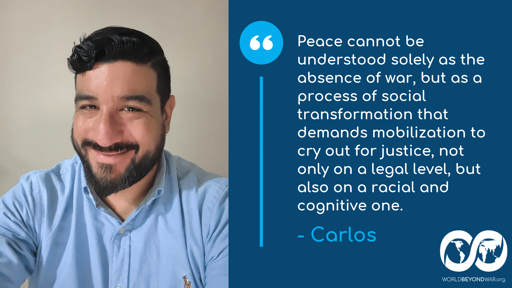
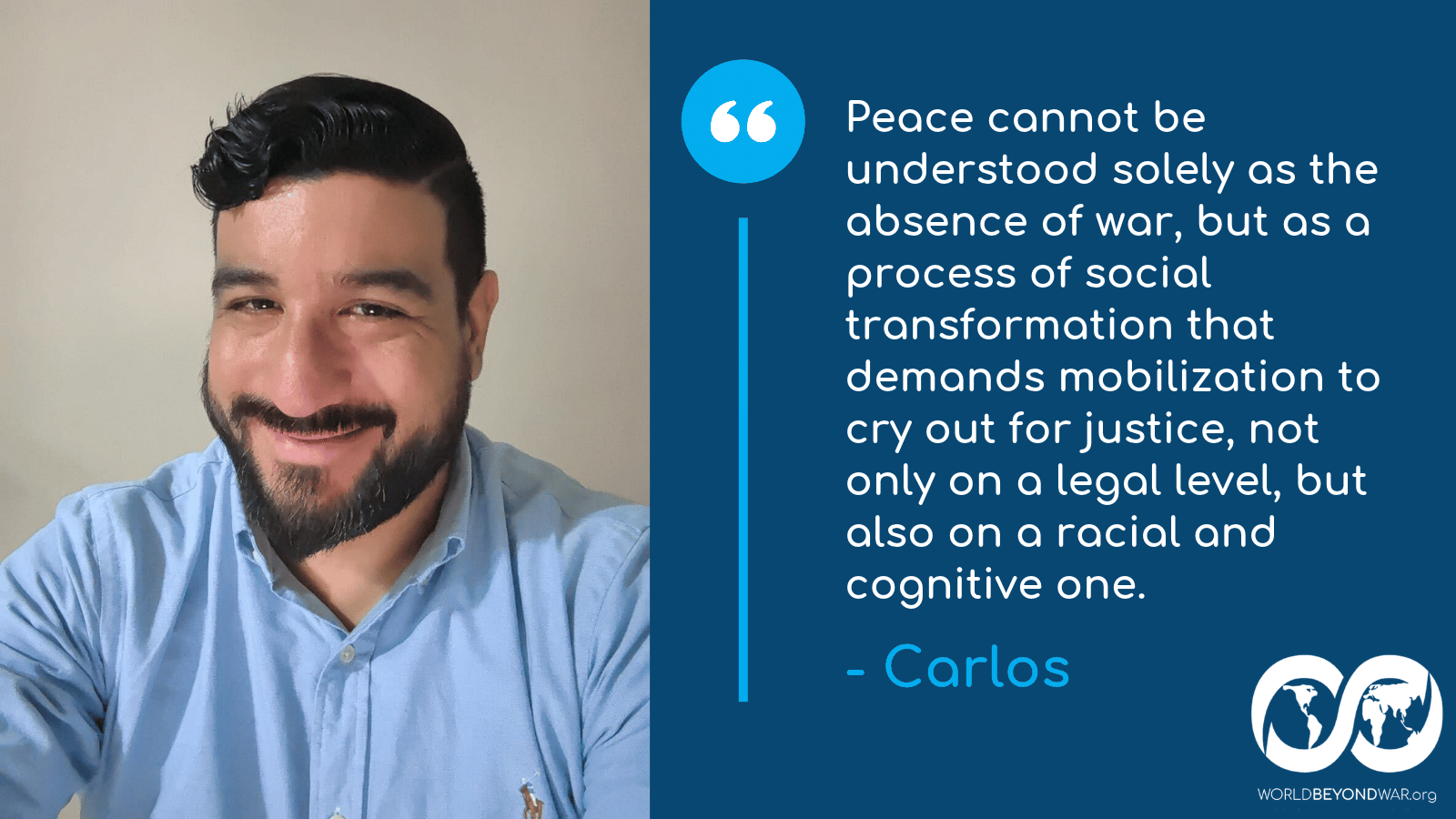
In this sense, living in Cali, Colombia—a country marked by decades of armed conflict where violence is intrinsically normalized—has helped strengthen my conviction that peace cannot be understood solely as the absence of war, but as a process of social transformation that demands mobilization to cry out for justice, not only on a legal level, but also on a racial and cognitive one. Because I am convinced that it is through citizen participation that the structures reproducing violence can be questioned.
From this perspective, I found appealing in World BEYOND War its transdisciplinary approach to addressing peace through dialogue with other cultures and from a firm culture of disarmament. It is a proposal that connects with my way of understanding peace: not merely as an ideal, but as a collective construction and praxis that requires education, organization, and citizen action.
What kinds of WBW activities do you work on?
I am the Chapter Co-Coordinator for the World BEYOND War Cali, Colombia Chapter. My main contribution to peace activism so far has been developed within the educational field, through academic reflection and discussion spaces. Although the chapter was recently launched, it is worth noting that as a Social Sciences teacher, I strive to create spaces where young people can analyze the historical, political, and economic causes of conflicts, question the normalization of violence, and recognize the importance of dialogue, human rights, and citizen participation. The idea is to eventually translate this into community spaces where decisions are brought to a more local level. We plan to promote a pedagogy for peace that incorporates critical and decolonial perspectives, allows for an understanding of the relationships between militarism, inequality, and power, and recognizes the role of communities in building alternatives to violence. I have had the opportunity to enroll in the seminars organized by WBW in pursuit of a peaceful world.
What’s your top recommendation for someone who wants to get involved with anti-war activism and WBW?
My main recommendation is to understand that peace activism begins with a critical attitude toward reality and the willingness to act to transform it. It is not necessary to be a specialist in international relations or armed conflicts to get involved. It is essential to stay informed, listen to communities affected by violence, participate in collective initiatives, and question discourses that present war as an inevitable solution. I would also recommend joining organizations like World BEYOND War, participating in their educational spaces, and recognizing that everyone can contribute from their own knowledge, experiences, and possibilities.
What keeps you inspired to advocate for change?
My main motivation comes from my experience as an educator and the conviction that new generations have the capacity to imagine and build different societies. Working with young people constantly reminds me that education can open up possibilities to question what is often presented as natural or inevitable, including war, inequality, and various forms of violence.
On the other hand, I am motivated by the reality of Latin America and, particularly, the history of Colombia. Our conflicts demonstrate that violence has deep historical and structural roots. There will always be a way out or a solution through dialogue, taking into account the experiences of resistance, solidarity, and the collective construction of peace. In short, what keeps me motivated is the conviction that war is not an inevitable destiny and that educating for peace is also a way to transform the world.
Posted October 31, 2026.
The post Volunteer Spotlight: Cali, Colombia Chapter Co-Coordinator Carlos Enrique Carrillo Piraquive appeared first on World BEYOND War.
From World BEYOND War via This RSS Feed.