

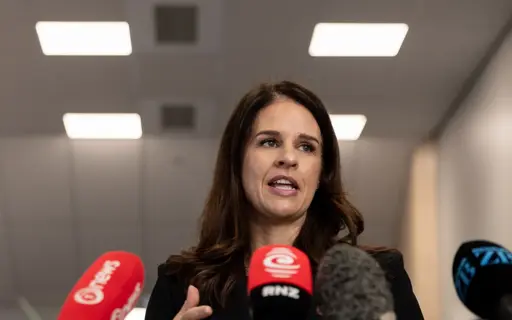

The Waitangi Tribunal described the “knowledge-rich” curriculum approach introduced under education minister Erica Stanford (pictured above) as “more like an experiment grounded in ideology than one based on evidence of what will work to close the equity gap here”. (Photo: RNZ / Samuel Rillstone)
The Waitangi Tribunal report on curriculum (Wai 3553, stage two, part one) was released in September. It details how the Crown breached multiple principles of Te Tiriti o Waitangi by sidelining the Indigenous curriculum model for Māori-medium and kaupapa Māori education, Te Tīrewa Marautanga o Aotearoa, and replacing it with the Minister of Education’s “knowledge-rich” science-of-learning design principles.
Jessie Moss, professional adviser at NZEI Te Riu Roa, gave evidence at the Tribunal’s urgent inquiry, which she summarises here. It shows that, contrary to education minister Erica Stanford’s claims, Māori wrote their own Indigenous curriculum, and her government stopped it from reaching tamariki Māori.
When Erica Stanford became the Minister of Education in November 2023, the Indigenous framework, Te Tīrewa — the foundation for the newly named Te Tīrewa Marautanga o Aotearoa, the curriculum for Māori-medium education — was complete.
Te Tīrewa was developed as an Indigenous reclamation and remedy for decades of education that served as an assimilation tool for Māori children. It was written and led by Māori educators, academics, and mātauranga Māori experts, guided by whānau, hapū and iwi.
Its updated histories section, Te Takanga o Te Wā, had been in classrooms for nearly two years. Pāngarau (mathematics) and te reo Māori were also complete and set for release in 2024. Other Tīrewa Ako (learning areas) were also well underway.
Stanford, as the incoming minister, was comprehensively briefed by the Ministry of Education on this and Māori education.
Te Tīrewa was internationally informed and grounded in mātauranga Māori. But before the Tīrewa curriculum could fully arrive at kura and schools, it was stopped in its tracks. And last month, after nearly three years of Stanford’s oversight, a very different Te Marautanga o Aotearoa was unveiled for years 0-10.
Te Tīrewa is gone, replaced by a new framework, “Te Anga”. Conceptual elements of Te Tīrewa can be found in Te Anga, but the Indigenous curriculum framework is lost.
As in the past, Te Marautanga o Aotearoa structurally mirrors the New Zealand Curriculum for English medium schools. The Waitangi Tribunal has said it is now a “curriculum delivered in te reo Māori rather than a Māori curriculum”.
It was extraordinary then that in April 2026, in the midst of sector-wide pushback on her curriculum reforms, and during the Waitangi Tribunal hearing itself, Stanford declared to parliament that “when I came to be minister and looked at what had been done . . . no work had been done on Te Marautanga o Aotearoa — nothing at all. Not a single word of the new curriculum . . . not one word — zero.”
Stanford’s claim was made in response to Labour’s Willow-Jean Prime asking why the consultation period for Te Marautanga o Aotearoa was “half that of the New Zealand Curriculum”.
According to Stanford, ministry officials had advised her that “no curriculum learning areas had been developed”. But this contradicts the many public ministry documents detailing the progress and completion of Te Tīrewa, which were signed by Stanford herself over a period of months, starting in November 2023.
In April 2024, for instance, an education report from the ministry to Stanford proudly explained that “as stated in international articles, Te Marautanga o Aotearoa puts New Zealand at the forefront of multiple international indigenous education communities. In this sense, the national, international, and indigenous significance of Te Marautanga o Aotearoa cannot be overstated”.
By June 2024, the Tīrewa framework had disappeared without any paper trail, public explanation, or consultation with Māori.

Te Tīrewa was a Māori-led Indigenous curriculum model. It was “internationally informed and grounded in mātauranga Māori. But before the Tīrewa curriculum could fully arrive at kura and schools, it was stopped in its tracks,” writes Jessie Moss.
The Waitangi Tribunal found the Crown failed to actively protect tikanga and mātauranga Māori “by sidelining the Te Tīrewa Marautanga framework in favour of the same knowledge-rich design principles that underpinned the New Zealand Curriculum”.
It also found that, without meaningful Māori involvement, this breached the Treaty principle of partnership. It concluded that the reforms were not driven by the “aspirations whānau, hapū and iwi have for their uri in Māori-medium and kaupapa Māori”.
The consequences are threefold. First, mātauranga Māori is no longer given substantive authority in the teaching and learning of tamariki Māori within Te Marautanga o Aotearoa. Second, mātauranga is now organised within western structures, rather than Māori knowledge organising the curriculum itself. And third, the knowledge hierarchy embedded in the New Zealand Curriculum has been carried into Te Marautanga o Aotearoa through its shared framework.
This constitutes epistemic violence, which occurs when a dominant power overwrites, marginalises, or erases the valid knowledge systems, histories and languages of another culture, forcing them into a framework they didn’t create.
Replying to an OIA request to the ministry in 2025, Pauline Cleaver, the deputy secretary of education, said that dropping Te Tirewa was an “internal decision”, and there was “no advice between the Ministry and the Minister” on this or the decision to disband Te Rōpū Whāiti, the expert advisory group for the Tīrewa framework and the redesign of Te Marautanga o Aotearoa. Cleaver said both decisions were made by the ministry, not the minister.
We’re therefore asked to believe that Te Uepu Reo Māori, the specialist group within the ministry’s Curriculum Centre, which was responsible for Te Marautanga o Aotearoa, as well as the writers of Te Tīrewa and Te Rōpū Whāiti, voluntarily abandoned decades of effort towards an Indigenous curriculum and instead adopted the minister’s design principles.
A 2022 report from Te Uepu Reo Māori to then Minister of Education Jan Tinetti said the redesign of Te Marautanga o Aotearoa “privileges mātauranga Māori and te reo Māori, shifting the focus toward indigenous ways of learning”. The report also explained that the first iterations of Te Marautanga o Aotearoa in the 1990s and 2000s had “followed the development of the New Zealand Curriculum and required the writers to align the expectations and outcomes to Western theory and practice”.
The 2026 Waitangi Tribunal report noted that during this initial redesign period, “the Crown was committed to both listening to Māori voices and to the accurate teaching of Aotearoa New Zealand’s past . . . . Instead of the assimilationist agenda that had characterised the education system for so much of the country’s history.”
At the Tribunal hearing in April 2026, Pauline Cleaver confirmed there was no co-design with Māori or anyone external to the Ministry of Education during the development of the “knowledge-rich” curriculum. She stated that the ministry wrote the curriculum itself, with “additional expertise contracted in”, noting this differed from how the ministry had worked previously.
During the Tribunal hearing, the Crown presented no evidence to refute the claim that Te Tīrewa had been displaced.
The evidence the ministry relied on for adopting the knowledge-rich approach came from an Australian education consultancy, Learning First, and a report by the Australian Education Research Organisation (AERO), which is currently under fire for the reliability of its research. Australian educators are calling for the public release of the federal review into AERO’s performance, undertaken by KPMG.

Pākehā sociologist Professor Elizabeth Rata, who believes Indigenous knowledge has no place in the curriculum, was one of Erica Stanford’s advisors. As the Waitangi Tribunal wrote: “If the Minister surrounds herself with external advisors who believe that Māori knowledge should only appear in New Zealand schooling as a kind of anthropological object of study rather than a knowledge system in its own right, it gives Māori a clear signal.”
In the AERO report on the knowledge-rich approach for the Ministry of Education, only three of the 150 sources cited were from New Zealand. Two belonged to Pākehā sociologist Professor Elizabeth Rata, a member of Stanford’s ministerial advisory group alongside Dr Michael Johnston from the New Zealand Initiative. Rata is well known for her contentious views on education, including her call to “end decolonisation’s success” and her claim that Indigenous knowledge has no place in the curriculum.
Ngā Kura ā-Iwi, the national collective for iwi-based schools, gave critical evidence at the urgent hearing that the Ministry of Education, acting as the Crown, failed to fulfil its obligations under the Kawa Whakapūmau agreement by not engaging adequately with them during the curriculum reform process. The Tribunal found this breached the Treaty principle of partnership.
The knowledge-rich curriculum “underpinned by the science of learning” is a hotly contested import to Aotearoa. The Tribunal’s report described this curriculum approach as “more like an experiment grounded in ideology than one based on evidence of what will work to close the equity gap here”.
In evidence to the Waitangi Tribunal, Pauline Cleaver maintained a “key driver” of the national curriculum changes and the focus on a knowledge-rich approach was to close persistent inequities in educational outcomes for ākonga Māori.
But the Crown presented no evidence to support this.
The ministry’s admirable intention was undermined when a claimant group giving evidence, the Māori research group Huia Kaimanawa, reminded Cleaver of the report the ministry itself had commissioned on equity for Māori in March 2024. The report, Equity, where is it?, by Huia Kaimanawa, was not used by the ministry to inform reforms.
A September 2024 briefing to Erica Stanford also reveals the formation of a “curriculum coherence” group for the New Zealand Curriculum, whose recommendations could be considered for Te Marautanga o Aotearoa “where relevant”. This group was led by Dr Michael Johnston, and included Dr Catherine Law, who was recently captured on film asking curriculum workers to avoid recording “OIA-able” information. Curriculum Centre practices are now the subject of a formal Ombudsman’s inquiry.
Te Tīrewa has disappeared. Meanwhile, Te Marautanga o Aotearoa no longer has its own Māori oversight group, and may now be overseen by a group with no identifiable Māori membership or mātauranga Māori expertise.
In light of the Ombudsman’s current investigation into the education ministry’s handling of OIAs and the recent review findings that revealed a workplace culture of intimidation and toxicity, was the adoption of Stanford’s “knowledge-rich” design made under immense pressure — pressure not recorded in writing?
Stanford’s claim that “not one word” had been written on Te Marautanga o Aotearoa when she took office suggests she wishes to distance herself from Te Tīrewa, as she claims to have done “more for Māori education than any predecessor”. This is despite Stanford ignoring ministry advice given in 2023 to build on work already undertaken with “experts in the education community”. The ministry also emphasised that agency and authority over kaupapa Māori education and the use of mātauranga Māori in both Māori and English medium settings “should reside with Māori”.
All of this amounts to another account of Crown breaches of Te Tiriti in education. As the Waitangi Tribunal reported:
If the Minister surrounds herself with external advisors who believe that Māori knowledge should only appear in New Zealand schooling as a kind of anthropological object of study rather than a knowledge system in its own right, it gives Māori a clear signal. It tells them that decisions about what and how their tamariki and mokopuna are taught are being made by people who do not understand and respect their values, their beliefs, and their cultural practices.
As the Tribunal recommends, the Crown must “return to the seeds that were planted” during the initial work on Te Tīrewa Marautanga o Aotearoa, and “work with Māori on designing a truly indigenous Māori-medium and kaupapa Māori curriculum”.
*Te Marautanga o Aotearoa is predominantly used by Māori immersion and bilingual units, where 97 percent of tamariki Māori learn. It’s also used by kura ā-iwi alongside their own iwi- and hapū-based curricula. Kura Kaupapa Māori have their own curriculum, Te Marautanga o Te Aho Matua, but can also use Te Marautanga o Aotearoa.
Jessie Moss is a registered teacher and the professional education adviser at NZEI Te Riu Roa. She has a background in primary school teaching and national curriculum resourcing. She is also a musician and te reo Māori enthusiast. She lives in Te Awakairangi.
The post What happened to the uniquely Indigenous Māori curriculum? appeared first on E-Tangata.
From E-Tangata via This RSS Feed.