



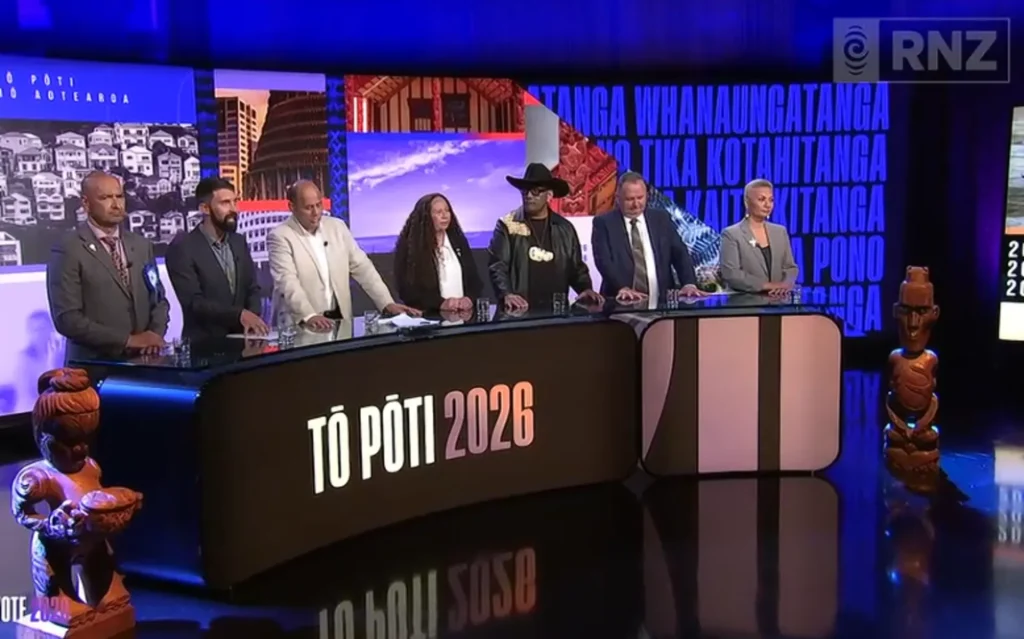
It’s hard to imagine Māori in places like Kaikohe — where more than 2,000 of the town’s 5,000 people are on a jobseeker benefit, and the average income of those with jobs is $28,100 — feeling heartened by last week’s Māori leaders’ debates, writes Jamie Tahana. Pictured above, the lineup for last week’s debate on Whakaata Māori.
Last week’s Māori leaders’ debates did little to turn around an election lacking in vision, hope, or even a plan for Māori, writes Jamie Tahana.
There was a poignant moment at the start of the Whakaata Māori leaders’ debate last week when the moderator, Moana Maniapoto, asked whether each of the five politicians before her had a friend or relative who was in a gang.
The audience chuckled at the question. The past week had seen the campaign descend into farce, as picture after picture of MPs meeting with members of the Mongrel Mob made headlines.
As Moana Maniapoto’s question powerfully highlighted, every Māori MP, indeed, every Māori, has whānau who have ended up in gangs, and whānau obligations and realities never fit neatly into political life.
Labour’s Willie Jackson and National’s Tama Potaka winced noticeably at the question. After all, their leaders had spent nearly a week arguing over who was tougher on gangs, and insisting that none of their MPs would ever work with them. Yet again the major parties’ Māori MPs were in a bind, caught in the inevitable tension between political populism and Māori reality.
This may also have been the only time all five candidates — Jackson, Potaka, New Zealand First’s Shane Jones, Te Pāti Māori’s Debbie Ngarewa-Packer, and the Greens’ Marama Davidson — agreed on anything.
Kaupapa Māori debates are usually surprising and refreshing for their collegiality. Willie Jackson made it clear that wouldn’t be the case this year, when he called Shane Jones and Tama Potaka “useless Māori MPs” in the opening minutes.
The tone was set. Jones, Jackson, and Potaka spent the next hour sparring in an at times incomprehensible verbal brawl. At one point, co-host Māni Dunlop begged us not to be sick of debates.
The wāhine were completely drowned out by what the Spinoff’s Lyric Waiwiri-Smith called an “unc problem”. If it were a marae, someone would probably have started singing to wrap it up. In a hot mic moment as they faded into an ad break, Moana Maniapoto let out an exasperated: “Ugh, bloody hell.” Exactly.
A day later, they were back at it on TVNZ’s kaupapa Māori debate, this time with Te Pāti Māori’s Rawiri Waititi, ACT’s Nicole McKee, and Eden Skipper, the Christchurch Central candidate for Opportunity. The tone wasn’t that different, and the brawl resumed.
TVNZ’s Kaupapa Māori debate. (Screenshot : TVNZ)
The outcome of this year’s election, whatever way it falls, holds significant consequence for Māori.
After a term defined by protest and a slate of legislation that has made changes in everything from land and foreshore rights to Māori participation in decision-making and the use of te reo Māori by government departments, a recent Curia poll for Whakaata Māori found that 72 percent of Māori think the coalition government has undermined the Treaty relationship.
Tama Potaka, National’s highest-ranked Māori MP, claimed the coalition had been a success for Māori, pointing to government funding for broadcasting, te reo, and Te Matatini. He glided past the relegation of te reo in everyday life, curriculum changes, the Regulatory Standards Act, and the overhaul of the Marine and Coastal Area Act, among other measures.
When pressed, he said he’d spoken in defence of Te Tiriti on the marae, but not in parliament, and refused to rule out supporting ACT and New Zealand First’s proposals to abolish the Waitangi Tribunal, calling it a “matter for the National Party leadership to decide”.
It wasn’t quite clear what he stood for.
Shane Jones, however, was explicit. The past three years, he said, had been defined by “performative outrage in Māori politics” against the coalition. The Tribunal had strayed from its purpose and should be gone. He called climate change “an ideological indulgence” and said that mining and drilling for oil would create jobs.
Nicole McKee said her party and its policies — including the deeply unpopular Treaty Principles Bill — were about unity, not division. Removing targeted programmes and funding was “putting need above race”, which, she said, “is required for everything”.
Marama Davidson spoke in defence of the Waitangi Tribunal, calling Te Tiriti “a beautiful blueprint for how we take the best possible care of each other,” while saying the hīkoi of 2024 was an endorsement to give the Tribunal, an unelected body, binding powers.
There wasn’t much the Greens and Te Pāti Māori didn’t agree on, including that the health system was racist. Rawiri Waititi said Te Tiriti should be enshrined. Skipper, when pushed, defended Opportunity not having Te Tiriti as one of the party’s bottom lines.
Willie Jackson, having been the most vocal in both debates, was tied in a knot on Thursday when he was asked what, exactly, would be different under a Labour government. So far this campaign, Labour has said it would not bring back Te Aka Whai Ora or co-governance, nor would it unwind several of the current government’s changes.
Throughout the campaign, there’s been a wariness about Chris Hipkins’ conviction on kaupapa Māori, and Labour’s lack of Māori-specific policy, with some questioning whether it would be tossed aside for political expediency. Willie Jackson defended the party, saying the previous Labour government had “brought in more kaupapa Māori than any other government in history.”
The debates were illuminating, but they did little to turn around an election that has been lacking in vision, hope, or even a plan for Māori.
Another poignant moment came from remarks by Te Aniwa Hurihanganui, co-moderator of the TVNZ debate. She had recently been in Kaikohe, she said, where more than 2,000 of the town’s 5,000 people are on a jobseeker benefit. For those who have jobs, the average income is $28,100.
It’s hard to imagine anyone in Kaikohe, watching the leaders shout it out on television, feeling heartened by either spectacle.
Jamie Tahana (Ngāti Pikiao/Ngāti Makino/Tapuika) is a journalist and broadcaster who has worked in both Aotearoa and the Pacific. He grew up between his Dutch mother in the Hutt Valley, Wellington, and his Te Arawa dad in Rotorua. He has a master’s degree from Te Herenga Waka Victoria University and was the Māori news editor at RNZ until May 2023.
The post Verbal brawls offer little to Māori appeared first on E-Tangata.
From E-Tangata via This RSS Feed.