

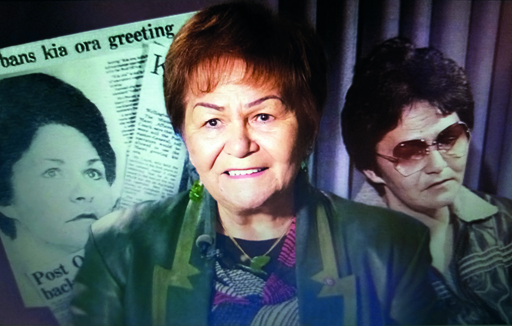

“It has been my life’s work to fight for the rights of my people, and central to those rights is the right to live in a way that honours ourselves and our culture,” says Naida Glavish, pictured in front of headlines she generated in 1984. (Photo supplied)
Kahurangi (Dame) Rangimārie Naida Glavish seized the headlines in 1984 for the simple act of saying “Kia ora” when answering the phone as a toll operator. It was a moment in time that was preceded by terrible tragedy in her whānau.
In this lightly edited extract from her memoir, The Kia Ora Lady, published next week, she recalls the events leading up to the “kia ora” controversy and its lasting impact on her life.
Before Māmā’s cataracts operation, we used to go for walks around Helensville. She liked to go around the corner to the Grand Hotel, have a jug of beer, and we’d walk back again. That would be her exercise for the week. She knew people by their voices. Her hearing was heightened, perhaps due to her blindness. I can understand that, because often when I am at a Māori hui, I close my eyes and focus on the tone of voice, and I hear, by focusing on that tone, messages that are not spoken.
And Māmā knew everybody by their voice. We were sitting in the hotel having our beer when Māmā’s first cousin’s mokopuna Georgina walked in. Māmā hadn’t seen her in years. We were all yarning away when Māmā said to me, “Tell Georgina that I want to name the baby.” I did so, and Georgina goes to me, “Ho! Who told her I was pregnant?” None of us had known, but my blind Māmā had sensed from Georgina’s voice that she was pregnant. Māmā then said, “I want the name ‘Aroha’, Georgina.” She never said anything else. So the baby was named Aroha.
Māmā died at 3am on November 4, 1972, and two months later we suffered another tragic loss. Our whānau was having a hui in Pukekohe after losing Māmā, and we were staying in a whare near the main road. The children were outside playing, and my then-youngest baby, Te Pania, came running to the door calling, “I won the race! I’m the winner.” She was so excited to tell me about it. Then a wheel fell off the back of a truck some distance away, and it rolled down and hit her — my three-year-old baby — right where she stood. She died instantly.
I knew straight away, as I ran screaming to pick her up, that she was already gone. So — two months after I lost my grandmother, my youngest baby died, too. I buried her on top of my grandmother.
For a whole year, I was lost in grief, I couldn’t cope. Eventually, though, I heard the voice of Māmā helping me out of my terrible sadness, encouraging me to become part of the world again.

Naida’s beloved māmā. (Photo supplied)
After I had my youngest daughter, Faith, in 1975, I began to work full-time to help our household financially, as well as continuing with my roles representing Māori. I was lucky I had an aunty unable to have children who offered to babysit for me. She was wonderful with the children, and her presence enabled me to start work in the Helensville post office as a toll operator, a long time before there were cell phones.
Only land lines were available back then, and when someone needed to make a toll or international call, my job was to sit in front of the switchboards to manually connect callers via jack cords. The shutter would come down, I’d put a plug in it and say, “Kia ora, tolls here,” before putting the call through. That worked well in Helensville. And, when I was promoted to another job in Auckland in 1982, it was also ka pai (good) — “Kia ora, tolls here.”
Then, in 1984, a supervisor from Taupō was employed to “tidy up” the toll exchanges in Auckland. The new supervisor brought in a different process. We were required to use a standard expression, which consisted of, “Good morning (or good afternoon, or good evening), tolls here.” That seemed stupid to me — why go to all that effort when “kia ora” covered it all? With my way, it didn’t matter what time of the day it was.
“Kia ora” was my reo, it was me, and it shouldn’t have offended anyone. So I persisted, but that new supervisor was after me. I was demoted — and assigned to off-the-board administrative duties, pricing toll tickets. This went on for some months, until an aunty of mine died back home in Puatahi. I needed to return to our marae for her tangi, so I asked for time off. I thought the supervisor might refuse me, so I was prepared to leave my job, but, to my surprise, he readily agreed for me to go home to her tangi. While I was back at Puatahi, our cousin was killed in an accident, and I needed more time off work for his tangi. Again, the supervisor agreed — surprisingly happily, I thought. In hindsight, I think he was just pleased I wasn’t in the toll exchange causing trouble.
After seven days away, I headed back to work, up and over the harbour bridge, prepared to face the supervisor’s usual disapproval of being the “Kia Ora Lady”, and willing to ease off, to give in to his attitude because I was grateful for the time off he had given me. But, as I approached the top of the bridge, I heard this voice in my ear say, “Nui ake tēnei take i a koe.” (This is far greater than just you.) I thought it was the wind blowing through my open window, so I wound it up. Then I heard it again — “Nui ake tēnei take i a koe.”
I knew that it was my grandmother in my ear, continuing to advise me. She had died in 1972, but here she was, in 1984, still giving me a hard time. At that moment, I knew I needed to continue with my use of te reo.
I went into the supervisor’s office. I thanked him for the time off that he had given me, and I said to him, “You do what you have to do as my supervisor. You do what you have to do, and I will respect that. I will do what I have to do as a mokopuna of my grandmother, and I’d ask you to respect the same.” I walked out of his office and went back to, “Kia ora, tolls here.”
The supervisor took the issue to a meeting of supervisors at the Post and Telegraph Association, so supervisors and toll operators across the country heard about it. Somehow the BBC in London got wind of it then and began to ask questions. Soon afterwards I happened to meet Ranginui Walker and said to him, “You know what, Rangi? I’m being treated really badly at work. They’re giving me a hard time.” I told him it was because I was using te reo Māori as a greeting.
He said, “That’s racist. That is so racist. We can’t let that continue. That’s a greeting indigenous to this country, so you should be able to use it.” He advised me to continue, so I did. Ranginui then called the chair of the New Zealand Māori Council, Sir Graham Latimer. They phoned Rob Talbot, the Postmaster-General and Minister of Tourism, who initially refused to budge. He supported his superintendent’s ban on “kia ora” because he thought that many people did not speak or understand te reo, so the language was inappropriate for general use.
Where was his understanding of Te Tiriti? Our reo is a taonga, protected under Article 2 of Te Tiriti! He also claimed that if te reo Maōri was used, other ethnic groups would be claiming the right to use their own national greetings too.

Tamariki at a display at Auckland War Memorial Museum. (Photo supplied)
One afternoon, a little later, I sent my daughter up to the shop from our rented New Zealand Post Office house in Mount Wellington, and she returned with the evening Star newspaper. On the front page was an article entitled “Toll operator chastised for saying kia ora”, together with a photo of me.
My daughter said, “The shopkeeper said to me, ‘Is this your mummy?’ I said yes, so he gave me the paper.” My husband said to me, “You’ve started a war. Where is your army?” I just responded that my army was on my shoulder — my tūpuna.
Yes, I was worried, because if I were to lose my job, I’d be evicted with my family from the house we were renting; I would be in trouble. However, I decided that if anything like that happened, I’d just have to go home to the Kaipara.
However, there was a negative public backlash about Talbot’s support for the ban, including a newspaper article I have kept about Ben Couch, the Minister for Māori Development, commenting that “Kia ora is ka pai.” (Kia ora is good).
Shortly after that, the BBC published an article about it. There was increasing concern that the raruraru (fuss), spread by word of mouth throughout New Zealand and then fired up by newspaper journalists, would affect tourism if it spread beyond our shores.
Prime Minister Rob Muldoon was out of the country at the time, but I have since been told that he had been briefed about the issue, was not in favour of the ban, and had advised Talbot to rescind his decision. Whatever the reason, Talbot did change his mind, saying (rather defensively, I thought) that “the issue was clearly an important one in the public mind, and it is good to see such a strong sense of public pride coming through”.
When Prime Minister Muldoon returned from his trip away, his flippant comment was “I’ve been overseas deciding the economics of this country and some girl wants to say ‘Kia ora’. She can do that, as long as she doesn’t say ‘G’day Blue’ (a song about an Australian bowling underarm), heh, heh, heh.”
So the decision was reversed, and I was able to continue. My grandmother was right: if you see something wrong in front of you, you are duty-bound to correct it. If you do not, you will become like it. When I went to work the next day, the 100 toll operators in the room couldn’t get their calls through because the exchange was jammed with people wanting to speak to the “Kia Ora Lady”.
It was disruptive to the exchange; the supervisor was not at all happy. I felt as if I had won a battle for our reo, but actually the country won that war. People everywhere began to use the greeting; it was a step towards the use of te reo Māori in the Pākehā world. Schools and students wrote in support of me.
That year, Carl Doy, a pianist and composer, released a record, Driftwood, which included a track called “Kia Ora”. Airline pilots began their talk to passengers with “Kia ora”, and the University of Auckland changed the title of their student publication from Craccum to Kia Ora for a week. What an amazing impact my disobedience had!
The supervisor was sent to toll enquiries, and I was promoted to international tolls. Immediately, it was, “Kia ora, Aotearoa.” My role as an international operator introduced me to a wider world in more ways than one.
Calls were coming in from all over the globe, and people were using their own language when ringing in to here. So my stance on the use of te reo had an international impact as well. Thirty-odd years later, when I was attending a First Nations health conference in New York, I received a call from a BBC reporter who had been researching old files in order to prepare a programme on people from around the world who had made a difference. She had come across the Kia Ora incident and wanted me to record a Kia Ora session in a BBC studio while I was in New York. I took a couple of friends with me and completed the interview, only to find that the session had hit the news in New Zealand before I had even arrived home.
 A short while ago, in 2024, I was amused to see a photo of two grandchildren of Vanessa Watene, my executive officer in my role as Chief Advisor Tikanga Māori Health for Auckland and Waitakere District Health Boards, in front of a wall display remembering me and the tolls incident.
The display was in the Auckland War Memorial Museum, on the 40th anniversary of the Kia Ora Lady’s use of the greeting, “Kia ora, tolls here.”
When I think of that incident, I still marvel at how it exploded into the news, hitting the front pages of the main newspapers across the country because of the involvement of the media and politicians.
By the time Prime Minister Muldoon intervened, it had become a national talking point, at a time when many other protests were taking place.
It followed the 1975 Land March led by Whina Cooper, the Takaparawhau/Bastion Point occupation of 1978, and the 1981 Springbok Tour.
From 1981, the Department of Māori Affairs agreed to pilot kōhanga reo, and kura kaupapa were considered not long after, so I think the Kia Ora incident happened at the right time and place to refuel the arguments about racism and our language in our colonised country.
While I had held local and nationally recognised positions on various committees and voluntary jobs prior to it, the Kia Ora issue certainly opened the door to new horizons for me.
Extracted with permission from The Kia Ora Lady: A memoir by Kahurangi (Dame) Rangimārie Naida Glavish with Lorraine McLeod. Published by Potton & Burton, November 2026. ($45 RRP)

Author Lorraine McLeod. (Photo supplied)
Kahurangi (Dame) Rangimārie Naida Glavish first rose to prominence in the 1980s when, working in the Helensville toll exchange, she made national headlines for refusing to stop greeting callers with “Kia ora”. Though threatened with losing her job, she eventually won this landmark battle, one of many she has fought during her long life advocating for the rights and recognition of Māori in Aotearoa.
Raised by her grandmother in an earth-floor whare on the shores of the Kaipara Harbour, Kahurangi Naida experienced the brutality of racism early in her life when, as a teenager, she was separated from her whānau and made a ward of the state for the flimsiest of reasons. That stoked a fire in her belly that has never dimmed, and she has been an activist ever since, in recent decades devoted to improving the experience of Māori in the health system.
Dr Lorraine McLeod is a Pākehā of English and Scottish descent. She comes from a farming family and spent the first two decades of her adult life juggling farming with early childhood and primary school teaching and further study. She later moved into teacher education. She is the author of two previous books: Toby Curtis Unfinished Business – Ki hea āpōpō*, the story of Te Arawa leader Sir Toby Curtis, and* Leave Your Big Boots at the Door: Pākehā confronting racism against Māori.
The post Naida Glavish: The Kia Ora Lady appeared first on E-Tangata.
From E-Tangata via This RSS Feed.