

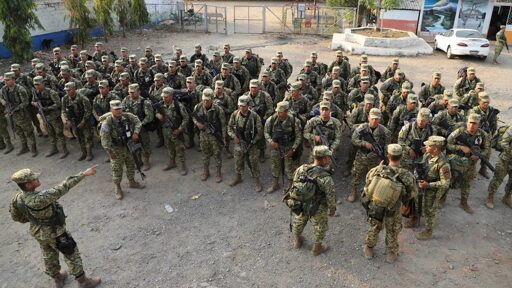

El Salvador’s right-wing president, Nayib Bukele, announced on October 29, that he will deploy a military force of nearly 2,000 soldiers to Haiti. The Salvadoran president has justified the measure by citing the disappearance of four Salvadoran soldiers on October 18.
The Salvadoran soldiers reportedly went missing following an armed attack in Croix-des-Bouquets, near the capital Port-au-Prince, involving the armored vehicle in which they were traveling. According to some reports, the attackers used very powerful weapons and explosives. Since then, the whereabouts of the soldiers remain unknown, and it is unclear whether they are still alive.
According to Bukele, thousands of Salvadoran soldiers are conducting search operations. Several critics have claimed that the deployment amounts to a military invasion of Haiti.
Bukele and unelected Haitian prime minister justify deployment
The Salvadoran president has denied accusations of an invasion: “This is not an operation against the Haitian people, nor is it an invasion of Haiti. We are not a major power. We have no interest in coming to dominate the Haitian people, nor in laying our hands on Haiti’s wealth … All we want is for our four aviation technicians to return home.”
In announcing the deployment, Bukele also addressed the issue of who is funding the operation: “We are practically the only ones paying for this operation. Although we receive a little logistical assistance from some other countries, it is with our own modest budget that we are covering 90% of the expenses.”
Furthermore, Bukele justified, in a biblical tone, the presence of his soldiers by stating that El Salvador also knows the hardships of gang violence: “We have gone through the same suffering that Haiti is going through today. We have experienced a bloodbath that was even more terrible than what the Haitian people are suffering now … We are not coming to Haiti to make money, because no one is paying us for this. We’ve come to Haiti to fight the bad guys. But this is what I ask of you: Trust us, pray to the one true God, and ask Him to heal Haiti.”
For his part, de facto Haitian Prime Minister Alix Didier Fils-Aimé stated in a press release that the deployment of thousands of Salvadoran soldiers is not an invasion, but rather an operation of “bilateral and cooperative coordination” to locate the missing soldiers.
Critics denounce deployment as further destabilization of Haiti
Human rights advocates, on the other hand, have warned against foreign interventions that historically have further destabilized Haiti and increased violence.
One of the countries in the region most closely aligned with the US, and a key part of the US-led “Shield of the Americas” bloc, El Salvador’s deployment is seen as far more than just a small regional nation’s military involvement. Donald Trump himself reportedly gave the Salvadoran president the green light for military action.
Further, Bukele’s own comparison to gang violence in El Salvador draws attention to the various groups and communities that have denounced his iron-grip response in the country. Many say the pretext of gang violence was used to institute an ongoing state of emergency that stripped basic democratic rights and led to a systematic consolidation of power by Bukele’s loyalists. Investigative journalists at El Faro also exposed that Bukele made a secret pact with the gangs before implementing his iron-grip model.
The suggestion that a similar approach needs to be taken in Haiti is exactly what human rights activists have been sounding the alarm about.
But understanding the implications of El Salvador’s deployment requires looking beyond the immediate search for the missing soldiers. Haiti’s security crisis is inseparable from the political instability, foreign interference, and historical structures of domination that have shaped the country for generations.
Political destabilization or gang problem?
The four Salvadoran soldiers in Haiti were part of the so-called Gang Suppression Force (GSF), a UN-authorized military deployment of personnel from different countries allegedly to help control the security situation in the country. The GSF has come under heavy criticism as the latest iteration of the UN occupation of Haiti which has already caused immense harm to the Haitian people and has been incapable of “controlling” the situation of violence.
In Haiti, public trust in the transitional leadership is already low. High-ranking officials, including former National Police Chief Frantz Elbé, faced widespread public backlash and demands for removal following allegations of political corruption, failure to protect citizens, and covert ties between elements of his police force and local gangs. Citing this corruption, experts say the situation in Haiti is much deeper than a gang crisis.
“These gangs regularly receive weapons and ammunition from the United States,” says Venezuelan academic Guillermo Barreto. “This action indicates a project that seeks to make the functioning of a nation unviable. But this attack on the Haitian nation is not recent. Haiti has been under siege by imperial powers since its independence.“
From BT News via This RSS Feed.