

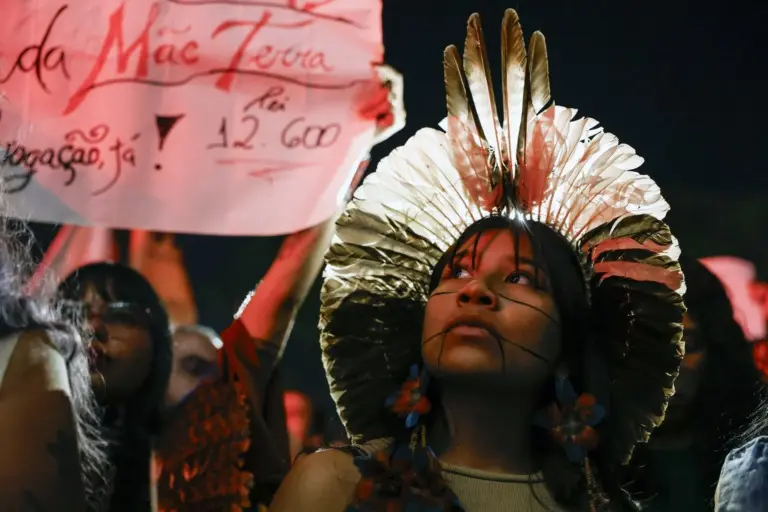
Brazil investigates violence against Indigenous communities in Mato Grosso do Sul after post-election threats, killings, and racist attacks.
Related: Tech Platforms Face Scrutiny Over Brazilian Election Interference
Violence Against Indigenous Communities: 30+ Alarming Cases Investigated in Brazil
Brazil’s Federal Police are investigating reports of violence against Indigenous communities in Mato Grosso do Sul following the country’s presidential election results. The cases include killings, hit-and-run attacks, death threats, racist abuse, and an alleged threat to poison water used by Guarani and Kaiowá families.
Brazil’s Ministry of Indigenous Peoples asked the Federal Police on Thursday to open a rapid and thorough investigation. The government said it is also maintaining contact with affected communities through its Department for Mediation and Conciliation of Indigenous Territorial Conflicts.[telesurtv]
The Articulation of Indigenous Peoples of Brazil (APIB) and the Aty Guasu Association are collecting complaints that could lead to formal legal action. APIB has recorded more than 30 episodes of violence connected to the electoral process.[telesurtv]
The Cases Under Investigation
Among the reported incidents are murders in Naviraí, a fatal hit-and-run in Coronel Sapucaia, death threats, racist statements, and threats to contaminate water consumed by Indigenous communities in Tacuru and Nioaque.[telesurtv]
In Tacuru, a municipal employee allegedly sent a WhatsApp message suggesting that the water used by residents of the Sassoró village be poisoned. The message reportedly read: “Put poison in the water, let’s kill these plagues.” The employee was removed from his duties after the incident became public.[telesurtv]
Ricardo Terena, legal coordinator for APIB, said water access in the region is precarious and that many communities depend on water delivered by tanker trucks. After the audio messages circulated, many residents stopped drinking the supplied water for fear of contamination.[telesurtv]
The Federal Public Prosecutor’s Office in Mato Grosso do Sul gave the Tacuru municipal government 24 hours to confirm whether the recordings were authentic, identify the person responsible, and explain what protective measures had been taken.[telesurtv]
A Pattern of Intimidation
Indigenous leaders say the violence intensified during the election period, but they stress that it reflects a longer-standing crisis. Intimidation, racist abuse, and physical attacks are not new for Guarani Kaiowá communities in the state.
Matías Benno Rempel, coordinator of the Indigenous Missionary Council (Cimi) in Mato Grosso do Sul, said pickup trucks circulated through Indigenous territories on Sunday and that several people were assaulted in an apparent effort to spread fear and prevent voting.[telesurtv]
“Now the region is in the spotlight,” Rempel told Agência Brasil. “But what happened this week—the attempted murders—happens constantly to the Guarani Kaiowá population.” He described so-called post-electoral violence as a permanent feature of rural militias.[telesurtv]
APIB data cited in the report indicate that six Guarani Kaiowá Indigenous people were killed in Mato Grosso do Sul between 2022 and 2026.[telesurtv]
External link: Agência Brasil
Lawmakers Demand Protection
Federal Deputy Célia Xakriabá of the Socialism and Liberty Party raised the issue before the Chamber of Deputies’ Human Rights, Minorities and Racial Equality Committee. She also cited a fire in the territory of the Tikmũn people, also known as the Maxakali, in Minas Gerais.[telesurtv]
“These are Indigenous peoples facing threats to their lives, water, and territories,” Xakriabá said. She called on public authorities to investigate the complaints and guarantee protection for affected communities.[telesurtv]
In Tacuru, village leader and local councilor Iván Montiel said he had received audio recordings containing discriminatory remarks attributed to two municipal employees. According to Montiel, those responsible have been identified and will face both criminal and civil proceedings.[telesurtv]
“We will not tolerate prejudice or the persecution of anyone,” Montiel said. “Democracy must always prevail, and therefore respect.”[telesurtv]
Lula Orders Ministers to the Region
President Luiz Inácio Lula da Silva ordered three ministers to travel to Mato Grosso do Sul on Friday to follow up on the threats and violence reported after the election.[telesurtv]
The delegation includes Eloy Terena, minister of Indigenous Peoples; Janine Mello, minister of Human Rights; and Wellington César Lima e Silva, minister of Justice. The ministers were scheduled to visit the Taquapiri and Sassoró villages on Saturday.[telesurtv]
“He asked us to go to the territory to closely monitor the situation,” Eloy Terena said.[telesurtv]
The federal government has created an interministerial task force, requested Federal Police investigations, and deployed the National Public Security Force to Sassoró, Taquapery, and Limão Verde.[telesurtv]
Violence Against Indigenous Communities in Context
The wave of threats in Mato Grosso do Sul cannot be separated from Brazil’s broader political polarization. Indigenous organizations say electoral disputes have become a trigger for attacks, particularly in regions where land conflicts, agribusiness interests, and armed rural groups intersect.
The Guarani Kaiowá live in one of Brazil’s most conflict-prone agricultural frontiers. Their territories are often surrounded by large farms, and disputes over land demarcation, water access, and public services have persisted for decades. Political tension has made those structural vulnerabilities more visible.
Similar concerns have emerged in the Amazon. Indigenous communities in Pará reported audio messages warning of possible illegal occupations of the Apyterewa Indigenous Territory if the far-right candidate Flávio Bolsonaro won the presidential runoff. Federal agencies, including the Federal Police, Ibama, the National Foundation of Indigenous Peoples, and the Ministry of Indigenous Peoples, coordinated monitoring in response.[telesurtv]
United Nations – Indigenous Peoples
A Test for Brazilian Democracy
The response from Lula’s government will be closely watched as a test of whether federal institutions can protect Indigenous citizens from political retaliation and organized rural violence. Investigations alone will not resolve land conflict, but civil society groups argue that accountability is an essential first step.
APIB has demanded that those responsible be held accountable if the allegations are confirmed. The organization has not released the full contents of its complaints or specified whether every case has already become the subject of an individual investigation.[telesurtv]
For Indigenous leaders, the immediate priority is safety: clean water, protection from armed groups, and assurance that communities can participate in democratic life without fear. The reported attacks show how electoral polarization can intensify pre-existing violence against Indigenous communities, particularly where territorial rights remain contested.[telesurtv][telesurtv]
Amnesty International – Brazil Indigenous Rights
From teleSUR English via This RSS Feed.