

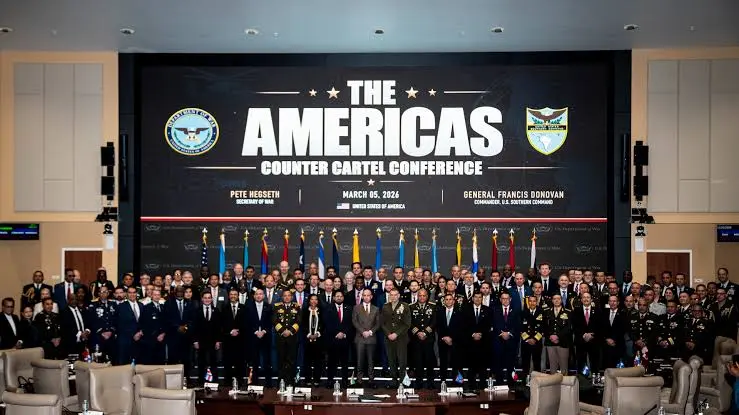
Chile weighs joining the Coalition Against the Cartels of the Americas amid a 30-day U.S. deadline and growing sovereignty concerns.
Related: Chile Launches 63rd Antarctic Scientific Expedition with International Cooperation
Coalition Against the Cartels of the Americas: 3 Major Risks for Chile
Santiago, Chile — October 31, 2026. Chile is weighing whether to move from observer status to full membership in the Coalition Against the Cartels of the Americas (A3C), a security initiative promoted by U.S. President Donald Trump’s administration and linked to the so-called Shield of the Americas. The decision has become a sensitive test of Chile’s security policy, congressional oversight and diplomatic autonomy.emol
Washington has given invited governments a 30-day deadline, which may be extended, to decide whether they will join the coalition. Chile attended the meeting convened in the Dominican Republic but has so far chosen to remain an observer. Interior Undersecretary Máximo Pavez conveyed that position to the organizers.emol
The government has not announced a final decision. Instead, it has begun consulting Congress and several public institutions to assess the potential consequences of joining. The debate comes at a moment when Chile is seeking to strengthen its response to organized crime without surrendering control over policing, intelligence or military operations.emol
The A3C is described by its promoters as a military and security arm of the Shield of the Americas. Its stated objective is to dismantle transnational criminal infrastructure through intelligence sharing, logistical coordination, border control and financial investigations.emol
Chile already belongs to the Shield of the Americas alongside 16 other countries. The A3C currently includes 19 adherent states, according to information published by Chilean daily El Mercurio.emol
A 30-Day Deadline
Although the Chilean government has avoided a formal commitment, the U.S.-imposed deadline has turned the issue into an immediate priority for national security and foreign policy. Officials are seeking to explain the proposal to lawmakers and public agencies before taking a position.emol
The debate intensified after reports suggested that Chile might decline to join the mechanism. Government coalition parties have asked the Executive to clarify the legal and operational scope of any possible membership.emol
Reports have also pointed to possible divisions within the cabinet. According to El Mercurio, presidential chief adviser Alejandro Irarrázaval would favor joining the A3C, while Defense Minister Fernando Barros would prefer that Chile remain an observer.emol
That tension reflects a broader dilemma. The question is not only whether Chile should cooperate more closely with the United States against drug trafficking, but how much cooperation is compatible with Chilean sovereignty, constitutional limits and the legal roles of the Armed Forces, Carabineros and the Investigative Police.emol
What the Coalition Offers
Supporters of the A3C argue that it would help Chile confront criminal networks that operate across borders, maritime routes, land corridors and financial systems. They say membership could provide access to U.S.-funded intelligence, technology, training and logistical support.emol
Richard Kouyoumdjian, executive vice president of the security think tank AthenaLab, supports Chile’s incorporation. He argues that the current version of the coalition is “a considerably watered-down” version of the original idea.emol
Kouyoumdjian believes there was a communications error when the A3C was first presented. In his view, it was portrayed as an exclusively military initiative, when it should be understood as a technical security-coordination framework that does not alter national sovereignty.emol
“Any effort that provides greater capacity to combat organized crime is positive, especially when it involves transnational organized crime,” Kouyoumdjian told El Mercurio.emol
He added that much of the organized crime present in Chile is imported, which makes international cooperation necessary. From his perspective, U.S. financing could translate into intelligence, logistical and technological resources that would strengthen Chilean institutions.emol
U.S. Department of State — for official U.S. policy on international counternarcotics cooperation.
Arguments for Membership
Hugo Harvey, an international affairs analyst at Universidad del Desarrollo, believes there are “sufficient reasons” for Chile to move from observer status to full participation. He sees the A3C as the most strategic security component of the Shield of the Americas.emol
According to Harvey, the coalition seeks to turn political will into concrete operations: intelligence exchange, logistical coordination, border control and financial investigations against transnational criminal organizations.emol
His central argument is that Chile faces a transnational crime problem that cannot be solved effectively within one country’s borders. He points to drug trafficking, human trafficking, smuggling and money laundering as threats requiring regional coordination.emol
However, Harvey rejects the claim that joining the coalition automatically means surrendering sovereignty or accepting military obligations. He argues that each state determines the type and degree of cooperation permitted under its own laws.emol
Chile, he says, could share or receive intelligence, financial information, logistical capabilities, maritime surveillance or border coordination without deploying troops. He also cites the Inter-American Treaty of Reciprocal Assistance, known as the Rio Treaty, which states that no country can be forced to use armed force without its consent.emol
External link suggestion: Organization of American States — for regional security frameworks and inter-American legal instruments.
Staying Out Is “Not Neutral”
Harvey also warns that remaining outside the coalition would not be a neutral choice. “Organized crime is adaptive and changes routes, bases and jurisdictions when pressure increases in certain areas,” he said.emol
If several countries in the region strengthen coordination, intelligence sharing and border controls at the same time, criminal organizations could redirect operations toward jurisdictions seen as less coordinated or more vulnerable. “Chile should not involuntarily offer that advantage,” Harvey argued.emol
For him, the real challenge is not choosing between cooperation and sovereignty. It is cooperating while preserving sovereignty by clearly defining which capabilities Chile shares, which it receives and how far it is willing to participate in joint operations.emol
Harvey also criticized political sectors that reject the initiative simply because it brings together ideologically aligned governments. “The real question is whether the mechanism produces results, becomes institutionalized and respects international law and national legislation,” he said.emol
Sovereignty and U.S. Control
Critics see greater risks. International relations analyst Paulina Astroza warns that the initiative could place responsibilities normally handled by Chilean police or the Armed Forces under U.S. control.emol
Astroza argues that, based on the information available about the Dominican Republic meeting, there is no explicit text defining the legal implications of membership. That lack of clarity, she says, makes it difficult to assess the obligations each country would assume.emol
“The main problem I see for Chile is that this is an initiative that places tasks belonging to the police — Carabineros and the Investigative Police in our case — or to the Armed Forces of participating countries under U.S. control,” she told El Mercurio.emol
She believes that applying such an arrangement would be legally impossible without an international agreement approved by Congress, because it would affect sensitive aspects of national sovereignty. Politically, she considers it dangerous.emol
Astroza links the A3C to what she describes as a “highly questionable” U.S. foreign-policy approach. While she acknowledges that fighting drug trafficking is a legitimate objective, she fears the coalition could open the door to foreign armed forces entering Chilean territory.emol
She specifically raises concerns about drones and autonomous surveillance technologies that could be introduced in a later phase. “Who has the capacity to do all this? The United States. Who has the technology and know-how? The United States,” she said.emol
For Astroza, the coalition would ultimately align Chile with Washington’s national security and defense strategies, echoing what she describes as the Monroe Doctrine. She calls that prospect “very dangerous for states.”emol
United Nations Office on Drugs and Crime — for international standards on transnational organized crime and drug control.
Geopolitical Context
The Chilean debate takes place within a wider struggle over the future of security cooperation in the Western Hemisphere. The United States is seeking to align Latin American governments around a common defense and counternarcotics agenda, while several governments and analysts fear that such coordination may deepen U.S. influence in the region.emol
For Washington, the A3C represents a way to coordinate action against cartels and other criminal networks that operate across national borders. For regional governments, however, participation raises questions about operational independence, military presence, data protection and the limits of foreign intervention.emol
The issue is particularly sensitive because the coalition’s technological, financial and military capacities are concentrated in the United States. Critics argue that this asymmetry could turn a multilateral framework into a mechanism of hemispheric control.emol
Chile’s decision could therefore carry significance beyond its borders. Full membership would strengthen a U.S.-led security architecture and signal closer alignment with Washington. Remaining an observer would signal greater caution and preserve room for an independent regional security policy.emol
What Comes Next
Any formal incorporation into the Coalition Against the Cartels of the Americas would require rigorous congressional review. The proposal touches defense, international cooperation, intelligence sharing and the possible presence or intervention of foreign forces.emol
For now, Santiago remains cautious. The government has declined to publicly commit to full membership while it evaluates the operational benefits of the coalition and the political, legal and sovereignty-related risks raised by its critics.emol
The outcome will help define Chile’s position in an increasingly contested regional security landscape. It will also test whether Latin American governments can pursue practical cooperation against organized crime without weakening their democratic institutions or strategic autonomy.
From teleSUR English via This RSS Feed.