

Discover the true Day of the Dead origins: how Indigenous traditions and Catholic rituals shaped Mexico’s living celebration of remembrance.
Related: Mexico City Unveils Record 33-Meter Catrina for Day of the Dead
Day of the Dead Origins: 3 Powerful Myths Historians Finally Debunk
The Day of the Dead origins are far more complex than the popular claim that Mexico’s celebration is simply “3,000 years old.” According to researcher Andrés Calderón Fernández of the Museo del Carmen, the holiday emerged from a sustained encounter between Indigenous beliefs and Catholic practice during the colonial period.
Calderón studies religious syncretism, the cultural legacy of Spanish rule in the Americas, and the symbolism behind Mexico’s annual remembrance of the dead. His central argument is clear: pre-Hispanic peoples honored death, but the modern Día de los Muertos took shape through negotiation, adaptation, and transformation.[ich.unesco][britannica]
A Living Tradition, Not a Frozen Relic
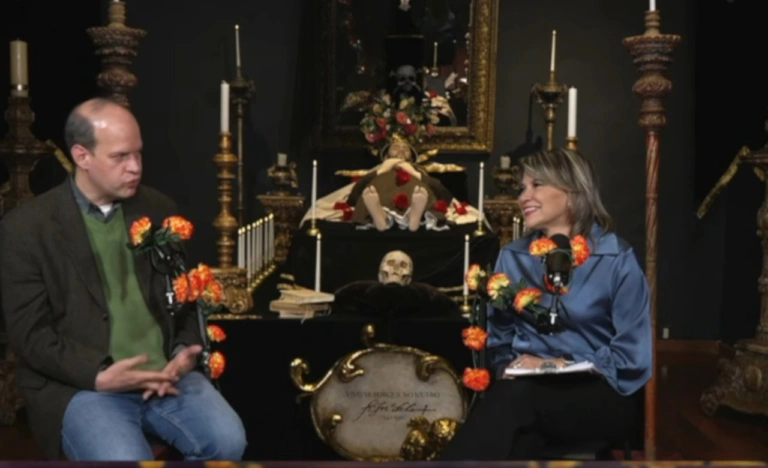
In an interview with teleSUR Latinoamérica’s special program Cultura y devoción, hosted by journalist Aissa García, Calderón explained why the Day of the Dead should not be treated as an unchanging relic. The celebration is alive, and each generation adds new customs to it.
He argues that many elements now considered essential to an ofrenda—such as sugar skulls, layered altars, candles, bread, mole, cigarettes, and beer—have specific historical trajectories. Some reflect colonial Catholic practices; others emerged later as families personalized their tributes.[smithsonianmag]
The result is not a single ancient ritual preserved intact. It is a living cultural language, continually reshaped by Indigenous communities, the Catholic Church, Mexican nationalism, migration, and popular culture. UNESCO recognizes the Indigenous festivity dedicated to the dead as Intangible Cultural Heritage of Humanity, describing it as a fusion of pre-Hispanic rites and Catholic feasts introduced in the sixteenth century.[ich.unesco]
UNESCO – Indigenous festivity dedicated to the dead
Before the Conquest: Death as a Continuation
For the Mexica, commonly known as the Aztecs, death was not an ending. It was a continuation of existence, though the destination of the deceased depended less on how a person had lived than on how that person died.
Calderón explains that people who died of old age or illness were believed to travel to Mictlán, a damp, subterranean realm where the dead still needed food, water, and tools. This helps explain why burials could include a metate, the grinding stone used to prepare corn.
Warriors and others who died in particularly significant circumstances were believed to have different destinies. Death was not uniform, and neither was the afterlife. Mesoamerican societies maintained rituals for the dead, offerings, and beliefs in a relationship between the living and their ancestors.[britannica][online.utpb]
But Calderón draws an important distinction: those ancestral beliefs do not equal the modern Day of the Dead. The present celebration is specifically connected to Catholic commemorations of All Saints’ Day and All Souls’ Day.[ich.unesco][britannica]
The Catholic Encounter That Shaped the Holiday
The modern celebration grew out of what Calderón calls a negotiation between Indigenous communities in New Spain and the Catholic friars who brought European religious festivals.
Catholic teaching distinguished between saints, who were believed to be in the presence of God, and ordinary souls, who might be in purgatory. Indigenous converts asked a practical question: where were their deceased relatives?
That question made the Feast of the Faithful Departed—All Souls’ Day—especially meaningful. Although the Church promoted All Saints’ Day, particularly after the Council of Trent, many Indigenous families gravitated toward the commemoration of ordinary dead because it spoke directly to their ancestors.[britannica][smithsonianmag]
Why the ‘3,000-Year-Old’ Claim Falls Short
One of the most persistent myths about the Day of the Dead origins is that today’s altars have existed unchanged for three millennia. Calderón calls that claim historically incorrect.
Pre-Columbian cultures certainly practiced rites connected to death. Yet the Catholic imprint transformed those practices so deeply that the modern festival cannot be described as a direct survival of an ancient ceremony. The continuity is real, but it is not simple.
The holiday’s recognizable form developed over centuries: it changed during the colonial period, evolved further in the nineteenth century, and largely consolidated into its present shape during the twentieth century. Historians also note that the festival’s modern national prominence was reinforced after the Mexican Revolution, when state and cultural projects promoted a shared national identity.[sortiraparis]
That does not diminish its Indigenous roots. Instead, it restores the agency of Indigenous peoples, who did not merely receive Catholic traditions but actively interpreted, adapted, and preserved elements of their own worldview within a colonial context.
Inside the Museo del Carmen Exhibition
The interview takes place beside a funeral catafalque at the Museo del Carmen in Mexico City. The display recreates the funeral rites of Saint John of the Cross, the Carmelite friar and mystic, marking 300 years since his canonization in 1726.[inah.gob][inah.gob]
The exhibition-altar brings together 84 works, including paintings, books, a sculpture, and a reliquary. It invites visitors to see how Catholic communities once commemorated eminent religious figures through elaborate funeral displays.[inah.gob]
In that setting, Calderón explains a detail that may surprise modern visitors: flowers were placed around the body because, in practical terms, the dead began to smell. Over time, flowers acquired a devotional meaning. When a person had a reputation for holiness, mourners sometimes took flowers home as relics.
INAH – Museo de El Carmen exhibition
From Sacred Attributes to Personal Offerings
The exhibition also helps explain one of the most familiar features of a Day of the Dead altar: the objects placed beside a photograph or image of the deceased.
In Catholic funeral tradition, an attribute identified a holy figure. A book and quill, for example, represented Saint John of the Cross as a mystical writer. Calderón argues that this practice gradually evolved into the modern custom of placing items associated with a loved one’s tastes.
That is why an ofrenda may include cigarettes, beer, pan de muerto, mole, fruit, or a favorite dish. The object began as a religious symbol and became a personal memory. The shift from attribute to preference reveals how a sacred form adapted to family life.[smithsonianmag]
Sugar Skulls and the Memory of Bones
Sugar skulls, or calaveritas de alfeñique, are another example of transformation. In colonial convents and churches, remains of deceased religious community members were sometimes brought from ossuaries and displayed during funeral rites.
Modern sensibilities and hygiene practices ended that custom. In its place came decorative skulls made of sugar, later given names to identify the person being remembered.
The meaning remained connected to death, but the form became gentler and more accessible. Calderón sees this as evidence that tradition survives not by remaining identical, but by changing its language while preserving its emotional purpose.
What the Altar Still Remembers
Many families build Day of the Dead altars in levels without knowing why. Calderón connects the practice to colonial cenotaphs and funeral monuments, which could have multiple tiers associated with the levels of purgatory.
In theory, a catafalque might have seven levels, corresponding to the seven levels of purgatory. In practice, colonial examples often had two, three, or four. Today’s domestic altars preserve that visual memory, even when families simply say, “My parents arranged it this way.”
Candles, layered platforms, flowers, food, and images of the dead therefore carry layered histories. They link a contemporary home altar to Catholic ideas of prayer, purgatory, and intercession, as well as to Indigenous practices of honoring ancestors.[ich.unesco][online.utpb]
Geopolitical and Cultural Context
The Day of the Dead is no longer only a Mexican celebration. Its imagery, food, music, and public processions now appear across Latin America, the United States, Europe, and Asia, driven by migration, cinema, tourism, and social media.
That global reach has brought visibility, but also tension. Commercial versions can flatten a sacred family ritual into decoration or entertainment. At the same time, diaspora communities use the holiday to maintain ties to language, ancestry, and homeland.
The broader significance is geopolitical as well as cultural. The festival challenges older colonial narratives that portrayed Indigenous peoples as passive recipients of European culture. Calderón’s work emphasizes continuity and agency: Indigenous communities remained central actors in New Spain, even as Catholicism reshaped public and private life.
A Tradition That Refuses to Disappear
The final lesson of Calderón’s research is that the Day of the Dead is neither a museum piece nor a postcard. It is a living tradition born from encounter, transformed by colonial rule, consolidated in modern Mexico, and still open to new meanings.
The proof is visible in every home altar: in the levels that recall purgatory, in sugar skulls that replaced displayed bones, and in books and quills that became cigarettes, bread, and mole. The Catholic faith left a profound mark, but Indigenous customs endured.
The faith was imposed. The customs remained.
From teleSUR English via This RSS Feed.