

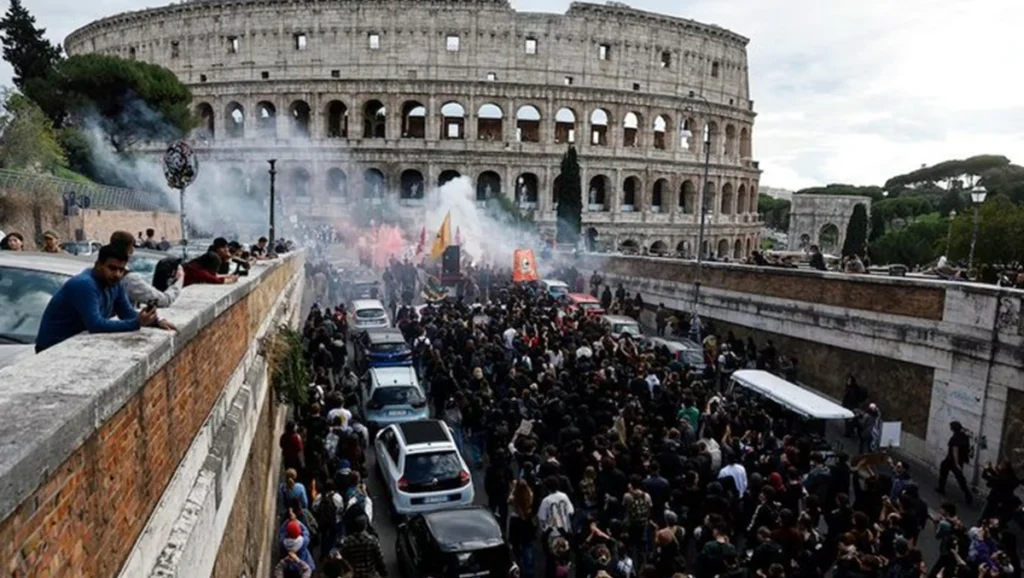
People join nationwide demonstrations against the far-right government, inflation, and war.
On Friday, thousands of people took to the streets of major cities across Italy to protest against far-right Prime Minister Giorgia Meloni, the rising cost of living, and increasing military spending.
RELATED:
‘No Meloni Day’ Brings Thousands of Italians Out Onto the Streets
In Rome, protests unfolded relatively peacefully during the morning, with a student march and the start of a protest encampment outside the Colosseum, which will remain in place through Sunday.
However, tensions escalated in midafternoon when police violently charged a column of demonstrators coming from the Trastevere neighborhood who were attempting to march toward the Parliament.
Armed with shields and other riot-control equipment, police carried out several charges to disperse the crowd gathered on the bridge over the Tiber River. One of the first reports said eight people had been arrested and would be subject to Meloni’s new anti-protest regulations.
🇮🇹🪧🚔 Confrontos com a polícia marcam greve geral na Itália
📌 Uma greve geral mobilizou manifestantes em Roma, na última sexta-feira (30), contra os baixos salários, o aumento do custo de vida e a elevação dos gastos militares.
🚧 No bairro de Trastevere, na capital do… pic.twitter.com/1h0HPfSNqE
— Sputnik Brasil (@sputnik_brasil) October 31, 2026
The text reads, “Clashes with police mark a general strike in Italy. A general strike brought protesters out in Rome on Friday (30) to demonstrate against low wages, the rising cost of living, and increased military spending. In the city’s Trastevere neighborhood, protesters attempted to cross the Ponte Sisto toward the Italian Parliament but were held back by riot police. Security forces used water cannons to disperse the crowd, while smoke rose over the streets as the officers advanced.”
In response to attempts to approach the center of political power, security forces blocked access to Piazza Colonna, where Chigi Palace, the seat of the government, is located, and Piazza di Montecitorio, home to the Chamber of Deputies.
Clashes subsequently spread to the banks of the Tiber River and the Testaccio neighborhood, where some demonstrators threw bottles, firecrackers, and blunt objects at officers, who responded with high-pressure water cannons.
At least 1.5 million people took part in demonstrations across Italy, which were part of a nationwide strike called by the Basic Trade Union (USB) and backed by students, public-sector workers, teachers, and housing rights advocates.
The day was marked by a major security deployment in the capital, amid heightened tensions following violent incidents on Oct. 17 and 18 in Milan, Turin and Bologna.
Those incidents prompted Meloni’s government to approve an emergency security decree and deploy 500 military personnel to support police forces.
teleSUR/ JF
Source: EFE
From teleSUR English via This RSS Feed.