

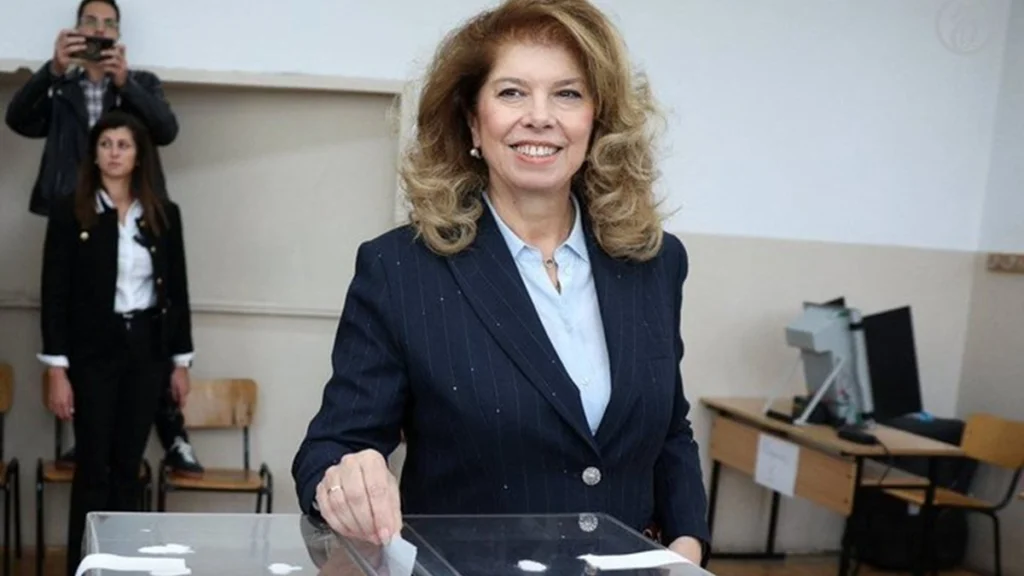
Iliana Yotova and Andrey Gyurov are competing for the presidency amid tensions over the Ukrainian war.
On Sunday, Bulgarians are called to the polls for a presidential runoff in which Bulgarian President Iliana Yotova, a socialist and pro-Russian politician, and pro-European former interim Prime Minister Andrey Gyurov are competing for the country’s presidency.
RELATED:
Bulgaria Holds Presidential Election as Turnout Hits Historic Low
Last week, Yotova, an ally of pro-Russian Prime Minister Rumen Radev, received 35% of the vote, three percentage points more than her rival, a former deputy governor of the Bulgarian National Bank.
The main difference between the two presidential candidates is their positions on the war in Ukraine. “We have an aggressor, Russia, that attacked its neighbor,” Gyurov argues, while Yotova maintains that “there is no longer any point in defining who the aggressor is, because there are two sides in this war.”
Bulgaria, a former communist country with a population of 6.4 million, has been a member of NATO since 2004 and the European Union since 2007. The election campaign was marked by recent drone attacks, allegedly carried out by Russia, against merchant ships in the Black Sea, near the coasts of Bulgaria and neighboring Romania. The attacks have left around 30 people dead or missing.
🗳️ Bulgaria’s presidential election heads to a Nov. 1 runoff, with incumbent Iliana Yotova leading former Prime Minister Andrey Gyurov in unofficial results, 34.6% to 32.7%, amid low voter turnout of 22.5% pic.twitter.com/dJ4TcifuE5
— Anadolu English (@anadoluagency) October 26, 2026
Another factor was the very low voter turnout in the first round of the election, at just 23%. Local analysts attribute this to voter fatigue among the population, which was called to the polls eight times between 2021 and 2026 alone to elect a new Parliament.
In any case, experts expect voter turnout to increase on Sunday. On Friday, the conservative Citizens for European Development of Bulgaria (GERB) party, which dominated Bulgarian politics for a decade until 2025, issued a recommendation urging its supporters to vote for Gyurov.
Yotova, a former television journalist who turns 62 today, is a veteran politician with the Bulgarian Socialist Party (BSP), the successor to the former Communist Party.
She comes from a family belonging to the former ruling class during communism. She was educated at the French High School in Sofia and pursued her studies in Bulgaria and at two French institutions: the National School of Administration (ENA) and the University of Strasbourg.
She has served as Bulgaria’s interim president since January, following the resignation of Radev, who is now prime minister. She served as his vice president for nearly 10 years.
Russia–Ukraine War and the Fracturing European Security Order: Military Power, Strategic Alliances and the Limits of Diplomacy – Principal judgment — High confidence: The Russia–Ukraine war remains the central military confrontation shaping European security. Russia retains the… pic.twitter.com/IaM9ciLXzn
— debuglies (@debugliesnews) October 31, 2026
Gyurov, meanwhile, is a 50-year-old economist educated in Bulgaria, the United States and Austria. He worked as a university professor and went on to become deputy governor of the Bulgarian National Bank.
Between February and May, he served as interim prime minister, leading a government of experts after early elections were called. Those elections were won by Radev’s new party, Progressive Bulgaria.
In March, Gyurov signed a 10-year cooperation agreement between Bulgaria and Ukraine. The pact drew harsh criticism from both Radev and Yotova, who accused him of fueling the conflict and involving Bulgaria in the war.
In Bulgaria, the head of state performs primarily representative and ceremonial duties, although the president can veto laws passed by Parliament and thereby delay their entry into force.
The president also has influence over government formation, particularly during periods of instability, such as in recent years, when the country held eight parliamentary elections between 2021 and 2026.
teleSUR/ JF
Source: EFE
From teleSUR English via This RSS Feed.