

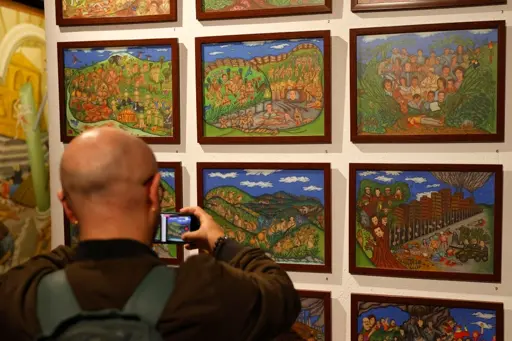
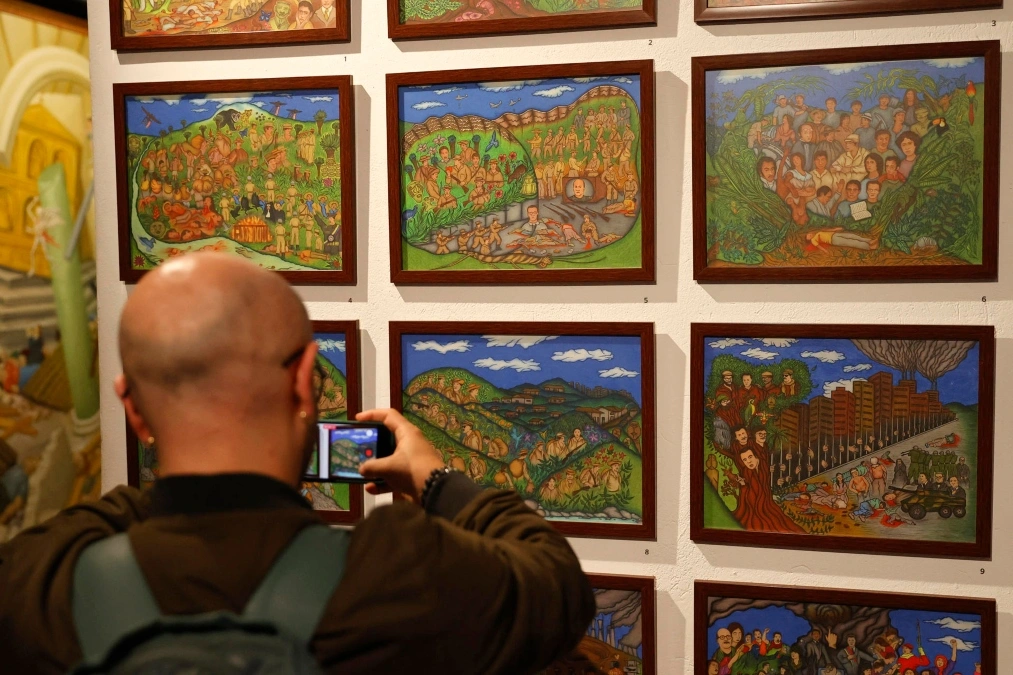
Colombia’s National Museum reinstated 63 artistic and historical pieces on Friday by court order after their October 15 removal as part of the government’s “cultural battle,” a move denounced as an attempt to censor historical memory.
Family Court 24 of Bogotá gave the Ministry of Cultures and the National Museum 48 hours to reverse the earlier action. The order specifies that no authority may remove pieces because of their content, ideological stance or political perspective.
The venue is again displaying cases, panels and audiovisual elements with materials showing key passages of Colombian politics, and its rooms show promotional posters for the presidential candidacies of Carlos Pizarro and Bernardo Jaramillo Ossa, left-wing figures assassinated in 1990.
RELATED: Colombian Opposition Raises Concerns Over Memorandum with the U.S.
Among the returned pieces are several related to feminist struggles, LGTBI movements, victims of the armed conflict and the 2016 peace process, including the “Balígrafo,” the pen manufactured from a bullet casing used in the signing of the peace agreement with the FARC.
The earlier removal was part of the “cultural counterrevolution” announced by Colombian President Abelardo de la Espriella, while Paola Holguín, minister of culture, said museums “must not serve as instruments of political indoctrination or spread biased versions of history.”
Among the removed pieces were a pride flag belonging to activist Elizabeth Castillo; a poster of Bernardo Jaramillo Ossa, the Patriotic Union candidate assassinated in 1990, which the Center for Memory, Peace and Reconciliation printed in 2010; and another of Carlos Pizarro, who was killed five weeks after Jaramillo, in April 1990.
La justicia le puso un alto a la censura y le dio la razón a la memoria!
El fallo de tutela que ordena devolver al Museo Nacional las piezas retiradas por decisión del Gobierno es una victoria de la libertad de expresión, la diversidad y la memoria histórica.
Mañana, 29 de… pic.twitter.com/Q6Dlct9ZU5
— Gabriel Becerra – Pacto Cámara Bogotá 🏛️ (@BecerraGabo) October 29, 2026
The official decision sparked strong reactions among activists, artists, politicians and Colombian public opinion. Colombian Law 397 of 1997, known as the General Culture Law, establishes in its first article and point four that, under no circumstances, “the State shall exercise censorship over the form and ideological and artistic content of cultural achievements and projects.”
A protest against censorship was also held outside the National Museum. The peaceful gathering was dispersed by police forces using water-cannon vehicles, stun detonations and tear gas.
From teleSUR English via This RSS Feed.