

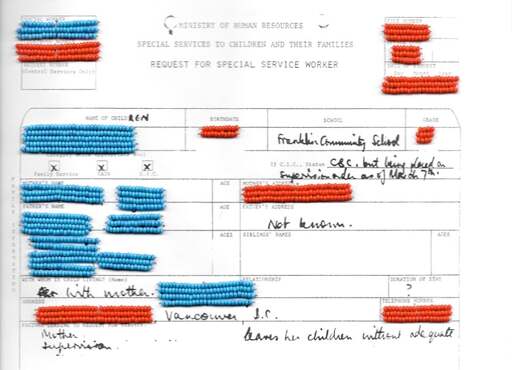

A closeup of Krystle Silverfox’s beadwork over her mother’s Sixties Scoop files, as shown in the display ‘Apprehension.’ Submitted image (cropped)
Krystle Silverfox uses straight lines of colourful beads to cover names, places and events recorded in her mother’s Sixties Scoop files. On the art pieces, printed headlines and handwritten notes remain with information relevant to the family’s journey in the child welfare system.
Apprehension, a body of work by Silverfox of Selkirk First Nation (Wolf Clan), is a multimedia display of her family’s archival documents and records.
With colourful beads redacting personal information on the documents, Silverfox’s artwork represents a reclamation of traditions severed by countless Indigenous families during the Sixties Scoop.
Apprehension is on display at the 27th edition of Art Toronto from Oct. 29 to Nov. 1 at the Metro Toronto Convention Centre in downtown Tkarón:to. Pieces from Apprehension, along with other artwork by Silverfox, are also set to be on view from Oct. 30 until Jan. 17, 2027 at the Two Rivers Gallery in “Prince George.”
A protection of family history
The Sixties Scoop term refers to the widespread removal of Indigenous children from their families and communities by child “welfare” authorities, who forced them into foster care or for adoption, often with non-Indigenous families. The Sixties Scoop Indigenous Society of Alberta describes removals – that separated children from their languages, cultures and communities – beginning in the mid-1950s and continuing through the 1980s.
“Canada’s” national Sixties Scoop class litigation, reached in 2017 and approved by the courts in 2018, aimed to provide eligible survivors with compensation to “support healing, wellness, education, language, culture and commemoration.”
To apply for compensation under the settlement, Silverfox’s mother, a Sixties Scoop Survivor, submitted a freedom of information request to receive her records.
Her mother then gifted Silverfox about 280 pages of documents including health records, court documents and apprehension and social worker records.

A piece by Krystle Silverfox that’s part of an exhibition ‘Apprehension,’ now on display in Toronto. Submitted image
Silverfox worked for more than a year with the documents and tells IndigiNews that the redacted information includes people’s names, places and events recorded in her family’s files. What she covers varies from page to page.
While she was working on the exhibition, she recalls taking time for herself and going for walks or discussing the findings with family members if they wanted to, but has “been giving this project a lot of space,” as the physical redaction has been very impactful.
She said the documents are difficult to go through because the material is “reflecting this difficult family history.”
“That’s why it’s called Apprehension because I have this apprehension towards working with this as a material,” Silverfox said.
She added that the documents she worked with included “actual apprehension records,” creating a layered creation journey.
For Silverfox, the beadwork acted as protection for her family’s history.
“But then I also think about the beadwork as a symbol of care. So taking care of these really difficult moments and protecting my family through the beadwork.”
Beading on paper
Silverfox has been beading since she was a child and now uses her beadwork to create these three-dimensional pieces in Apprehension and previous artworks which also utilize other materials such as blankets, pennies and more.
Silverfox says the works in Apprehension are among her most demanding pieces.
“It’s very challenging, to be honest. This is probably the most difficult project I’ve undertaken yet,” she said.
Silverfox has created other artwork with beads on images, including some of her Distant Relatives collection, which featured multicoloured flowers and their leaves over images such as neon signs and landscapes from her travels.
“I’m more used to beading curves than I am to bead straight lines, so it’s been really challenging,” she said about the creation of her new art pieces.
She notes that the works in Apprehension were “more delicate” as they feature straight lines of beads purposefully covering personal information.
While Silverfox had created beaded works in Distant Relatives, Apprehension came with its own challenges such as finding the proper thick paper to use and reinforcing the works to ensure the small thread pieces stay in place as the beads are properly placed.
Learning across disciplines

Krystle Silverfox. Submitted photo
Silverfox’s educational background in visual arts and gender, race, sexuality and social justice influences her work.
“I really got into visual arts as kind of a way to communicate ideas,” she said.
From there she received her master of fine arts degree in interdisciplinary studies at Simon Fraser University, where she learned alongside disciplines such as puppeteering and music, allowing her to experiment and learn from others.
“Instead of me being the person who has to know how to use the materials, I look to professionals to help me and guide me,” she said.
“My favourite part about my job is I get to learn how to do new things.”
Having worked across many media, she encourages Youth who want to become artists to keep experimenting.
“I think just keeping an open mind and working with as much as possible, being kind to yourself and forgiving if you do make mistakes. I think it’s really important to just continue doing your best.”
“If you don’t know… it’s not bad to ask for some help,” she said.
Silverfox credits her former visual arts teacher Dana Claxton, who is a member of Wood Mountain Lakota First Nations, with helping shape her practice. She describes Claxton’s Indigenous feminist art as empowering.
One reference point was Claxton’s AIM series which featured reproduction of Federal Bureau of Investigation surveillance files with confidential information regarding the American Indian Movement blacked out.
While she thought of these prints while working on her own pieces, Silverfox notes that Apprehension has its own intimate aspect with personal information that she worked to redact. Where Claxton’s prints reproduce documents with information already withheld. Silverfox makes the redactions herself, stitching beads over names, places and events she wants to keep private.
Silverfox hopes that her artwork can show audiences this “important part of our history” and allow families who have been impacted by the Sixties Scoop to recognize the care behind her art.
“Also, for people who don’t have a lot of knowledge about this, I hope it really is a learning moment to learn about the history of Canada,” she said.
Silverfox has noticed that – with her inspirations of Indigenous feminism, Indigenous futurism, transnationalism, decolonialism and activism over the years – her work has become a showcase for the history Indigenous people have experienced. She begins projects with materials that inspire her and allow her to create artwork organically to share these stories including the ones in Apprehension.
At Art Toronto, Silverfox is one of 105 exhibitors from around the world, with her collection available to see at United Contemporary gallery’s group booth featuring the work of four female-identifying artists.
The post Utilizing beadwork, an artist encounters her mother’s history in the child ‘welfare’ record appeared first on Indiginews.
From Indiginews via This RSS Feed.