

Brazil’s magistrates investigate whether Meta algorithms and prediction market bets were weaponized to inflate right-wing electoral momentum.
After the presidential election in Brazil, in which President Luiz Inácio Lula da Silva won with 51,79% of the valid votes, compared to 48,21% for candidate Flávio Bolsonaro, Brazilian authorities initiated formal legal probes into the campaigns.
RELATED: Milei and Allegations Regarding Aiding the Escape of Flávio Bolsonaro
Supreme Court Justice Alexandre de Moraes and judicial figures ordered federal law enforcement agencies to investigate potential illegal foreign financing for Bolsonaro’s campaign, coordinated algorithm manipulation, and external digital interference targeting the Brazilian democratic process.
This investigation serves as an opportunity to observe how contemporary far-right political movements operate across national borders. Rather than functioning as isolated domestic phenomenon, reactionary political campaigns frequently rely on financial backing from foreign billionaire networks and digital infrastructure managed by major technology corporations.
Examining these connections provides clear insight into how external actors attempt to influence political outcomes within sovereign Latin American states, highlighting the structural vulnerabilities of modern democratic systems to foreign technological and financial intervention.
Vance-Thiel Ties, Right-Wing Funding
The Brazilian Supreme Court ordered the federal police to conduct a judicial inquiry to examine financial flows from United States-based political donor networks.
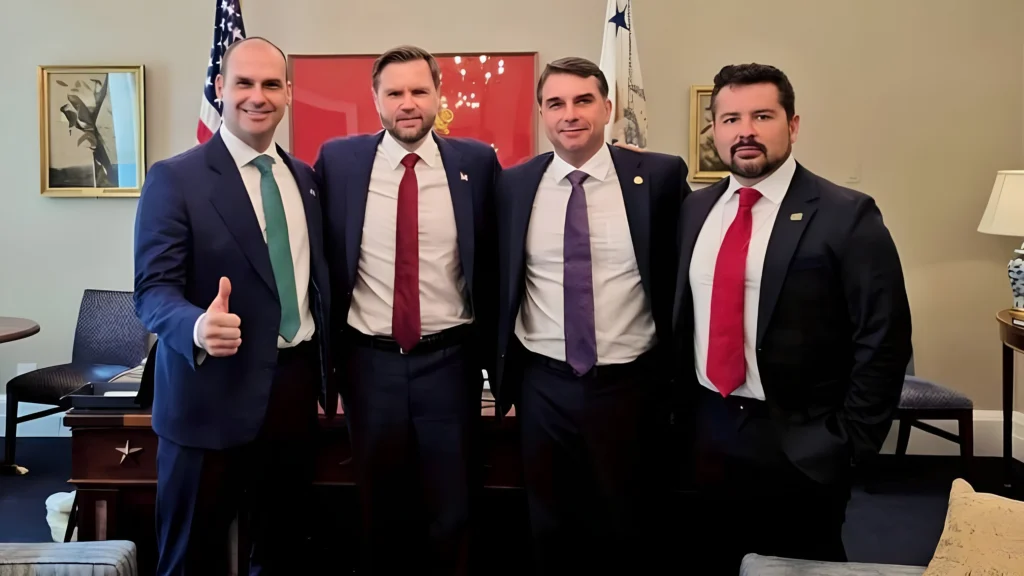
Among the focal points of the investigation are financial conduits and ideological organizations linked to prominent U.S. political figures and conservative donors, including networks associated with U.S. political figures such as Vice-president JD Vance and tech billionaire Peter Thiel, such as the Rockbridge Network.
Investigators are tasked with determining whether resources from these entities crossed international borders to support Flávio Bolsonaro’s presidential campaign, potentially violating Brazilian campaign finance laws that strictly prohibit foreign funding in national elections.
The mechanics of these financial transfers reflect a broader pattern of transnational cooperation among right-wing factions. Wealthy conservative donors such as Thiel, Vance, and Zuckerberg increasingly allocate capital to ideological allies across the globe to advance shared economic and political objectives.
By bypassing domestic transparency regulations, these international funding streams allow external actors to prop up political movements that align with their geopolitical and ideological interests.
Analyzing these financial channels clarifies the material foundations supporting far-right electoral strategies in Latin America and underscores the challenges sovereign nations face in maintaining electoral integrity against well-funded foreign interventions.
New documents reveal that Rockbridge, the secretive Silicon Valley coalition funded by Peter Thiel, was exploring how to expand operations to Brazil, going so far as to create an LLC called “Rockbridge Brazil.” People close to the Flavio Bolsonaro campaign who attended Rockbridge… pic.twitter.com/o4D3hHqZN5
— Nick Cleveland-Stout (@nick_clevelands) September 29, 2026
Polymarket, Meta, and Digital Manipulation
The judicial mandate issued by Supreme Court Justice Flávio Dino explicitly extends the federal investigation beyond financial transactions to encompass digital infrastructure operated by major technology corporations and prediction platforms.
The investigation targets the activities of Meta Platforms and the decentralized prediction market Polymarket, which receives major financial backing from Peter Thiel’s Founders Fund, to evaluate their potential role in distorting the Brazilian digital information ecosystem during the presidential race.
Federal police are examining whether algorithmic recommendation engines on platforms such as Instagram and Facebook deliberately throttled content from progressive political organizations, including President Lula da Silva’s coalition, while systematically amplifying content favoring Flávio Bolsonaro.
In parallel, investigators are assessing the influence of prediction platforms like Polymarket, where financial betting mechanisms generate real-time probabilistic odds on political outcomes.
The probe aims to determine whether large-scale financial bets were deployed on these platforms to artificially inflate candidate odds and manufacture a false perception of electoral momentum.
Brazilian authorities are seeking to verify if coordinated international entities utilized artificial intelligence tools, paid online influencers, and targeted digital distribution networks to bypass electoral transparency rules, effectively weaponizing technical platform architectures to shape public opinion and undermine democratic confidence.
US election interference: Veteran journalist @eduguim says the JD Vance founded, Thiel/Mercer funded Rockbridge Network, is throwing $10 million dollars at Brazilian media in exchange for their shielding of Flávio Bolsonaro, and that the Lula government already knows about this. https://t.co/lUbIbMjOG9
— BRASILWIRE (@BRASILWIRE) October 1, 2026
The Hypocrisy of the Bolsonaro Clan
After his election defeat, Flávio Bolsonaro departed Brazil alongside his family, traveling through the Argentine province of Misiones, before boarding a private flight from Guayaquil, Ecuador, to Miami, Florida.
The departure occurred amid the active federal investigations against him, involving alleged financial improprieties and money laundering schemes.
Minutes after the presidential election results were finalized, Supreme Court Justice Alexandre de Moraes issued an order canceling Senator Flávio Bolsonaro’s passport and directing him to surrender his travel documents to federal law enforcement authorities, a deadline the candidate failed to meet.
President Luiz Inácio Lula da Silva characterized the flight as a shameful evasion of legal accountability, asserting that individuals who have committed no offenses do not seek to flee their home country.
Conversely, United States offered implicit support. President Donald Trump acknowledged that U.S. authorities had granted entry permissions to the Bolsonaro family, publicly describing the Brazilian electoral process as very strange while declining to criticize the Senator’s sudden departure.
WATCH: Brazilian President Lula on Flávio Bolsonaro leaving Brazil for the U.S.:
For the Bolsonaro family, Brazil is their second homeland.
Their first homeland is licking boots in the United States, just as they are accustomed to doing. pic.twitter.com/ugCdYWD9gg
— Clash Report (@clashreport) October 27, 2026
The “Presidential” Stunt and U.S. Limits
Shortly after arriving in United States, Senator Flávio Bolsonaro issued a public open letter from Miami proclaiming himself the “true president-elect” of Brazil.
In his statement, Bolsonaro asserted that he had not fled his home country, claiming instead that he departed for Brazil’s benefit to lead the national opposition from abroad while alleging widespread electoral fraud and institutional overreach.
The declaration explicitly urged foreign governments and international organizations to withhold diplomatic recognition from the incoming administration of President Luiz Inácio Lula da Silva.
The public stance drew swift pushback across the Brazilian political spectrum and among international observers. It characterized the statement as an attempt to undermine democratic institutions and subvert the constitutional order.
After intense Brazilian backlash and subtle diplomatic pressure, Bolsonaro subsequently deleted the initial letter, releasing a revised text that removed the claim to the presidency and referred to his role as a leader of the Brazilian political opposition.
While political figures such as Donald Trump confirmed that U.S. authorities had granted entry permissions to the Bolsonaro family, official statements from Washington maintained a calculated diplomatic distance regarding the proclamation.
U.S. officials declined to endorse Bolsonaro’s claim to the presidency, reiterating a stance of non-interference in the internal legal and electoral affairs of Brazil.
Defending Sovereignty Against Imperial Reaction
Flávio Bolsonaro’s presidential campaign highlights the complex intersections between domestic electoral processes and international political networks.
The integration of foreign financial capital, algorithmic content distribution, and decentralized prediction markets presents distinct challenges for national regulatory frameworks designed to protect electoral integrity.
Protecting democratic institutions requires comprehensive regulatory mechanisms capable of addressing cross-border political financing and ensuring algorithmic transparency among digital platform operators.
As Brazilian judicial authorities continue their investigations into campaign transactions and online information practices, the case emphasizes the necessity of maintaining rigorous legal oversight to safeguard national sovereignty against foreign technological and financial influence.
Sources: Agência Brasil – Brasil de Fato – BBC – TeleSUR – Al Jazeera – Meidas Touch News – Gov.br – O Globo – Folha de S.Paulo – O Estado de S.Paulo – El País
From teleSUR English via This RSS Feed.