

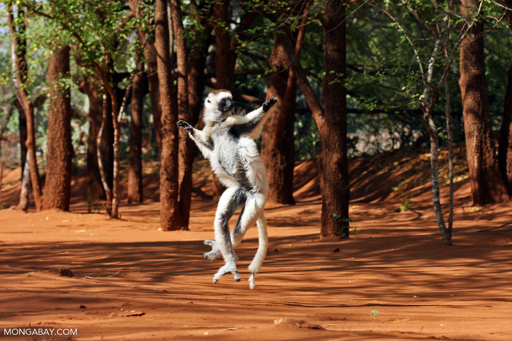
More than 100 known species of lemurs live in Madagascar. These primates with large eyes, a pointed snout, and long bushy tails are found only in the island country, where they usually live in large groups on trees. Lemurs are one of the world’s most threatened groups of primates, under pressure from the loss of their habitat and hunting. On World Lemur Day, celebrated on the last Friday of October, we highlight some recent Mongabay stories about these remarkable animals. Restoring a connection between forests offers hope for lemurs In eastern Madagascar, Andasibe-Mantadia National Park and the Analamazoatra Special Reserve shelter around a dozen species of lemurs, alongside an extraordinary array of other animals and plants, many of which are found nowhere else on Earth. Once connected by continuous rainforest, the landscape between the two parks was fractured in the 1960s, when large stretches were cleared for agriculture and cattle pasture. What remained was a patchwork of forest fragments separated by degraded land, limiting wildlife movement and threatening biodiversity. Mongabay’s Marina Martinez reported in April about how a coalition of researchers, conservationists and local communities is rebuilding the forest corridor. Launched in 2023, the reforestation project aims to restore 150 hectares (370 acres) of native forest and reconnect these two critical habitats. Lemurs like invasive guava fruits, and that could be a problem for reforestation Restoring native forests is critical for lemurs. However, once damaged, forests in Madagascar are vulnerable to takeover by invasive guava trees, whose seeds the lemurs…This article was originally published on Mongabay
From Conservation news via This RSS Feed.
I’m far from an authority on the subject but I have an suggestion: give lemur habitats into a protected area with zero allowance for commercial lumber.
