


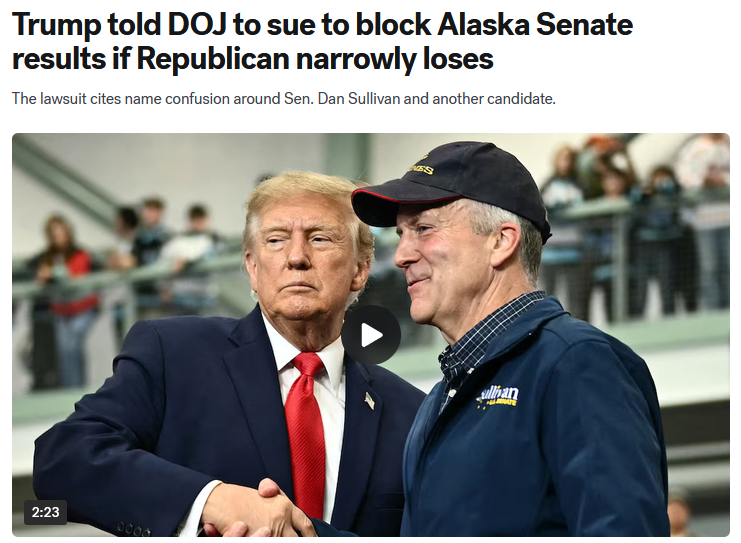
“It’s never our intention to improperly interfere with elections or the state confirmation process or certification process,” said Attorney General Todd Blanche (ABC News, 10/23/26), in a statement that cried out to be scrutinized by reporters.
We don’t know if there was a second gunman involved in the JFK assassination in Dallas. We do know that there is a second Dan Sullivan running for US Senate in Alaska.
Can you believe it? Two Dan Sullivans? In Alaska? The New York Times is on it.
Dan S. Sullivan is a Republican representing Alaska in the US Senate, facing a strong challenge from former Democratic Rep. Mary Peltola. Her viability in the race is worrying the GOP about the midterms generally—while also, as a pro-oil Democrat, encouraging those in her party who fear it’s moving too far to the left (Politico, 10/28/26).
People outside the snowy state learned about the existence of another Republican on the ballot named Daniel J. Sullivan, Jr.—the state has a multi-candidate ranked-choice system—when President Donald Trump ordered the Department of Justice, as ABC News (10/23/26) reported,
to preemptively file a lawsuit to try to block the certification of the crucial Alaska Senate race if Republican Sen. Dan Sullivan loses, citing name confusion among the candidates.
This struck many as a sign, as Time (10/28/26) put it, “that the midterm elections could face unprecedented interference by federal authorities.” The last time Trump won a major election, he instigated an insurrection to try to block certification of his opponent’s victory. His threat to annul the voting result in Alaska suggested that he was going to similarly reject the results of the 2026 midterms.
But the New York Times put its investigative efforts, not into Trump’s threat to democracy, but into attempting to document that he might have a point.
‘T****o coax other would-be spoilers’
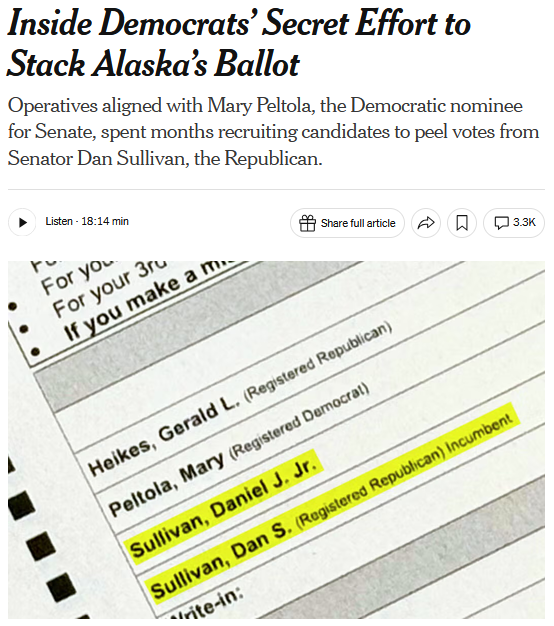
The New York Times investigation (10/28/26) notes in passing that “the Justice Department…filed a lawsuit in federal court at President Trump’s behest last week seeking to block certification of the election results if votes for the other Mr. Sullivan cost Senator Sullivan the win”—as if that were the normal operation of politics and not a shocking trampling of democratic norms.
The New York Times produced an in-depth report (10/28/26) headlined “Inside Democrats’ Secret Effort to Stack Alaska’s Ballot.” The subhead: “Operatives aligned with Mary Peltola, the Democratic nominee for Senate, spent months recruiting candidates to peel votes from Senator Dan Sullivan, the Republican.”
The meat of the piece, by Times political reporter Kellen Browning, was this:
The Peltola campaign has repeatedly denied any involvement in [Daniel J. Sullivan’s] candidacy. But the Times has found, based on interviews and text messages, along with documents prepared for a potential lawsuit against the campaign, that not only did Ms. Peltola’s team work with people trying to recruit Mr. Sullivan to run for Senate, but the effort was much broader. The group worked to coax other would-be spoilers into the race, to dilute the incumbent’s support and help catapult the Democrat to victory.
Anyone who follows US elections closely knows that spoilers are a part of politics. Sometimes campaigns will quietly help third-party candidates from the opposite end of the political spectrum in hopes that they’ll siphon votes from their major rival (Fortune, 9/2/24). And other times they recruit candidates with a look-alike name in hopes that some voters will check the box next to the wrong candidate.
According to Ballotpedia, “28 states had at least one 2026 race between candidates that share the same last name.” In 1998, who did Georgia Republicans find to challenge civil rights hero and then–Democratic Rep. John Lewis? Another guy named John Lewis.
The Brookings Institution (10/28/26) recalled when John F. Kennedy first ran for Congress:
One of Kennedy’s opponents was an Italian-American Boston city councilor named Joe Russo. Kennedy’s father, Joe, set about to confuse voters by allegedly paying another Joe Russo, a janitor with no political experience, to run on the primary ballot as well—in hopes of splitting the Italian vote. As it turned out, it wasn’t necessary to get the other Joe Russo into the race—Kennedy won the primary by a large margin.
‘Common in politics’
While not a particularly honorable campaign tactic, recruiting a candidate with a confusing name is not a crime. In fact, the New York Times admits:
Ballot-stacking tactics are common in politics and generally considered legal—and have been employed by both parties in Alaska. But this operation, which has not been reported before, reveals the lengths to which Democrats went to seek advantage in a Senate race that could determine control of the chamber.
So these tactics are “common,” and “legal,” but also reveal “the lengths” Democrats are willing to go to win a historic midterm election? Common, legal lengths?
The paper also said that “Alaska’s voting system makes it especially easy to add spoilers to the ballot,” which “allowed Mr. Sullivan of Petersburg, a longtime supporter of Ms. Peltola and other Democrats, to land a spot on” the ballot. It continued, “Republicans have also taken advantage of this system,” noting that when Peltola “ran for re-election to the House two years ago, the state Republican Party backed an effort to help a Democrat—an inmate who ran his campaign from a New York prison—stay on the ballot.”
While the article does lay out the drama of how Democrats seized an opportunity to make the election messier for the incumbent, the Times doesn’t ever make a case that Democrats broke the law.
‘Liberal shrieks fading now’
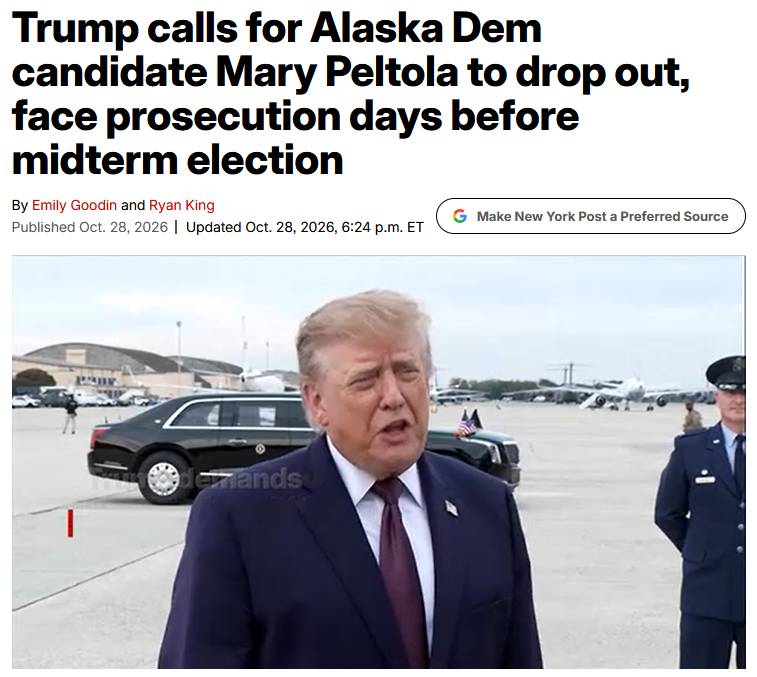
Trump used the New York Times report as a pretext to call for the jailing of another political opponent (New York Post, 10/28/26). Which raises the question: Should you report on politics differently when you know you have a president who is trying to use the Department of Justice to jail his political opponents?
You know what is a crime? Annulling an election so that the candidate who wins the most votes can’t take office. Though Trump administration officials had already announced an intent to commit that crime, the New York Times report seemed tailor-made to abet their efforts.
Predictably, Republicans seized on the Times investigation to lend legitimacy to Trump’s election-threatening efforts. Trump himself called for Peltola “to drop out of the race and be criminally prosecuted,” the New York Post (10/28/26) reported; it quoted the president, “They said they didn’t do it, and they did do it, and they got caught.” The tabloid explained:
Top aides of Peltola were behind the recruitment effort, the New York Times reported. She had originally denied any involvement, but Wednesday’s shock report revealed she was “definitely aware” of the scheme.
Wall Street Journal editorial board member Kimberley Strassel (10/28/26) explicitly cited the Times report as an after-the-fact justification for Trump’s election-nullification plan:
When the Justice Department sued Alaska over its manipulated Senate ballot, liberal shrieks could initially be heard up to the Arctic. They’re fading now, after the New York Times on Wednesday published evidence that Democrats rigged Alaska’s ranked-choice ballot with a decoy candidate who threatens to deny Republican Sen. Dan Sullivan re-election.
The National Review‘s Michael A. Fragoso (10/28/26) also relied on the “bombshell New York Times report” to bolster his argument that the recruiting a same-named candidate was “different from lawful trickery.” The second Sullivan, Fragoso argued, is “designed to take voters who intend to vote for the incumbent and trick them into not doing so even though they want to.”
Tell that to Florida Democratic voters who were deceived into voting for Pat Buchanan for president with maldesigned ballots in 2000, an incident that helped usher George W. Bush into the White House without a popular mandate (American Political Science Review, 12/01).
‘Disturbing new evidence’
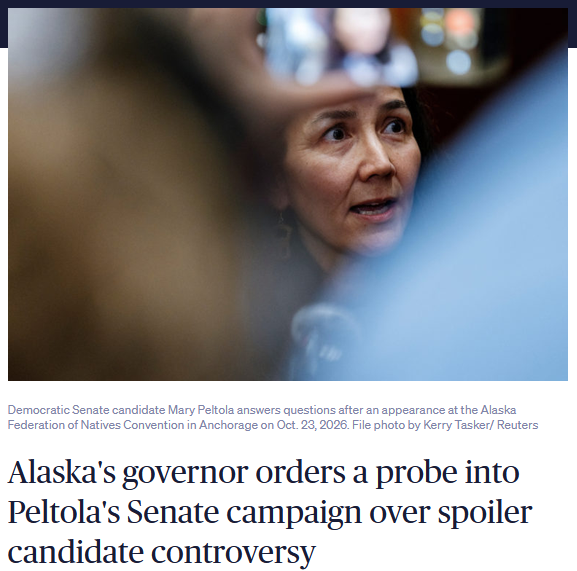
Nowhere does this AP report (via PBS, 10/29/26) acknowledge that a president and governor threatening a opposition politician with prison over her campaign tactics is a dangerous development.
The New York Times investigation prompted state officials as well as the feds to target Peltola (AP, 10/29/26). Alaska Gov. Mike Dunleavy, a Republican, announced that he had ordered an investigation into whether Peltola should face civil or criminal penalties, saying that the Times report
reveals disturbing new evidence of an organized effort to manipulate Alaska’s elections by recruiting candidates—including one with the same name as an incumbent US senator—to deliberately confuse voters and misdirect their votes.
Times editors had to have known that this article would be a gift to an administration that claims Democratic wins are not legitimate, and that the very notion of Republican losses can only be explained by complicated election rigging rather than not getting enough votes (New York Times, 8/20/26, 10/17/26, 10/25/26, 10/27/26, 10/27/26).
If the Times had found potential wrongdoing by Alaska Democrats, that would have been a necessary story for readers. This, however, is a long-read about the usual shenanigans of US electoral politics. It doesn’t add to our understanding of politics, nor is it especially damning in the bigger context.
It is mildly entertaining, for sure, but the biggest impact this investigation will have is providing more justification for an authoritarian administration that already has plans in place to shut down democratic outcomes.
From FAIR via This RSS Feed.
They were pretty quiet on this in Florida last cycle…