

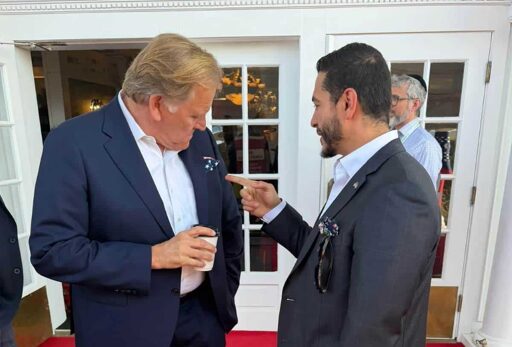
According to the latest polls, Michigan’s Democratic senatorial candidate Abdul El-Sayed has widened his lead over Republican candidate Mike Rogers, but it is still a competitive race. The race has received national attention because it could determine whether the Republican Party — which is likely to lose control of the U.S. House of Representatives — can maintain control of the Senate.
While the election is seen as a referendum on the Trump administration, it is also a referendum on whether the Democratic Party can prove itself to be an alternative to Trump and inspire people to show up to the polls. For Michigan Democrats, this challenge is not new. Kamala Harris’s 2024 presidential campaign failed to mobilize the Democratic Party base to the polls, which contributed to Harris’s loss of Michigan, a key swing state, to Trump.
El-Sayed has also made a concerted effort to talk to Black voters, according to Black activists like Jeremiah Wheeler, a lead organizer for Detroit Action and chair of BlackConvergence, who hosted a meeting with El-Sayed to discuss issues facing Black people in Michigan. El-Sayed has also done interviews and talk shows addressing the animosity between the Black and Arab communities in an effort to combat attempts by Republicans — and many conservative Democrats — to capitalize on that divide. El-Sayed’s campaign held a rally with Obama on Saturday in Detroit in an effort to win over Black voters. Additionally, at the end of September, El-Sayed appeared with Harris at a roundtable discussion at Birth Detroit, talking about Black maternal health.
Concern Over the Economy Fuels Democratic Support
El-Sayed’s campaign is based on a left populist program that seeks to capitalize on the growing gas prices and cost of living. His slogan has become “Medicaid for all, money out of politics, and money in your pockets.” This makes his campaign clear and compelling. His stance on Palestine and ICE has garnered support among a growing number of young voters who are embracing socialism in large numbers and are concerned about the Right.
This approach is part of a national electoral strategy that Democratic strategists hope will lead them to capture the House and the Senate. Of course, this isn’t the first time Democrats have used this approach, and it hasn’t always gone well for them. In the past, Trump and the Republican Party have built successful campaigns on economic populism as well, but Trump’s growing unpopularity among voters, thanks to his ICE raids and the Iran war, has opened up opportunities for Democrats that go beyond their limited program, which, among other things, does not seek to empower and grow the movement. In fact, candidates like El-Sayed have taken positions that delegitimize some of the movement’s demands, like defunding and abolishing the police, or even the idea of a socialist alternative to capitalism. In this way, their campaigns play a demobilizing role rather than catalyzing struggle, which is what Argentinean revolutionary Trotskyist Myriam Bregman did when she used growing interest in her run for president to mobilize a “March of Anger” that brought tens of thousands of people into the streets to confront the government of far-right libertarian Javier Milei.
Whipping Up Islamophobia and Division
For his part, Republican Mike Rogers’s campaign has leaned heavily on Islamophobia, running attack ads against El-Sayed that seek to tie him to the Muslim Brotherhood, question his allegiance to the United States, and claim that he seeks to bring Sharia law to Michigan. While Rogers asked AIPAC not to participate in his campaign, he has sought to win over Zionist Democrats to his coalition by labeling El-Sayed a Hamas supporter because he opposes Zionism and the ongoing genocide in Gaza.
To capitalize on divisions within the Democratic Party over El-Sayed and other progressive and social-democratic candidates, Rogers’s campaign launched Democrats for Mike Rogers. Although it has been reported that the bulk of the money raised for the group has come from Republican donors, he has managed to get actual Democratic Party members to speak in support of his campaign. The latest to do so is Melanie Rutherford, Representative Haley Stevens’s fiancé and former Pontiac city councilperson, who is Black.
Rogers is also hoping to capitalize on divisions between Black and Arab communities and among Black voters to win them over to his campaign or sow enough doubt among Black voters to discourage them from voting for El-Sayed. Along with Rutherford, Rogers’s campaign has also featured Cynthia Haynes, a Black woman from Flint who was a loyal Democratic Party voter for nearly 40 years. At a televised debate on October 21, Rogers made a big effort to speak to Black voters, as did El-Sayed, underscoring the important role Black voters play in Michigan.
To Fight the Far Right, Grassroots Organizing and Self-Organization Are Key
Rogers can’t be considered a serious ally to the Black working class. As a state representative, he helped launch an attack on public education and local governance in Detroit led by Republican governor John Engler. Nor can we believe that he will take up the fight against anti-Black racism when he is spewing reactionary anti-Arab racism and Islamophobia.
And while he has criticized Trump in the past, including for his claim that he was the rightful winner of the 2020 presidential election, Rogers has expressed skepticism about the election process and says it needs to be closely monitored. This claim not only aligns him with efforts to attack democratic voting rights but also opens up a specific effort by the Trump administration to cast doubt on the midterm election results and position Rogers’s campaign and Trump to challenge its results, especially if the votes are close.
There are general concerns that Trump will try to interfere in the election, as he did in 2020 and as he has done internationally in countries like Brazil, Argentina, Colombia, and Honduras. While the midterm elections will likely deliver the Trump administration a critical blow, it doesn’t mean the end of the Far Right or Trump’s authoritarian attacks on the working class and oppressed. In fact, the loss might make Trump, who no longer even has complete control of the Republican Party, more likely to go on the offensive.
It would be a grave mistake for the movement against Trump and the Right to rely on the Democratic Party, especially since the party has sought to launch attacks against many of the radical demands and growing socialist sentiment coming from the youth and important sectors of the movement against Trump. Therefore, our focus must be on building and expanding the movement against Trump and the Right, which includes fighting for full rights for immigrants; uniting the struggles against state repression targeting the movement, the working class, and oppressed communities; opposing the Trump administration’s imperialist offensive against Latin America; standing in solidarity with Palestine; abolishing ICE; and closing ICE prisons like the Northlake Detention Center in Baldwin, Michigan.
The post No Matter the Results of the Michigan Senate Race, We Still Have to Fight the Right appeared first on Left Voice.
From Left Voice via This RSS Feed.