

By Nel Bonilla – Oct 24, 2026
I want to quickly comment on what has been unfolding in France over the past few days. France is by no means an isolated case, but the process underway there has just become much clearer and more visible than before.
More importantly, what we are witnessing is not a single event. It is the culmination of a legislative and administrative trajectory that has been building since at least 2017—a year that falls squarely into the period when the imperial adaptation to multipolarity, the turn toward what I call the Bunker State, and the acceptance of specific territorial holding-and-staging functions by European NATO members slowly but surely began to take shape. (It also bears a striking resemblance to the legal and administrative architecture installed under Javier Milei in Argentina—a parallel process much less observed in Europe unless you are from or closely follow Latin America.)
The Bunkerstate: A qualitative transformation of the modern state in the imperial core. Rather than a provider of public goods, the state’s planning shifts entirely toward securitization and militarization. In this model, the domestic population is no longer viewed as citizens possessing civil and economic rights, but primarily as objects of national security. Furthermore, the country and the region become operational nodes in a wider network for the purpose of all-domain hybrid warfare against so-called strategic competitors and their allies.
This likely warrants a full essay of its own (this is no essay, rather a Note that turned out too long, hence the missing sources, but I will do my best to remedy this soon), but for the time being, I want to leave you with the following:
No state of emergency was needed
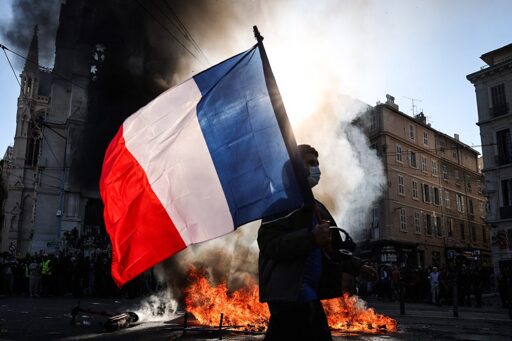
Reports from the ground in France over the past week have read like coming from a besieged city: Operation Sentinelle soldiers deployed domestically, Centaure armored infantry vehicles parked outside the National Assembly, elite counter-terror units (RAID, BRI, GIGN) mobilized alongside 70,000 police and gendarmes, last-minute route relocations pushing protesters onto the urban periphery (périphérique), over 30 metro stations shuttered or turned into search checkpoints with automatic €135 fines, curfews across a dozen cities, and private security guards patrolling commercial streets.
These developments represent the synchronized activation of a statutory and administrative apparatus built between 2017 and August 2026 that blurs external defense and internal policing, subordinates civil rights to risk management, and integrates civilian infrastructure into counter-insurgency and hybrid-warfare planning. (The Bunkerstate, you see.)
The most revealing fact of the October 2026 crackdown was that the government did not declare a formal State of Emergency (état d’urgence). Even as figures on the right demanded it, Prime Minister Sébastien Lecornu kept it in reserve while Interior Minister Laurent Nuñez told the Senate that the state would rely strictly on “mesures de droit commun” (ordinary law) and “police administrative.”
Why? Because the state of exception has already and basically been pre-installed into ordinary law.
National legislation: normalizing the exception & the “continuum of security”
Over the last nine years, the French Parliament has systematically converted temporary emergency powers and wartime doctrines into permanent domestic governance:
From emergency to ordinary law
The 2017 SILT law permanently transposed post-2015 state-of-emergency powers into ordinary administrative law, creating warrantless “protection perimeters” and individual administrative surveillance measures (MICAS). Tested further during the 2024 Paris Olympics, this surveillance ratchet was locked in two months ago via the RIPOST Law of August 18, 2026, which extended algorithmic video surveillance (VSA) to 2030 across train stations and shopping centers, expanded automated license-plate reading (LAPI) to “public order at gatherings,” and created a 72-hour emergency drone authorization for “urban violence” (with 14 police drones deployed over Paris this weekend, and over Lyon high schools earlier this month).
Militarization and the “continuum of security”
While the Global Security Law institutionalized the integration of private security into public order and restricted the documentation of police operations, LOPMI funded the physical militarization of internal security—most visibly the procurement of 90 VBMO Centaure armored vehicles equipped with 30-tube automatic tear-gas launchers, and remote weapon stations (yes, why?).
Total Defense and the New Statutory Exception: Promulgated just two months before the October unrest, the revised LPM added €36 billion for high-intensity warfare, introduced a national service registry profiling citizens’ skills and disposition for military engagement (explicitly designed, in part, to free up soldiers for domestic Sentinelle deployments), and created a brand-new legal regime between peacetime policing and martial law (état de siège): the State of National Security Alert (état d’alerte de sécurité nationale). Alongside the Critical Infrastructure Resilience Bill (transposing EU Directives interestingly), it brings nearly 1,500 regional and local authorities, hospitals, transport networks, and civilian “vital importance operators” (OIV) under national security compliance, forcing civilian operators to maintain war stocks and authorizing private subcontractors for counter-drone warfare.
From subjects of rights to objects of security
In the Bunker State, the liberal social contract is inverted and changed: fundamental rights become conditional privileges granted by the executive, while welfare and social reproduction are weaponized as instruments of security compliance.
Licensing the right to assemble
Ahead of the October 24 demonstrations, the Interior Ministry instructed prefects to judge protest declarations based on the “fiabilité des organisateurs” (reliability of the organizers) and to execute “contrôles des flux” in train stations to “identify persons who are not authorized to participate in demonstrations.” President Macron stated flatly that requests from “people who have no legitimacy” would be refused and only marches co-signed by established trade unions would be permitted. Turning a constitutional, declaratory right into a state-licensed privilege.
The “Casseur-Payeur” Bills and conditioning welfare on obedience
Currently being fast-tracked through the Senate with government amendments announced by Nuñez on October 21, the “Breaker-Payer” legislation introduces collective civil liability of up to €10,000 for anyone remaining in a crowd after dispersal orders, establishes joint financial liability for the parents of minors, and revives pre-emptive administrative bans on protesting prior to any judicial conviction. Further, the bill lifts the legal unseizability of family, housing, and minimum-income (RSA) benefits to pay for state and insurer subrogation, while an interministerial circular signed by Justice Minister Gérald Darmanin and Housing Minister Vincent Jeanbrun on October 19 ordered prefects and prosecutors to cut social benefits (prestations sociales) and initiate public housing evictions “immediately,” without even waiting for the law to pass.
(For those who follow Latin America, this is the logic of the legal and administrative regime installed under Javier Milei and Patricia Bullrich in Argentina: “el que corta no cobra“, stripping social assistance from anyone participating in roadblocks or unauthorized protests, billing social movements for the operational costs of their own repression, and reclassifying socio-economic protest as a threat to national security.)
Hybrid warfare turned inward: military substitution, intelligence primacy, and austerity planning
When governmental planning is subsumed under hybrid-warfare doctrines and fiscal austerity, domestic dissent stops being treated as a political or social question. It is increasingly processed as counter-subversion, a threat to a society’s stability.
Civil-military fusion
Following an Élysée Defense and National Security Council convened specifically to address domestic protests, the government requisitioned regular army units under Operation Sentinelle on October 20 to act “en substitution” of internal security forces—guarding fixed institutional sites so that 70,000 police, CRS, mobile gendarmes, helicopters, and elite counter-terror units (GIGN, RAID, BRI) could conduct mobile street containment. Notably, this reversed Prime Minister Lecornu’s own 2025 doctrine that “one does not deploy the army against one’s own people.”
Intelligence services?
Macron’s strategic pivot centered on a summit “with all the intelligence services,” after which the executive framed cost-of-living and social unrest as “seditious acts” (actes séditieux) orchestrated by the “ultragauche” and an “agenda of destabilization” ahead of 2027. The National Anti-Terrorist Prosecutor (PNAT) was placed in observer status following the Limoges city hall arson, Territorial Intelligence (DNRT/SCRT) was pressured to map links to parliamentary opposition, and a 30-proposal Senate report led with calls to expand upstream human and algorithmic intelligence to track “at-risk groups” and criminalize mere participation in undeclared gatherings.
Budgetary austerity sequenced behind security
All of this serves a rigid fiscal architecture. France’s 2027 draft budget enforces €43 billion in consolidation, freezing all state spending “excluding the increased defense effort”, allocating +€6.4bn to Defense, +€1bn to the Interior, and +€0.4bn to Justice. With 24-year-high bond yields cited as the reason concessions are “unaffordable,” the state ordered an entire week of total physical containment before scheduling a “social round table” for Monday, October 26.
Dual-use infrastructure, spatial banishment, and privatized protection
At the regional and municipal levels, national doctrine is executed through the unilateral power of the Prefect (arrêtés préfectoraux), backed by administrative courts and recent European Court of Human Rights (ECHR) jurisprudence validating pre-emptive protest bans in the name of a “pressing social need.”
Spatial lockdowns and peripheral banishment
Rather than triggering parliamentary oversight via the 1955 emergency law, authorities imposed decentralized curfews across 12 cities and banned demonstrations entirely in Lyon and across 30 communes in the Bouches-du-Rhône (with administrative courts rejecting union and human-rights appeals across the board). In Paris, the institutional center was declared a “Red Zone” where exiting a metro station into an undeclared perimeter triggers an automatic €135 fixed administrative fine, while on Friday evening—less than 24 hours before the march—the Police Prefecture banished the demonstration from Bastille–Nation to the Boulevards des Maréchaux along the outer ring road.
Dual-use civilian infrastructure as a filtering airlock
Public transit networks now function as extensions of the Police Prefecture. Over 30 Paris metro stations across 9 lines were closed to sever urban connectivity, while anti-terror protection perimeters were applied to major rail hubs, empowering public transit networks’ security agents to frisk passengers across every station in Île-de-France alongside police checkpoints confiscating protective gear (goggles, masks, serum). Simultaneously, digital infrastructure is co-opted under the EU Digital Services Act (DSA) “systemic risk” duties: platforms were summoned to the Interior Ministry, TikTok disabled protest-related search autocomplete, and Nuñez invoked 2025 Conseil d’État jurisprudence affirming that “nothing in principle forbids” the executive from suspending social media features during riots under “exceptional circumstances.”
The “whole-of-society” approach and privatized security
Aligned with the 2025 Revue Nationale Stratégique (which anticipates the home territory targeted by “massive hybrid actions”) and the June 2025 Stratégie Nationale de Résilience priority to “make all citizens useful in the service of the Nation’s resilience,” the Paris Prefecture opened a dedicated portal for citizens to upload video footage of protesters to feed investigations. Even more starkly, the state’s monopoly on protection is being commodified: while the Paris Prefecture advised shopkeepers to “participate in the security of their businesses” by hiring private guards and dog teams, Lyon Métropole and the Chamber of Commerce formally funded 40 private security agents in coordination with the prefecture to patrol downtown “sensitive zones.” (Which reminds me a little of what happens during the movie “The Uprising,” if anybody has watched it, based on historical events. The more things change….)
What we see in France is a qualitatively transformed state; one that has re-engineered its legal, infrastructural, and fiscal machinery so that the state of exception operates silently as the ordinary rule of law, citizens are managed as potential vectors of hybrid destabilization, and the public square is governed like a military base.
Unfortunately, this process is underway in many countries. It is silent and only emerges at times when people start acting as subjects rather than passive objects, which the current imperial order wants us to become.
Addendum
These are the Notes and Interviews that partly touch upon the topics discussed here:
On the bunker state, Europe and the shared political horizon
From the Kyoto Symposium (Geopolitics in the Time of Monsters)
On the French Student Protests: Political Conflict as a Technical Glitch
From Orinoco Tribune via This RSS Feed.