

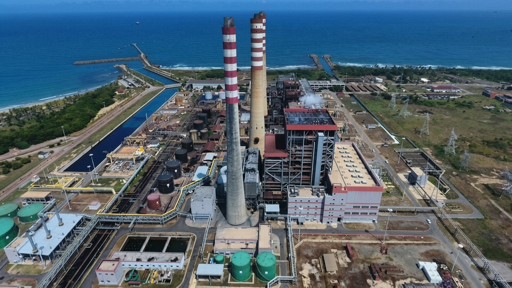
China Machinery Engineering Corporation is supplying technical assistance and spare parts to help restart a key thermal power plant.
Unit 6 at the Planta Centro complex in Venezuela’s Carabobo state is undergoing final tests ahead of a planned restart. The oil-fired unit, part of the country’s largest thermal power plant, has been out of service for nearly seven years. Once online, it is expected to supply 600 megawatts (MW) to Venezuela’s struggling electricity grid.
According to reports, Venezuela’s state-owned electric company, CORPOELEC, is working with China Machinery Engineering Corporation (CMEC) to return the unit to service by November. CMEC’s involvement implies the continued diplomatic and commercial ties between Caracas and Beijing, despite Washington’s efforts to alienate the two allies. The Trump government has halted Venezuela’s direct oil sales to Chinese companies since taking control of the country’s oil sector following its January 3 military intervention.
The government of then-President Hugo Chávez signed a contract with CMEC in 2010 to build Unit 6. Construction took place from 2012 to 2016. The project was funded by a US$5.4 billion loan from the China–Venezuela Joint Fund, with Venezuela’s state-owned company PDVSA’s daily oil sales to China National United Oil Corporation serving as collateral.
The 600-megawatt unit operated until December 2019, when a catastrophic failure in its turbogenerator set forced it to shut down. Earlier that year, a massive fire had severely damaged about 30 percent of the facility. Amid reported sabotages by far-right groups, Caracas deployed the Bolivarian Militia to the plant for weeding and patrolling.
Venezuela began restoring Unit 6 with some technical assistance from CMEC, but US sanctions sharply reduced the Caribbean nation’s oil production and revenues, making it harder to pay for heavy industrial components manufactured in China. From 2020 to 2022, the pandemic also prevented specialized Chinese engineers from traveling to Venezuela to diagnose the unit’s damaged turbine. Reduced oil sales and disrupted import logistics continued to hinder repair efforts from 2023 onward.
Without the original Chinese blueprint, spare parts and engineers, CORPOELEC was unable to rebuild the heavily damaged turbine-generator independently. Earlier this year, Caracas and Beijing reportedly renegotiated the contract to restore Unit 6, potentially in response to a modest increase in Venezuelan oil sales and the country’s recent access to international markets, following the recent easing of sanctions by Washington. The temporary lifting of sanctions coincided with Caracas granting the United States unrestricted access to Venezuela’s oil resources.
Venezuela: 300 Megawatts Added to Electricity Grid in Less Than 24 Hours
Planta Centro has five other units that are also out of service. Units 1, 2, 3, 4, and 5 were built in 1978, 1982, 1982, and 2015, respectively. Unit 1 went out of service in 2009, Units 3 and 4 in 2014, Unit 2 in 2017, and Unit 5 in February 2026. With Unit 6 back online, the thermal complex would operate at about 23 percent of its combined 2,640-megawatt capacity.
“We are in the crucial hours before Unit 6 at Planta Centro comes online,” Venezuela’s Acting President Delcy Rodríguez said Tuesday at a public event in Guacara, Carabobo state. “New spare parts are being brought in,” she added, recalling that the US economic blockade had for years prevented the Venezuelan state from acquiring spare parts and machinery for the national electricity system.
Restarting Venezuela’s largest oil-fired power plant is essential to easing the chronic blackouts that have plagued the country for more than a decade. The outages worsened after twin earthquakes in June knocked 800 megawatts offline. Since then, 600 megawatts have since been restored.
In September, Electric Energy Minister Rolando Alcalá announced a comprehensive plan to add 1,300 megawatts to the National Electric System (SEN) by year’s end, followed by a further 5,000 megawatts over the next four years. Recent progress includes the return to service of Unit 5 at the Termozulia plant in Zulia state, adding 150 megawatts to the system. Shipments from General Electric and Siemens have significantly advanced repair work.
Alcalá has also announced agreements with Brazil’s Eurobras, Argentina’s IMPSA, US-based GE Vernova, and Germany’s Siemens covering hydroelectric and thermoelectric generation, as well as transmission and distribution. Eurobras is expected to help restart Units 17, 18, and 20 at the Simón Bolívar Hydroelectric Power Plant, known as El Guri, in Bolívar state. The facility supplies about 70 percent of the country’s electricity.
Stabilizing the grid is vital to restoring crude oil production, and several international companies have pledged to help repair power infrastructure. They include US oil major Chevron, Spain’s Repsol, and Venezuelan private company North American Blue Energy Partners (NABEP). NABEP is the Pentagon’s partner in operating 17 Venezuelan oilfields under preferential terms for the United States.
From Orinoco Tribune via This RSS Feed.