

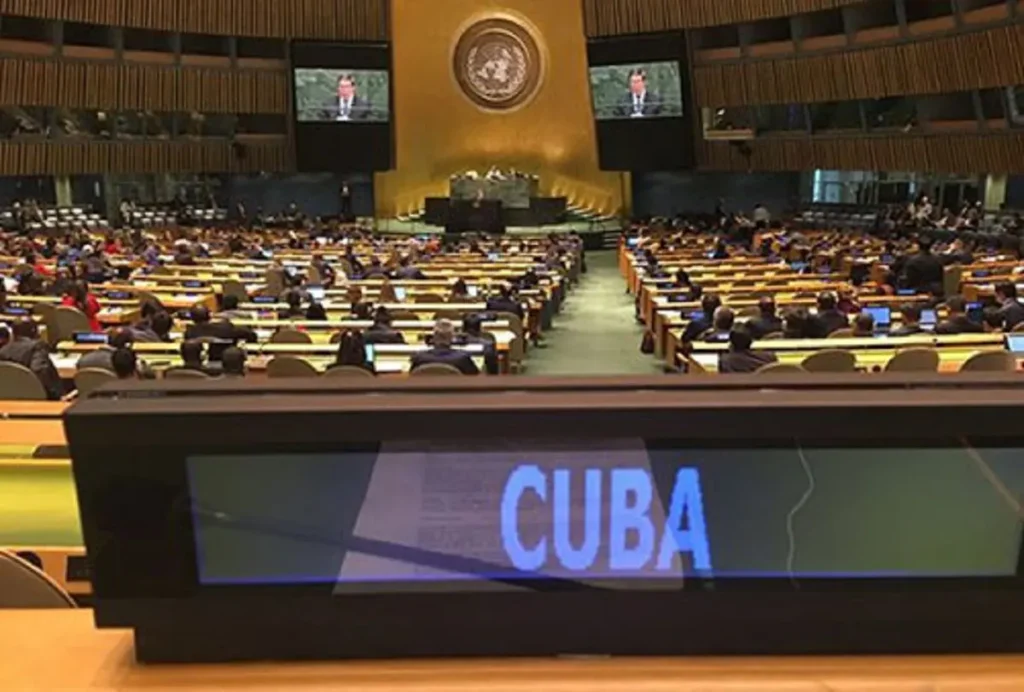
The United Nations General Assembly approved for the thirty-fourth time a resolution that demands the end of the economic, commercial and financial blockade of the United States against Cuba, with 130 votes in favor, 17 against and 25 abstentions. Cuban President Miguel Díaz-Canel thanked the nations that supported the initiative and denounced pressure from Washington to modify the result.
RELATED:
Broad International Support for Cuba at the United Nations General Assembly
“On behalf of the people of Cuba, we appreciate the solidarity of the 130 nations that voted against the genocidal blockade and the collective punishment to which the U.S. government subjects us,” Díaz-Canel expressed through the X social network.
The president described the vote as an act of courage and sovereignty, despite U.S. diplomatic efforts aimed at reducing support for the resolution presented by Havana.
The previous day became a diplomatic battle between Cuba, which defends multilateralism and international law, and a MAGA version of the United States that repeatedly violates the United Nations Charter and views the world as its backyard.
El mundo ha vuelto a pronunciarse mayoritariamente contra el #bloqueo, incluso por encima de las más groseras presiones y chantajes de EE.UU para cambiar el rumbo de esta votación.
1/3 pic.twitter.com/lOyUZqVS8s
— Miguel Díaz-Canel Bermúdez (@DiazCanelB) October 28, 2026
The text reads, “The world has once again spoken out overwhelmingly against the blockade, even above the most brazen pressures and blackmail from the U.S. to change the course of this vote.”
The Cuban Foreign Minister, Bruno Rodríguez, warned about an unusual deployment by the United States to reduce support for the document. During the debate, the U.S. representative to the UN, Mike Waltz, maintained that the blockade does not exist and attempted to blame the Cuban leadership for the economic crisis suffered by the country, claims that the Cuban delegation strongly rejected.
Diplomats from various nations defended the cessation of unilateral coercive measures and pointed out their effects on the development of the Cuban nation. The day took place in the midst of bilateral tensions and a debate on compliance with international law and the Charter of the United Nations.
The vote took place in a context of tightening U.S. restrictions. Between March 2025 and February 2026, damages attributed to the blockade amounted to $8,083.3 million, 7% more than in the previous period. The accumulated damages over six decades reach more than 178.7 billion dollars in current prices.
La política absurda del gobierno EEUU contra Cuba bloquea todo aquello que sostiene la vida. Hasta sus propios ciudadanos sufren las consecuencias.
¿Por qué el bloqueo contra Cuba impide que 7 millones de estadounidenses reciban los beneficios del medicamento cubano NeuralCIM… pic.twitter.com/OrGyTzMEVK
— Bruno Rodríguez P (@BrunoRguezP) October 29, 2026
The text reads, “The absurd U.S. government policy against Cuba blocks everything that sustains life. Even its own citizens suffer the consequences. Why does the blockade against Cuba prevent 7 million Americans from receiving the benefits of the unique Cuban drug NeuralCIM, which can combat Alzheimer’s, senile dementia, neurodegenerative diseases, with a treatment of proven effectiveness, incomparably superior to its counterpart”
The resolution seeks the lifting of unilateral restrictions that, according to Havana, affect sectors such as electricity generation, transportation, food production, health and education. The text also mentions that the fuel shortage has affected blackouts and the operation of essential services.
Cuba has presented this initiative before the General Assembly every year since 1992. On the 34 occasions in which it has been put to a vote, the resolution has received a large majority of support, although the level of support has varied depending on the international political context.
The approval reiterates the international demand for the end of the U.S. blockade against Cuba, while the government in Havana has demonstrated with verifiable data that the US measures constitute collective punishment with economic and social consequences for the Cuban population.
From teleSUR English via This RSS Feed.