

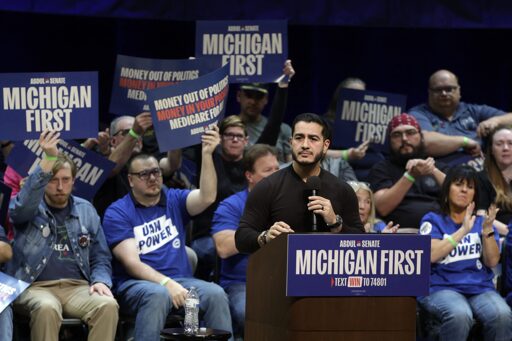
You may have heard that Michigan Democratic Senate nominee Abdul El-Sayed is “having a lot of trouble putting [the Democratic] coalition back together,” or that “Democrats [are] struggling to unite behind El-Sayed,” or that “Democrats are still struggling to unite behind El-Sayed,” or that “El-Sayed faces resistance from some voters who would ordinarily be inclined to support a Democrat,” or that “Democratic divisions could hurt El-Sayed.” It’s a prominent narrative that is driving political discourse in the closing weeks of the tight Michigan Senate race.
There’s only one problem with this narrative: It has zero empirical basis. It’s a total confection of US media and the pro-Israel lobby that isn’t supported by any data whatsoever. Two recent polls, one from Marist and one from RedBox Research, make it clear that El-Sayed’s support among Democratic voters in Michigan is both extremely high (95%) and the exact same percentage as Republican candidate Mike Rogers’ support with Republicans. And a new poll from Mitchell Research CBS complicates the narrative even further, finding that support for El-Sayed among Democrats is, in fact, 3 points higher than Rogers is among Republicans, at 94% versus 91%, respectively.
If El-Sayed and Rogers have the exact same percent of party dissent—or, as is the case in the CBS Detroit poll, Rogers has more—then why are there countless stories highlighting, handwringing, and scandalizing the trivially small dissent for only one of the candidates? Where are the breathless profiles of Republicans refusing to vote for Rogers? Where are the NPR and CNN segments focusing on “Republican divisions”?
There, of course, aren’t any, because this narrative wouldn’t advance an ideological agenda.
The “Michigan Democrats are divided” narrative has been pushed by local and national media alike, from Bridge Michigan to Reuters to Michigan Advocate to the New York Times, who reported Thursday (again, falsely), “Democrats in Michigan… remain far more divided than party leaders had hoped to be going into the election.” The Bulwark’s Sarah Longwell said on Wednesday that El-Sayed is “having a lot of trouble putting [the Democratic] coalition back together again” after his defeat of Hayley Stevens in the Democratic primary in August. The AP insisted that “Democrats are still struggling to unite behind El-Sayed” which, again, is outright false: El-Sayed has the support of 95%of Democrats.
An April IMEU poll found that Michigan Democrats think Israel is committing genocide in Gaza 66%to 14%, at a ratio of almost 5-to-1. Does this seem like an issue Michigan democrats are “divided” over?
For another point of reference, El-Sayed’s support among Democrats of 95% is higher than other high-profile centrist Democrats, including Roy Cooper of North Carolina (94%), Sherrod Brown of Ohio (93%), Kathy Hochul of New York (85%), and even with Josh Shapiro of Pennsylvania. El-Sayed is even doing better with top Democrats in his own state, with Michigan gubernatorial candidate Jocelyn Benson winning only 91.8% of Democrats versus El-Sayed’s 93.1%, according to a Michigan State Department of Political Science survey published on Thursday. Yet one is hard pressed to find any “divided Democrats” stories about any of these candidates.
The theme of “Democratic divisions” in Michigan, like the attendant assertion that Israel is “dividing Demcorats” more broadly, is a wholly concocted media narrative, pushed by the pro-Israel lobby and its media allies to create tensions and the appearance of a meaningful split where none exists. As I noted in the Intercept in June, the percentage of Democrats who have a positive view of Israel, 13%, is lower than the percent of Democrats who believe in young earth creationism or those who back a full abortion ban or Christian prayer in public schools. Yet these traditionally right-wing views are never said to be “dividing Democrats” because, by and large, they clearly are not.
Just the same, Israel doesn’t really “divide” Michigan Democrats either. An April IMEU poll found that Michigan Democrats think Israel is committing genocide in Gaza 66%to 14%, at a ratio of almost 5-to-1. Does this seem like an issue Michigan democrats are “divided” over? If it is, there are dozens of other traditionally 5-to-1 issues—from marriage equality to climate change to prayer in school—that they are also technically “divided” over, but they are never discussed in these terms because they are fringe opinions among liberals.
The myth of widespread liberal zionism among Democrats is too big to fail, so it continues in zombie form, propped up by an elite liberal class that simply needs it to exist.
That’s because it’s a playbook––a PR tactic––not an actual reflection of political reality. In this playbook, our media obsesses over a trivially small percent of anti-El-Sayed Democrats in Michigan while never mentioning Republicans disillusioned with Rogers despite their polls being statistically equal. As Michael Arria at Mondowiess notes in his analysis of this manufactured “division,” polls consistently “upend the narrative that Democratic voters are split on El-Sayed.” So why does it persist?
It persists because the myth of widespread liberal zionism among Democrats is too big to fail, so it continues in zombie form, propped up by an elite liberal class that simply needs it to exist so they can appear humanitarian, worldly, and sophisticated while continuing to back—albeit with the occasional wristslap—a genocidal state currently experiencing political paralysis because their nominal liberal wing is simply too racist to give Arab parties any power whatsoever.
The rebellion against El-Sayed in Michigan, such as it exists in reality, is largely driven by ideologically motivated donors and party elites, namely those whose primary issue is bipartisan support for Israel. But it’s tacky to point this out, to note that this opposition is largely coming from a small number of actual voters and is being amplified way beyond its objective news value because influential zionist advocacy groups are pushing it to media organizations and their internal allies. This is awkward and uncomfortable to discuss, so, like with the nonexistent “Democratic divisions over Israel,” it has to be reframed as some organic dissent among “voters” or “Democrats” when, in reality, the number of El-Sayed holdouts is statistically trivial. This isn’t to say media cannot focus on issues that matter to a small number of voters. What gives the game away is that this is literally not being done for Rogers, or other high-profile centrist Democrats, despite party dissent for these candidates being greater or roughly the same.
So where are the articles profiling angry Republicans refusing to vote for Rogers? Where are the countless CNN and PBS segments detailing their grievances and pundits demanding Rogers “reach out” to them? Where are the glib, unsourced throwaway lines in the New York Times about how “Republicans in Michigan remain far more divided than party leaders had hoped to be going into the election”—since, again, this is statistically just as true for the GOP as it is for El-Sayed? There aren’t any, because this angle doesn’t discipline Israel critics and drive up the negatives on a candidate most media elites clearly want to see underperform or, if at all possible, outright lose.
h/t Brian Tashman for exquisite poll watching.
From The Real News Network via This RSS Feed.