

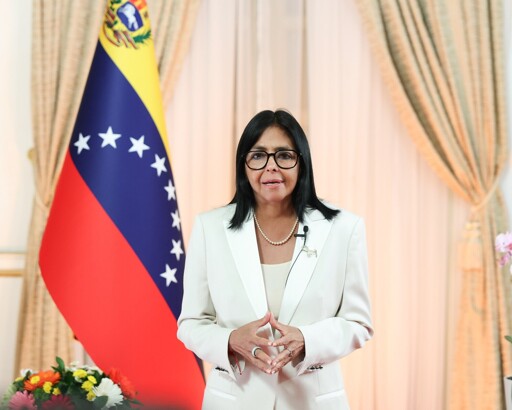
The acting president of Venezuela, Delcy Rodríguez, has delivered a special message reviewing different achievements of the government this year. Notably, this included an announcement confirming that over the course of 2027, workers’ incomes are planned to increase at four stages, and in no case may they be lower than the economic growth of each preceding quarter.
She began her review this Thursday, October 29, with a summary of the various actions her government has taken, as well as its operational frameworks. “Venezuela’s political horizon is not measured by a date on the calendar,” she emphasized, “but rather by a sequence of objectives we must reach.”
Analysts suggest that since the return of far-right politician María Corina Machado, the Chavista leadership has entered into a pre-campaign mode aiming at the upcoming tentative elections.
“I confess that the decisions we have taken and those we must take are not easy,” Rodríguez explained. “For some this is yielding too much, and for others it is advancing too little. Between those two tensions is where we govern, and we have chosen a path that with firm steps reaches a safe harbor.”
She enumerated the deep transformation of the justice system “to rebuild confidence and recover credibility in institutions,” citing that a major national consultation for reforming criminal justice is underway. “A consultation that seeks to listen to everyone to build a fairer, more humane, transparent, and impartial justice,” she explained, “which leaves behind corruption, procedural delay, and the criminalization of poverty.”
She also cited as an achievement the Amnesty Law, “to help heal the wounds caused by years of confrontation between brothers.” Since its approval, almost 9,000 people have benefited, “ending criminal proceedings derived from the confrontation in which we were immersed.” More than 1,000 people have been released as a result of the enforcing of this law and the review of other cases not covered by it.
She recalled that she had publicly acknowledged that the Law against Hate had been applied abusively and asked for it to be reformed to remove criminal penalties provided in that instrument. “I ask the National Assembly to carry out a broad and inclusive process of consultations with all sectors involved to enable a wide debate on this proposal.” Once approved, the justice system will have to review the cases of people criminally prosecuted based on this law.
“I have instructed security forces that no person be detained without a judicial order, except in cases of flagrante delicto,” she stated, adding that “responsible practice of politics is guaranteed for everyone. The doors are open. Peaceful protest is a constitutional right, and the exercise of that right must be accompanied by respect for the physical and moral integrity of our security officials.”
She further recalled that in October, the third round of the political dialogue table between representatives of the far-right so-called “2015 National Assembly” and the National Government was held in Caracas, with an agenda focused on political guarantees for all participants in upcoming electoral processes, reform of the Supreme Court of Justice, and the recovery of resources for post-earthquake socioeconomic relief. “This is not a dialogue for a photo; these are complex issues and are not resolved in a day.”
On economic matters, Rodríguez reported that she has “instructed the valuation of nonessential assets in the hands of the state that can be offered to the private sector or returned to their former owners. This is already advanced. Private property is a right protected and guaranteed by our Constitution.”
She recalled the approval of “a law for the optimization of procedures that has already borne fruit, among them the process of simplification, modernization and digitalization of the SENIAT.” Sixty-one oil contracts have been signed with national and international investors under the parameters of the new Hydrocarbons Law, “and 44 more agreements are under negotiation. Likewise, important negotiations are under way in mining: gold, aluminum, iron,” she emphasized.
Regarding the table of dialogue for labor consensus, she announced that “in 2027 increases in workers’ incomes are planned at four moments, and in no case may they be lower than the economic growth of each preceding quarter.”
Rodríguez reported that the government continues to restore access to news websites that were subject to administrative measures as a result of the confrontation experienced. “I ask communicators in the country for responsibility and respect for citizens’ rights,” she stated. “At the same time, I ask the media, both national and international, not to stigmatize the image of Venezuela, nor its demonym or national identity.”
Minor announcements and further actions
The acting head of state reaffirmed that she is familiar with the affairs of the state in depth because of the different positions she has held. “I come from the system we are transforming and changing; I do not hide that; I turn that origin into a strength to drive the changes Venezuela needs.”
“A transformation of this magnitude, if it is not led by someone with experience and real capacity to execute it,” she explained, “remains an announcement, and Venezuela has already had too many announcements.”
She said the measure of these changes is not her words, “they are tangible and verifiable actions.”
“There will be elections, all those mandated by our Constitution, organized by a renewed electoral authority and with the world as witness,” she reported regarding the electoral issue.
Messages to different sectors
She ended her remarks with messages to different sectors of the country:
• To workers who have demanded wage improvements: they have the right to demand and I hear them.
• To families who continue to rebuild their homes after the June 24 earthquake: reconstruction has not stopped and every month I will show what was done, where, and when.
• To those who stand with us: nothing of what has been built is lost, what works is protected, and what is wrong is corrected. Sovereignty is not negotiated; we cooperate with everyone, but we make our own choices in Venezuela.
• To young Venezuelans: it is worth believing again. These reforms are here so that, when it is your turn to decide the country’s course, you find institutions and not ruins.
• To those who are far from home: return will always be voluntary, dignified, and with guarantees. Whoever decides to return will find a country that receives them with open arms, with respect, with their documents in order and with job opportunities. We are building the country worth returning to.
“I ask you to judge me by deeds,” she said in closing; “less fighting, more solutions.”
(Alba Ciudad) by Luigino Bracci with Orinoco Tribune content.
Translation: Orinoco Tribune
OT/JRE/AU
From Orinoco Tribune via This RSS Feed.