

By Misión Verdad – Oct 29, 2026
The acting president of Venezuela, Delcy Rodríguez, called on far-right opposition politician María Corina Machado to rectify her political conduct following her return to Venezuela. “Hopefully there will be repentance, remorse, rectification, and she can contribute something to the country,” said Rodríguez when asked about Machado’s return, while on an official visit to the Dr. Carlos Arvelo Military Hospital.
Rodríguez referred to the political responsibility of those who have promoted sanctions against Venezuela, who had promoted actions of international pressure and measures of force to topple the Venezuelan government. She also questioned the drama that accompanied Machado’s return and stated that politics should be oriented toward providing solutions for the country. However, she left open the possibility of Machado participating in the political dialogue, a process that requires seriousness and a willingness to contribute to national stability.
Machado’s life of violent politics
Machado’s political trajectory is marked by a confrontational strategy that combines disregard for Venezuelan institutions, requesting international pressure, support for economic blockade, and the promotion of force to remove the Chavista government. From her early years of political activity, her project has been associated with networks of financing and international promotion that have contributed to positioning her as one of the main figures of the Venezuelan opposition. Her return to the country necessitates a review of that journey.
Machado began to gain national prominence through Súmate, an organization founded in 2002 that received funding from the National Endowment for Democracy (NED), a US government entity dedicated to financing initiatives for “promoting democracy” in other countries. In 2004, Súmate played a central role in the campaign to call the recall referendum against President Hugo Chávez, the outcome of which went in Chávez’s favor. Súmate was also the subject of judicial investigations for receiving foreign funds.
In 2005, Machado met then US President George W. Bush at the White House, a meeting that solidified her standing in Washington’s political circles. Since then, her career has maintained ties with international networks of financing, leadership training, and political promotion, including the NED and organizations associated with US conservative politics.
The confrontation took on a new dimension in 2014, when Machado aligned herself with Leopoldo López and Antonio Ledezma in the strategy known as La Salida (the exit), which sought to oust President Nicolás Maduro from power through political violence. The violent protests of that year left more than 40 dead and numerous injured, amid clashes, barricades, and violent actions.
Five years later, Machado supported the opposition offensive that culminated in the attempted military uprising on April 30, 2019, presented by its promoters as Operation Freedom. In parallel, she called for greater international pressure and the consideration of intervention mechanisms, including the Inter-American Treaty of Reciprocal Assistance (TIAR) and the Responsibility to Protect (R2P), promoted by the US. In December 2018, she also sent a communication to Israeli Prime Minister Benjamin Netanyahu, asking for a military intervention in Venezuela.
The use of foreign pressure also has an economic dimension. Machado has defended the tightening of US sanctions and has called for new measures against the Venezuelan government, while supporting initiatives aimed at restricting its income and trade relations. In 2017, she called the US sanctions “surgical and effective” and called for increased pressure. In subsequent years, she supported measures against companies and assets associated with the Venezuelan state. In 2025, she supported Donald Trump’s strategy against Venezuela and celebrated decisions targeting the oil sector, including the revocation of the license that allowed Chevron to operate in Venezuela under specific conditions.
The dispute over electoral institutions is another constant. After winning the opposition primaries in 2023, Machado maintained her presidential aspiration despite the administrative disqualification that prevented her from running, confirmed by the Supreme Court of Justice in January 2024. The opposition’s Unitary Platform ended up backing Edmundo González Urrutia as the candidate in the presidential elections of July 28 that year.
After the official result was announced, Machado and her circle did not recognize President Maduro’s victory and published documents that, according to the far-right opposition, showed a different result. The public discussion was marked by contradictory statements from various opposition leaders regarding the number of available records and the percentage of votes they could certify. In a previous publication, Misión Verdad compiled those discrepancies that show how the handling of electoral records was part of a strategy to question institutional legitimacy and maintain political pressure after the elections.
The post-electoral confrontation moved to the streets on July 29-30, 2024, when public facilities, political headquarters, services, monuments, and spaces associated with Chavismo were attacked. Venezuelan authorities reported 25 fatalities and 192 injuries in the context of those events.
Other episodes that are part of Machado’s political controversies include the construction of persecution narratives, such as the report of an alleged detention in January 2025, followed by a video in which she claimed to be safe, and probable staging of an incident related to her campaign in Barquisimeto in July 2024.
Negotiation and institutional path
The dialogue between the Venezuelan government and opposition sectors constitutes the space where political and institutional conditions are discussed to move toward national political stability. In these conversations, representatives of the government and opposition sectors associated with the 2015 National Assembly are participating, in an agenda that includes institutional reforms and guarantees for political participation.
Among the issues raised is the overhaul of the Supreme Court of Justice and, subsequently, the reform of the National Electoral Council. These steps are part of a sequence of institutional reorganization prior to the definition of an electoral calendar. So far, no definitive date for the elections has been announced.
The United States has expressed its support for this route and has outlined its own expectations for the next steps.
In this context, María Corina Machado and her supporters’ demand to set an immediate date for elections deviates from the agenda being discussed in the dialogue. The demand intends to prioritize a schedule over a negotiation that first addresses the institutional conditions to move toward elections, which, according to Acting President Delcy Rodríguez, in a recent message to the nation, should not be a reason for confrontations and destabilization. The pressure to expedite the call for elections also contrasts with Washington’s current position, which supports the sequence of reforms and ongoing talks.
The contradiction becomes more significant when considering Machado’s trajectory, marked by her support for sanctions against Venezuela and the promotion of international pressure strategies. It is difficult for her to justify how she now tries to impose her demands outside of a dialogue process that has the support of the same US government that backed previous pressure initiatives against the country. The political path to follow (including elections), ultimately, must be built through agreements among Venezuelan political sectors, without a unilateral imposition of timelines or disregard for the negotiation spaces opened by the government.
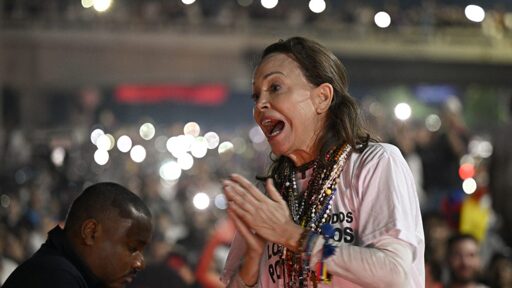
After Months of Announcements, María Corina Machado Returns to Venezuela
Possible scenarios associated with Machado’s return
The Venezuelan political dynamic faces two possible courses of action regarding the presence of María Corina Machado in the country.
One is her attempt to influence the dialogue that is already underway, trying to introduce her proposals in a negotiation between the national government and opposition sectors. Her eventual participation could translate into an indirect influence on the agreements and political decisions that are made during the process.
The second scenario, also very likely in light of her career, is that Machado would resume the confrontational strategy that has characterized her political career. The demand for an immediate call for elections, promoted by her followers outside the agenda being discussed in the negotiation, constitutes a sign of that possibility. Violent politics could once again become a tool to try to impose her timeline and condition institutional decisions.
This second path is related to the background of a person who has supported economic sanctions against Venezuela, promoted mechanisms of international pressure, and accompanied initiatives of force and insurrection against the government. Her return, therefore, forces us to consider the possibility that these practices may once again take a central role in the political arena, with grave consequences for national stability and for the dialogue efforts currently underway.
Ultimately, Machado would have to bear the cost of sacrificing the last remnants of a “leadership” that is already quite tarnished. Her political conduct has repeatedly shown a marked resistance toward institutional objectives and concrete agreements, systematically opting for tactics of sabotage, agitation, and destabilization that prioritize confrontation and social fracture.
Translation: Orinoco Tribune
OT/SC/CD
From Orinoco Tribune via This RSS Feed.