

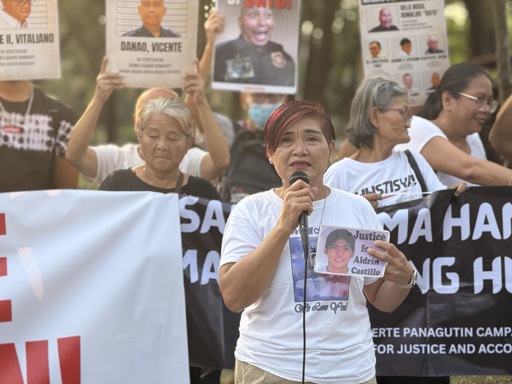
Nine years later, the family still has no definitive answers about who killed their son, why the gunmen targeted him, and whether authorities thoroughly investigated the shooting.
Trigger warning: details of violence and death
Nine years after their son was killed in former president Rodrigo Duterte’s drug war, Nanette and Bong Castillo stepped forward to the Truth Commission’s fifth Public Truth-Telling Session on October 23 to recount what they believe happened to Aldrin Castillo and seek answers on his death.
They believe that the case of their son may have been a case of mistaken-identity, while the police and medical records reviewed by forensic pathologist Raquel Fortun exposed significant gaps in the original documentation of Aldrin’s death.
Aldrin was 32 when gunmen shot him in Tondo, Manila, on October 2, 2017. He was visiting his sister to help repair her air conditioner.
His parents believe the gunmen were looking for another man and killed Aldrin because they mistook him for their intended target.
Nine years later, the family still has no definitive answers about who killed their son, why the gunmen targeted him, and whether authorities thoroughly investigated the shooting.
Son with a future
Nanette came to the Truth Commission determined to tell people who Aldrin was beyond the circumstances of his death.
“I want everyone to know how good Aldrin was as a son,” she said in Filipino.
Aldrin was her firstborn, whom she remembered as affectionate, hardworking, and attentive to the needs of others.
In elementary school, he was recognized for keeping himself neat and clean, and he ranked first in his class in Grade 4.
Nanette recalled that he would ask her to share food with friends who had nothing to eat, even when their own family had little money.
When Aldrin began earning, he gave his mother part of his salary and made sure they ate together before she went home.
Bong also brought his son to catering jobs so he could learn to work and earn money.
Aldrin later learned welding through his partner’s family and dreamed of working abroad to give his parents a better life.
Nanette remembered his promise to take her to Saudi Arabia and build her a house when he found work there.
“Gagawin kitang doña,” (I will make you rich.) Aldrin would tell her.
For Nanette, the promise represented a future her son wanted to build for their family, a future cut short when he was killed.
The night of killing
On October 2, 2017, Aldrin visited his sister in Tondo to help repair her air conditioner.
Nanette hesitated before allowing him to leave because she had heard reports of killings in the area. She thought the checkpoints and the election gun ban in effect at the time might help keep him safe.
She gave him money for transportation and watched him leave.
Bong was away in Quezon City for work when the family learned that Aldrin had been shot.
According to the police incident report presented by Fortun, Aldrin was with friends in Tondo when armed men arrived on motorcycles and shot him before fleeing.
Nanette recalled reaching the scene and finding her son lying motionless on the street, his eyes open.
She called for a doctor and an ambulance, still hoping someone could save him.
She held his hand and pressed her ear against his chest, trying to feel a pulse or hear a heartbeat.
“Umaasa ako. Umaasa ako. Umaasa ako,” she recalled, repeating how she kept hoping that her son might still be alive.
Nanette also recounted how police officers initially prevented her from approaching Aldrin, saying she might disturb the crime scene. She pleaded to stay beside him, promising not to move anything.
The shock of that night has remained with her.
She still remembers the ordinary details of life with Aldrin, including the meals he loved and the way he would come home and ask what they would eat.
Those memories now coexist with the questions that followed his death.
Mistaken identity
During the session, Nanette recalled hearing that the gunmen had been looking for someone wearing a white sleeveless shirt. It was her nephew who mentioned this detail.
Bong also recounted that a man later approached him and said he was the person the gunmen had been looking for that night.
The parents presented these accounts as the basis for their belief that Aldrin was killed by mistake.
Their account has not, in the material presented during the session, established the identity of the intended target or the people responsible for the shooting.
The possibility of mistaken identity has nevertheless shaped the family’s search for answers. If the gunmen were looking for someone else, the family wants to know why Aldrin was killed and who was behind the attack.
Nanette continues to ask people in the area, including tricycle drivers, whether they know anything about the killing.
She said she returns to the place where Aldrin fell to light candles and ask questions, hoping someone might share information that could help clarify what happened.
“Parang hanggang ngayon nga po ako’y nag-iimbestiga,” she said, describing how she still finds herself investigating her son’s death.
Her words underscored a central concern raised by the case: the burden of seeking answers has continued to fall on the family, even years after the killing.
Gaps in forensic record
Raquel Fortun reviewed Aldrin’s death certificate, police autopsy report, incident report, and crime-scene photographs. She also examined his remains after they were exhumed on September 24, 2026, with the family’s consent.
Her presentation identified significant shortcomings in the documentation of Aldrin’s death and the subsequent investigation.
Fortun first questioned the death certificate’s incomplete manner-of-death field. She said it should have identified the death as homicide rather than leaving the field blank.
She also criticized the record’s reference to “death by legal intervention,” questioning the terminology used.
The police autopsy report, conducted on October 3, 2017, the day after Aldrin was shot, stated that he had sustained five through-and-through gunshot wounds. Fortun noted that the body had already been embalmed before the examination.
She said the report was only about one and a half pages long and lacked the detail needed to document the injuries adequately.
The report described gunshot wounds to the head, neck, and trunk, including injuries involving the spinal cord, a major blood vessel, the lungs, heart, liver, and intestines.
But Fortun questioned whether the report sufficiently documented the injuries and their trajectories. Without a detailed account of the entry and exit wounds, she said, it was difficult to determine which wounds corresponded to one another.
The limitations of the original autopsy became particularly important years later, when Fortun examined the preserved remains.
During the September exhumation, she examined the bones and conducted X-rays. Her preliminary findings identified fractures consistent with gunfire to the head and neck region and the trunk, including damage to the first cervical vertebra and ribs.
However, the remains could not answer every question. The soft tissue had decomposed, and the passage of years limited what could be determined from the bones alone.
Fortun said she could only assess the evidence available to her. She also expressed hope that additional records and materials could be obtained to clarify the case.
Her presentation did not identify the gunmen or establish who ordered the killing. Instead, it highlighted the limitations of the original medical documentation and the questions that remain because the available evidence does not provide a complete reconstruction of the shooting.
Questions about the police investigation
Raquel Fortun’s concerns extended beyond the autopsy to the police investigation at the crime scene.
The police incident report described men arriving on motorcycles before shooting Aldrin and fleeing. Investigators recovered five spent cartridge casings, according to the records Fortun presented: two .45-caliber casings and three .40-caliber casings.
But the available documentation did not provide a complete account of the shooting or establish what further investigative steps had been taken.
Fortun questioned the handling and documentation of evidence at the scene, pointing to photographs that raised concerns about crime-scene control, lighting, and the way evidence was marked.
She also raised questions about whether investigators had adequately documented physical evidence and followed up on potential leads.
The gaps in the records left Fortun unable to reconstruct the attack with greater certainty. She said the original investigators should have gathered and documented evidence more thoroughly.
“The people who should have done the investigation, the gathering of evidence, the documentation should have done their job,” she said.
Fortun acknowledged the limits of what the Truth Commission could establish from the available material. Without more evidence, she said, the Commission could not confidently determine what further action the case might warrant.
The shortcomings she identified do not establish who killed Aldrin or prove the family’s mistaken-identity theory. They do, however, raise questions about the completeness of the investigation and whether authorities did enough to establish the circumstances of his death.
Grief beyond killing
Aldrin’s death fractured the Castillo family in ways that extended far beyond the funeral.
Nanette said she blamed herself for allowing him to go to Tondo and later blamed her daughter for asking her brother to visit.
She stopped speaking to her daughter for more than a year because she could not understand why the family had lost Aldrin.
Bong described trying to support his wife while dealing with his own grief and anger.
He said he sometimes withdrew or drank to cope, while Nanette struggled with the emptiness of returning home without her son.
Their pain also followed them online, where strangers mocked Aldrin and told the family that he deserved to die because they believed he was involved with drugs.
Nanette said she initially fought back against such comments, but she later learned to ignore people who did not know her son or understand what the family had endured.
“Kung hindi niyo kami kayang damayan, huwag niyo kaming bastusin,” she said, asking people not to insult the family if they could not offer support.
She told the commission that even if people accused someone of a crime, they should not celebrate that person’s death.
The family’s account challenged narratives that reduce people killed during the drug war to labels that make their deaths appear acceptable.
Nanette said she wanted the public to know Aldrin as a son, brother, worker, and person with plans for his future.
Demand for accountability
The Castillo family wants those responsible for Aldrin’s killing to be identified and held accountable.
Bong thanked the Truth Commission for giving them an opportunity to tell their story. Nanette said she hoped the Commission would help establish what happened to her son.
She called on those responsible for the killing, whether police officers or people paid to carry out the drug war, to confront the harm they had caused.
Nanette said she would not seek revenge. She wanted those responsible to face due process, the protection that Aldrin did not receive before gunmen shot him.
For the family, accountability would not bring Aldrin back. But establishing the truth could help them understand his death and prevent other families from experiencing the same loss.
Fortun’s presentation showed how incomplete records and unanswered investigative questions can constrain efforts to establish the circumstances of a killing years later.
The Commission’s next steps will depend in part on whether additional records and evidence can be obtained to clarify the gaps Fortun identified.
At the end of the session, participants took part in a ritual for loved ones who had died, represented by an empty chair and a lit candle.
Nanette read a poem she had written for Aldrin, recalling the difficulty of saying goodbye to a son whose absence continues to shape her life.
She remembered his familiar questions about dinner and the sound of his voice at home.
“Walang hanggang pagmamahal, Aldrin ko, hanggang sa muli nating pagkikita, anak,” she said, ending the poem with a promise of enduring love.
Nine years after Aldrin’s killing, his parents gave their account before the Truth Commission and renewed their call for answers.
Their testimony has brought the case back into public view, while Fortun’s review has highlighted the limitations of the records left behind. Who killed Aldrin, whether he was mistaken for someone else, and whether the remaining evidence can help establish accountability are questions that still await answers. (RTS, RVO)
The post 9 years later, parents still seek answers over son’s killing amid ‘drug war’ appeared first on Bulatlat.
From Bulatlat via This RSS Feed.