

Sandra Hale Schulman and Shirley Sneve
ICT
Three Native people – an historian, a writer and a physician – are among 20 people chosen to be MacArthur Fellows for 2026 by the John D. and Catherine T. MacArthur Foundation.
The fellowships come with an $800,000, no-strings-attached stipend, known as “genius grants,” for their work.
“For 45 years, MacArthur Fellows have defied boundaries, by questioning conventions, crossing disciplines, and driving collective progress,” according to a statement by Kristen Mack, vice president of communications, on the MacArthur Foundation website.
“The 2026 Fellows continue that creative tradition — they explore the depths of our humanity; they reveal untold origins to modern challenges; they expand the edges of scientific inquiry and life-saving research,” Mack said. “They show us new ways to understand the world.”
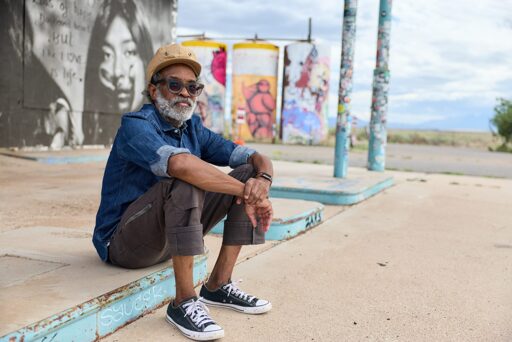
The winners, announced Sept. 29, include Elizabeth Ellis, Peewaalia/Peoria Tribe of Indians of Oklahoma, a tribal history liaison and scholar; Layli Long Soldier, an Oglala Lakota writer, poet, visual artist, and educator; and Chip Thomas, an African-American and Lumbee physician/artist known for his work — and his murals — on the Navajo Nation.
Elizabeth Ellis
Ellis is an associate professor of history at Princeton University, teaching early American and Native American history as well as Indigenous Studies. She also serves as the historian for her tribe.
Ellis is a scholar of early North America with a focus on diplomacy, borderlands, cross-cultural exchange, and Indigenous politics. She received her bachelor’s degree from Tulane University and her doctorate from the University of North Carolina at Chapel Hill.
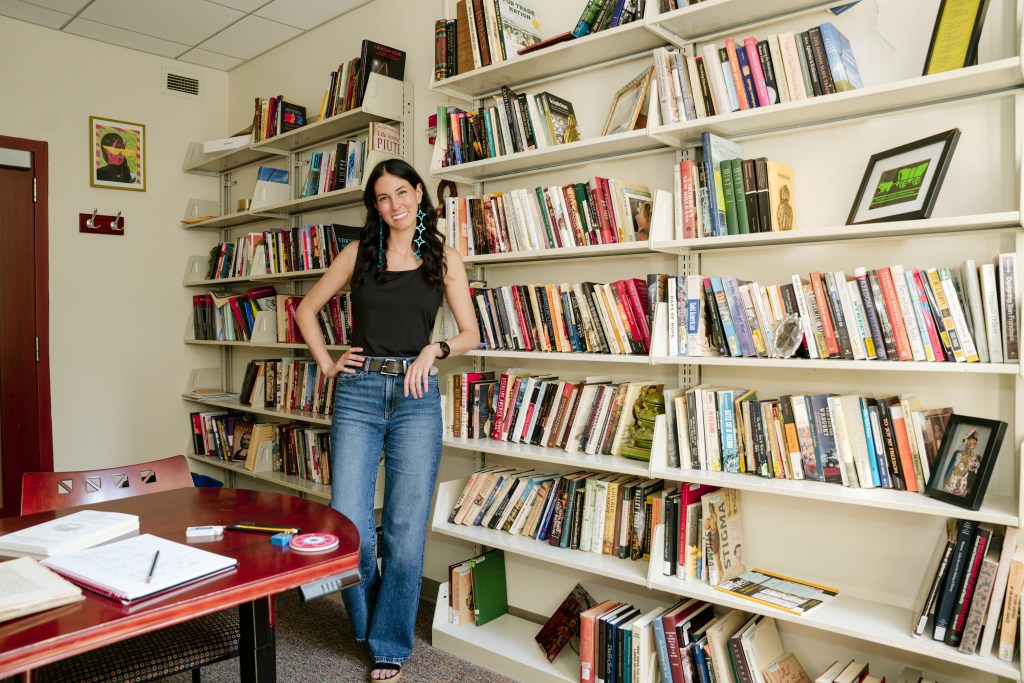
Elizabeth Ellis, an associate professor of history at Princeton University and a historian for her tribe, the Peewaalia/Peoria Tribe of Indians of Oklahoma, was among three Native people named to a 2026 MacArthur Fellowship, known as a “Genius Grant,” with its $800,000 award. Credit: Courtesy of John D. and Catherine T. MacArthur Foundation
Her ongoing collaborative work includes the Reclaiming Stories Project; the CRoyAN – Collections Royales d’Amérique du Nord project; and the “Indigenous Borderlands of North America” research project.
“I have the great pleasure and the great fortune to work on and think about and engage with Indigenous issues as my full-time job,” Ellis told ICT.
“I’m teaching this semester an intro to Native American history, which is a lot to wrangle because they expect that to go from the domestication of corn to Standing Rock protests,” she said. “So we have to move very fast. But for a lot of my students here on the East Coast, they don’t have familiarity with Native history and Native issues.”
Her work provides important historical evidence for the ongoing efforts by tribes to gain federal recognition.
“As a historian, I think how can you possibly understand our current political moment, the dynamics of this nation, without a deep understanding of Indigenous history in this continent?” she said. “So I get to teach stuff like that.”
Ellis was working in her office when she found out she had won the fellowship.
“They had a very clever ruse,” she said. “They told me that I was nominating other people. I had a list of names. I was ready to explain why these people were so wonderful. And then they told me it was me, and I just sat here shaking, not really sure what to do with myself.”
The grant will help her build on her work.
“With the funding I want to run programming on the reservation or in my own community,” she said, “to do research on archives and old documents for education and engagement with community gatherings.”
Layli Long Soldier
Long Soldier is perhaps best known for her poetry collection, “Whereas,” which references the 2009 U.S. Congressional Apology to Native peoples. Her work uses visual poetics and often covers Indigenous history.
Her multi-disciplinary practice moves across poetry, prose, and visual media, such as sculptural star quilts and visual series explored in her 2026 collection, “We,” to document collective memory, resistance, and community.
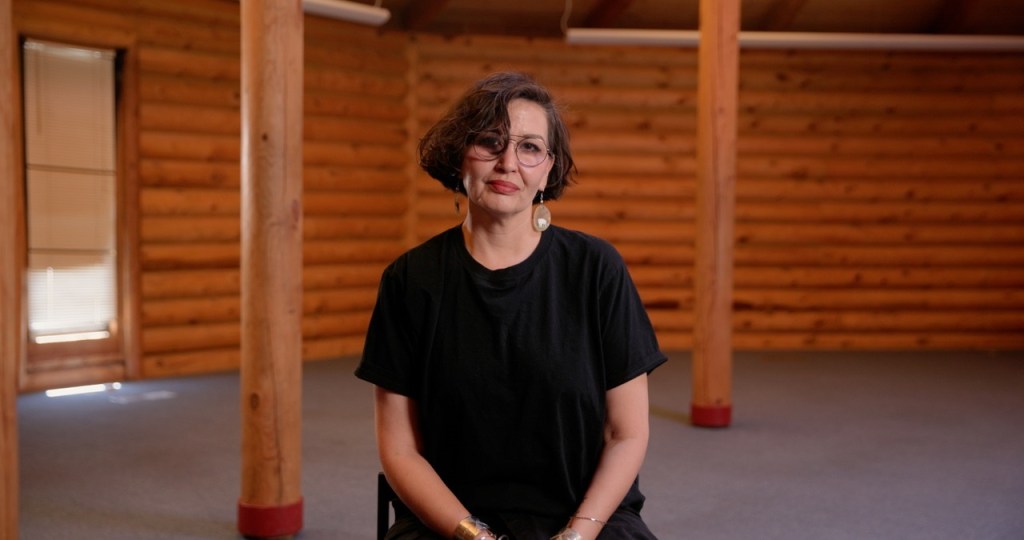
Layli Long Soldier, an Oglala Lakota writer, poet, visual artist, and educator, is perhaps best known for her poetry collection, “Whereas,” which references the 2009 U.S. Congressional Apology to Native peoples. She was one of three Native people among the 20 named in 2026 to a MacArthur Fellowship, known as a “Genius Grant” with an $800,000 award. Credit: Courtesy of John D. and Catherine T. MacArthur Foundation
She is a faculty mentor in the master’s degree creative writing program at the Institute of American Indian Arts, known as (IAIA).
*“*I’m a poet exploring ways to articulate Native histories and celebrate our enduring kinship, strength, and creativity,” Long Soldier said in a statement released by the MacArthur Foundation. “While I certainly do address aspects of law, policy, treaty, and historical events, deep inside a lot of that work is a sense of love and kinship, community, language, and all the things that make us who we are today.”
She says certain threads run throughout her work.
“The first one always seems to be motherhood. Also the practice of making art,” she said. “I’m always thinking about those things that bring joy and life to who we are in the present day. I also engage with historical events for Native people and historical documents. The process of research, conversations with other scholars and community members is really a way for me to process my emotional reaction, but also grow in my own understanding of history and policy and law.”
She continued, “My book, ‘Whereas,’ is a response to the congressional resolution of apology to Native Americans. In the poem, I unfold the way that they avoid ever using the word genocide. I’m using that language to hold up a mirror. This is what this language looks like. This is what it sounds like. And I ask readers to feel it for themselves.”
Chip Thomas
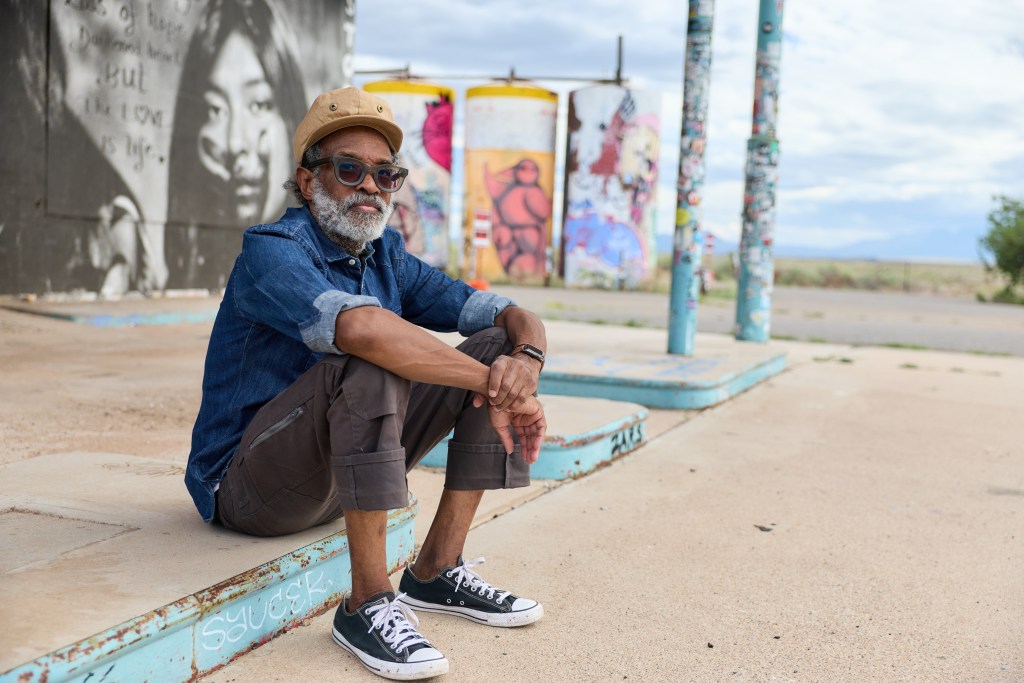
Thomas has a most unusual story with a 36-year career as a primary care physician on the Navajo Nation and as an artist who uses the images of the people he met there as a basis for his powerful photographic mural art.
Since 2009, Thomas has installed striking large-scale black-and-white photographs of people, sheep, horses, and landscapes on abandoned buildings, grain silos, and other roadside buildings across the Navajo Nation.
In 2012, Thomas formed the Painted Desert Project, bringing more than 30 street artists from around the world for a residency on the Navajo Nation. The artists collaborated with Diné to design and install murals throughout the area.
More recently, Thomas has been installing and curating exhibitions that show difficult, little-known histories of the American West, such as Native enslavement and the entangled history of Black soldiers sent by the U.S. Army to remove Indigenous people from their land.
“The U.S. government paid for my medical school education for four years,” Thomas told ICT from his home in Flagstaff, “and I knew when I finished my training, which happened in 1987, that I had to spend four years working in a health shortage area. A friend of mine from that school was working on the Navajo Nation with her husband at the time. They invited me out to Inscription House Health Center in Tonales, Arizona.”
Thomas liked the area and the health center, so he stayed, and one of his neighbors left him a dark room that he ended up using for 22 years. He had a love for street art and in 2009 he saw an example of the work of French artist JR, who was taking black and white photographs and enlarging them and using them as street art.
“When I saw that, I realized, yeah, that was something that I just had to figure out,” Thomas said. “And it took me a little bit, but I was able to. I was doing the development and printing of the film myself. There were some good images. I was able to have shows of that work, but the people who were pictured actually weren’t coming to the shows in Flagstaff or Durango or anywhere else.”
He took his art to the people.
“I decided to talk with the people whose photographs I had taken to see if they were okay with me using them as a form of street art,” he said. “They were. So I started putting images along the roadside. I was curious how they would be received by people on the Navajo Nation. And initially, there was some skepticism and reluctance. People weren’t sure why pictures were appearing, or whether it was art or just what it was. But over time, it gradually came to be accepted.”
Thomas says that many think of the Navajo Nation as being remote, but it gets a lot of tourist traffic, both national tourist traffic as well as international, to see Canyon de Chelly, Navajo National Monument Valley, and always the Grand Canyon and Lake Powell.
In addition, Thomas began photographing the installation of the murals as fine art within the landscape, making it a third dimension of his art.
“It’s the gift that kept on giving,” Thomas said. “I saw the movie, ‘Exit Through the Gift Shop,’ [about the elusive street artist Banksy] and I thought, ‘Well, that’s how you do street art. You sneak around at night, no one knows who’s doing it.’ That was my MO a little bit.”
He realized his work was catching attention after he quietly posted a photograph of code talkers on the wall of a decaying roadside stand. Then driving by one day he realized four people were making repairs to the stand.
“I asked if I could take a photograph of my picture on their stand, they said, ‘Sure, you may as well. Everyone else has been stopping,’” he said. “They said that so many tourists coming from Lake Powell had stopped to take a picture of the art with the stand that they decided to rebuild the roadside stand and start using it again. I realized at that point that this could be a win-win situation, so I told them I was the one who put the picture on the stand.”
They thanked him, and asked if he could put art on the other side, too, to stop traffic coming from the other direction.
“At that point, I stopped sneaking around at night and started engaging the wall owners to ask if it was okay if I used their walls,” he said.
Eventually, his work was making its way into galleries and then museums becoming very successful.
What does the MacArthur award mean to him?
“The success of this work, especially out on the Navajo Nation, where the land is very open, you can see the horizon, having big pictures of people from the community pasted along the roadside, had resonance with people who saw it and with people on the Navajo Nation,” he said.
A curator friend called him last year and said he heard he’d been nominated for the MacArthur Fellowship, but didn’t say anything else. When he didn’t hear anything from them, he assumed he didn’t get.
He was shocked when they called at the end of August this year and said, “This is the MacArthur Foundation, we have some good news.”
“That was funny because I didn’t recognize the number from Chicago,” Thomas said, “so I didn’t answer it. But they called back the following day, and I didn’t know that MacArthur comes with a cash prize, so that was a surprise.”
“But in general, I don’t get these types of awards or prizes, so I didn’t know a lot about MacArthur. I just knew it was something that lucky people get. Lucky, talented people get.”
He wants to use the award to continue his work in the community.
“The Painted Desert Project, which I started in 2012, was an effort to invite street artists from all over and not just street artists, but poets, too, so I would like to continue that effort,” he said.
“I’d like to make more connections with schools, with wall owners, and see if we can keep the Painted Desert Project going and teach some youth on the rez, how to make prints, or be printmakers, and to paint murals.”
The post Three Native Americans awarded MacArthur ‘Genius Grants’ appeared first on ICT.
From ICT via This RSS Feed.