

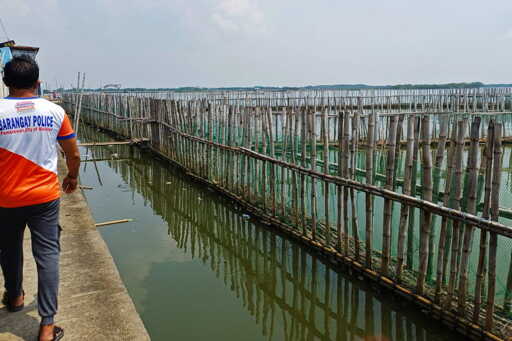
PAMARAWAN, Philippines — For years, residents of Pamarawan barangay, or village, in the City of Malolos, had to live with floodwater inundating their streets as the southwest monsoon, known locally as hagabat, brought strong waves into the fishing village. It got even worse during typhoons. “When there was a typhoon, the waves would go over the breakwater by almost a meter, a direct hit on the houses beside the dike,” said Roldan Dayao, secretary of Pamarawan, a low-lying fishing village at North Manila Bay that is only accessible by boat. The village already has a concrete breakwater that stands 3 to 4 meters (9-13 feet) high, Dayao said. But it does little to prevent the recurring flood. The situation changed after the construction of a nature-based coastal defense and flood control project. It used locally available materials, such as bamboo poles, oyster shells and coconut husks, to protect Pamarawan from tidal waves and storm surges. Interlocking, interconnected bamboo cribs now cover 14 hectares (35 acres) off the coast. The bamboo structures, alongside discarded oyster shells placed inside cocomesh, or coconut husk nets, serve as breakwaters that reduce incoming wave energy. Small boats inside a bamboo enclosure, part of a nature-based coastal defense and flood control project, in Pamarawan barangay, in Malolos City, Bulacan province, the Philippines, on Sept. 28, 2026. Image by Oliver Samson for Mongabay. The cribs also trap drifting mud and sand. Over time, the accumulated sediment is expected to gradually raise the seabed to a height sufficient…This article was originally published on Mongabay
From Conservation news via This RSS Feed.
This is super cool. Would love to be able to jump 100 years forward to see what it looks like then.
