

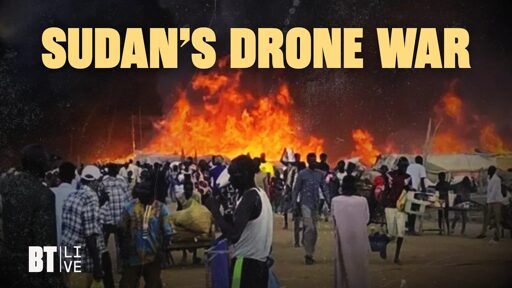

Sudan’s “civil war” is a proxy war for gold, now waged from above with foreign-armed drones. Journalist and researcher Mosaab Baba says Sudan’s “gold curse” has both the army and the UAE-backed Rapid Support Forces (RSF) increasingly striking civilian targets in a neocolonial war entering its fourth year, which has already killed thousands of civilians and left millions facing famine.
With most of Sudan’s gold now funneled to Abu Dhabi, Baba tells Rania Khalek and Zoe Alexandra the country has become a “backyard” for the UAE, Egypt, Saudi Arabia and Turkey to extract precious minerals, farmland and access to the Red Sea. A year after the fall of El Fasher, he also explains why the world’s largest humanitarian crisis keeps slipping out of the headlines. Baba also unpacks how the legacy of the December Revolution still offers hope for a sovereign, people-led Sudan, and lays out the stakes driving the Sudanese campaign against Emirati diplomat Lana Nusseibeh’s potential bid to become the next UN secretary-general.
“The only glimmer of hope is that Sudanese people themselves are starting to realize how insane this war is [and] how much they need to remove these neocolonial leaders from the country.”
Watch full episodes of BT Live, join breakthroughnews.org as a member today!
******
Rough transcript follows:
[Speaker 1:] The UAE is the main culprit in pushing for the RSF to take over Sudan, driven by the gold trade and regional domination. They’re closely allied with the Ethiopian government, and unfortunately, Abiy Ahmed is aligned with them, though not fully carrying out their wishes. They have a strong influence on Chad and are the biggest investors in Egypt. This is why we explain this as a neo-colonial war. These powers might support both sides but have no issues with each other.
[Speaker 2:] Moving on to Sudan, another drone strike occurred this week, blamed on the Sudanese army, killing dozens in a crowded market in Nala. The RSF’s de facto capital in Darfur was affected, and RSF drones knocked out power across central and eastern Sudan, including Khartoum. Sudanese journalist and researcher Mossab Baba joins us to discuss this proxy war, now in its fourth year, and the foreign-supplied weapons that have killed thousands of civilians.
[Speaker 3:] Thank you for having me. I appreciate it.
[Speaker 2:] We appreciate your time and analysis. Let’s start with the latest in Nala. Local tolls range from 21 to over a hundred killed. The army claims it’s softening RSF positions ahead of a ground assault. This follows hundreds killed in drone strikes last week. Is this recent strike the opening of a push into Darfur?
[Speaker 3:] There have been changes in how both sides conduct this war, with drone strikes becoming more prominent. It shifted from relying on mortars and ground forces to drone strikes over the last year and a half. The pattern is unusual; whenever there’s stagnation between the forces, drones start firing. The SAF targets markets, as seen in Nala and a disputed area between Sudan and South Sudan.
After these attacks, the RSF retaliates by hitting civilian infrastructure in SAF areas, leaving millions without power. The strikes in Nala were fatal, and similar incidents have occurred before, like in West Darfur. This shift to drone warfare is partly due to the increasing international drone market, with both sides having partners willing to supply weapons. The SAF, as the official army, faces fewer issues bringing in weapons, but the RSF relies on a network traced by a UN report, mainly through Libya and Chad.
[Speaker 2:] The Sudanese citizen is being pummeled by this war, and neither side takes responsibility. The SAF doesn’t acknowledge strikes hitting civilians, and the RSF remains silent on their attacks. This leads to speculation about rogue elements within these camps. The SAF camp is fragmented, with different factions and militias, while the RSF has rogue elements crossing borders.
[Speaker 3:] The use of drones is a dangerous escalation in this war, now over three years old, causing one of the worst humanitarian catastrophes. International players are involved on both sides. This isn’t merely a Sudanese conflict. Powers like the UAE, Egypt, Turkey, and Saudi Arabia are involved. How did Sudan become a battleground for these powers?
[Speaker 3:] The SAF and RSF were part of the same government under an imperial order. Decisions about Sudan go through Cairo, Abu Dhabi, and Riyadh. This control carries over from the Bashir regime, which handed Sudan to Gulf countries. Both SAF and RSF were recruited for the war in Yemen in 2015 and remain there. The war’s goal was to kill the people’s movement calling for sovereignty and wealth redistribution. The West views these demands as socialism, though in Sudan, it’s seen as government responsibility.
Forcing Sudan to sign the Abraham Accords is another factor. Netanyahu often includes Sudan in his maps of the new Middle East. This is a late-stage neo-colonial order, with military forces lacking loyalty to the Sudanese people, allowing countries like Turkey, the UAE, Egypt, and Saudi Arabia to exploit Sudan for resources like gold and farmland.
[Speaker 2:] Speaking of resources, what’s up for grabs in Sudan? Gold, farmland, Red Sea access—what are foreign powers targeting?
[Speaker 3:] Gold is the most fatal, with the RSF utilizing it economically. Most gold ends up in the UAE, which has destabilized regions for gold mines. This gold rush causes instability, similar to the oil curse. Livestock is a close second, while agriculture struggles due to sustainability issues and food crises. Gold is a quick fix for militias and warlords running the economy and war.
[Speaker 2:] It’s been one year since the ethnic cleansing in Al-Fashir, and several massacres have occurred since. Why hasn’t Sudan registered more on people’s radars? What international efforts are being made to end the conflict, and who’s stopping them?
[Speaker 3:] Internally, there are efforts for national dialogue and a negotiated end to the war. Political parties and traditional leadership engage in people-to-people dialogue. Activists, especially in the diaspora, campaign against the UAE, which lobbies the UN and influences US policy. The UAE’s deep pockets are the main reason this conflict lacks attention. They’re pushing for the RSF to take over Sudan for gold trade and regional domination.
[Speaker 2:] Eight years ago, the Sudanese revolution began, a hopeful moment for organizing across sectors. Now, the military establishment has co-opted and crushed it. Your thoughts on this?
[Speaker 3:] The December revolution was a historic moment, uniting Sudan against the Bashir government. It was coerced by leadership and countries pressuring the military. Protests in Khartoum last December remembered the revolution. Many volunteers and activists emerged from it, maintaining social fabric and aid efforts. The revolution’s core discourse remains valid, and though affected by war, it will manifest differently as people realize the war’s insanity.
[Speaker 2:] Before we wrap up, regarding the UAE, one name floated for the next UN Secretary-General is Lana Nusseibeh, an Emirati diplomat. After the UN accused the RSF of genocide, she dismissed the allegations. If she becomes Secretary-General, it could undermine confidence in international bodies. Any thoughts?
[Speaker 3:] People see through it. Human rights organizations are making noise about this. Sudanese have a campaign against her appointment. If she’s allowed to become Secretary-General, it will erode trust in international bodies. The UN’s role in documenting atrocities is crucial, and her appointment would damage confidence in any Western body, even those with good intentions.
[Speaker 2:] Thank you, Mossab, for your time and analysis. We look forward to speaking with you again soon.
[Speaker 3:] Thank you, Ronnie and Zoe. Appreciate it.
From BT News via This RSS Feed.