


Illustration: Shawn Parkinson / The Narwhal
Hundreds of rats across the small town of Hawkins, Indiana, scurry into a dark, abandoned building in season three of the science fiction series, Stranger Things. When the horde reaches the basement, they stop and squeal as they burst into a writhing sludge of fur, bones and blood. It’s an omen of danger to come.
This scene sticks out to veterinary pathologist and epidemiologist Chelsea Himsworth. It’s an example of how rats have become entrenched as a symbol of evil.
Rats have become the “fall guy,” Himsworth says: a species that’s taken the brunt and the blame for underlying issues. She took an interest in the long-tailed rodent back in 2010, when she learned there was little known about rat ecology or the risks they pose to city dwellers today. So she started the Vancouver Rat Project with the goal of understanding more.
The rat problem “is going to get worse,” Himsworth warns. “Our cities are enormous and rats rely on humans for resources. The more humans, the more resources, the more rats you will have.”
In response, many cities have declared a “war on rats.” Alberta’s concerted campaign to control rats started in the 1950s, and today the province claims to be rat-free. (A dead rat was found in Alberta last month.) Common tactics include traps, poisons, gases or other technologies that promise to eradicate rats. Those might have worked when smaller populations were spread across large areas. But today, Himsworth says, this approach is a losing one.
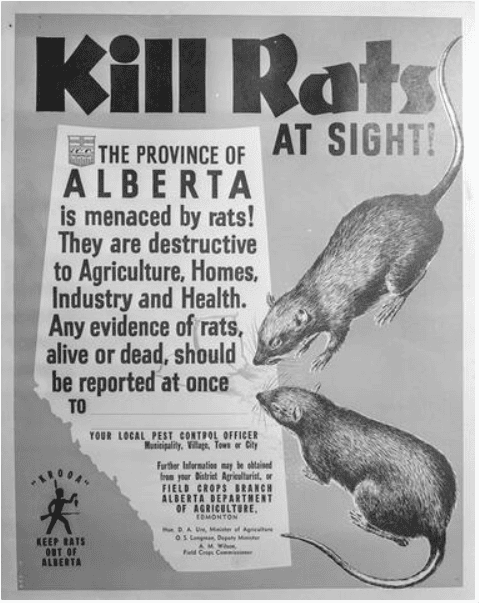
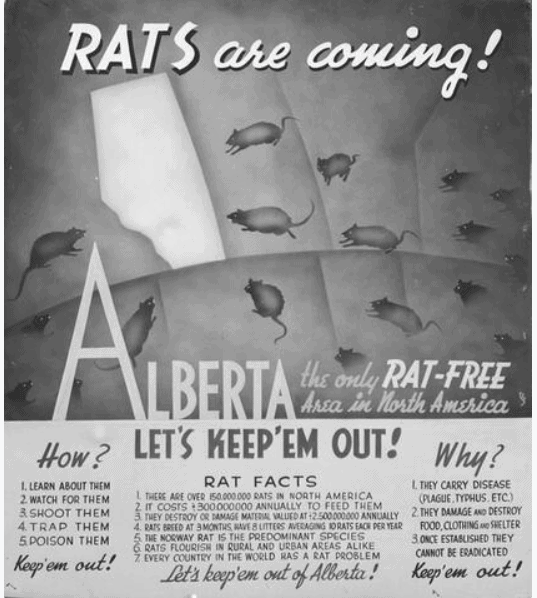
The Alberta government’s website describes rats as “the most destructive vertebrate in the world.” Photos: Provincial Archives of Alberta
Himsworth is also a clinical associate professor in the School of Population and Public Health at the University of British Columbia and the B.C. regional director for the Canadian Wildlife Health Cooperative.
The Narwhal asked her to explain why we’re doomed to lose this war, what cities should be doing instead — and if we really need to be afraid of rats. (We also asked if rat kings are real. No spoilers!)
This conversation has been edited for length and clarity.
News stories report rankings of Canada’s rattiest cities, and I’ve read that warming temperatures will spur on even more rat population growth. Are rats about to take over?
There’s not really any empirical evidence to say how many rats there are or the degree to which the rat problem is increasing. No one’s been able to figure out a good way to count rats across the landscape.
When you look at the impact of climate change, there have been some that have hypothesized that just strict warming will stimulate increases in rat populations because it will do things like prolong the breeding season or prevent freezing cycles that might reduce food sources for rats. I don’t think there has been great evidence to show that that’s the case. I mean, rats exist on every continent except Antarctica, and they exist in places that are bitterly cold.
Instead, I hypothesize that climate change will impact rat populations in terms of the societal chaos that it causes. Rats really capitalize on chaos. For example, natural disasters like floods that disrupt garbage collection and waste management and allow the accumulation of waste that will serve as resources for rats.
You’ve been researching rats for over a decade with the Vancouver Rat Project. What are the key things that you’ve learned?
We were looking at how different cities approach rat management, with the belief that someone must have figured this out. But unfortunately, rather than finding the solution, we were able to identify a very entrenched problem, which was really a barrier to success, almost globally.
I call the way we approach rats and rat management the ‘war on rats mentality.’ This is the idea that the way to deal with rats is to kill as many as you can wherever you find them, which has quite a few parallels to the war on drugs. The way we will deal with drugs is by taking as many drugs off the street, making drugs illegal. We’re just going to try and get rid of this entity or substance that we perceive as being harmful. And now we realize that ‘war on rats’ mentality wasn’t working for two key reasons.
One, winning a war requires an inordinate amount of resources, both in terms of cash and labour. With all of the issues facing society today, no program is ever going to be funded sufficiently to win the war on rats or to really eliminate or substantially reduce rats across the landscape.
The second is that the ‘war on rats’ mentality doesn’t take into account the complexity of the rat problem. We kind of have a good idea about how to get rid of rats on a property. A city is just a bunch of properties side by side. So if we just do the same thing many times, then we’ll be successful across the city. But it doesn’t take into account the complexity that comes with scaling.
We need to take a more nuanced and systems-based view of rats in order to start addressing the problem.
What makes it so complex?
The number of rats, or even the rats themselves, are not the main problem.
If I told you there were rats on the moon, you probably wouldn’t be as concerned as if I told you there were rats in your kitchen. So really, the harm occurs at this interface between rats and people. Sometimes it’s a mental health impact, sometimes it’s a physical health impact, sometimes it’s damage to your vehicle.
You can look to the ‘war on drugs’ and how one of the different approaches was harm reduction. Rather than just getting rid of all the drugs, can we find ways to reduce the harms that drugs cause? And so we’re trying to borrow some of that thinking when it comes to rats. Rather than just indiscriminate removal of rats from the landscape, can we actually look at where harms are occurring and have more targeted interventions. That may include reducing the number of rats, but may be actually more focused on the harm.
What does a ‘harm reduction’ approach look like when dealing with rats?
We did a study looking at the mental health impacts of rats on people living in Vancouver’s Downtown Eastside. This is a really, really marginalized community. We found that exposure to rats caused a variety of negative psychological impacts. If you had rats in your living space, then people were losing sleep. They were feeling anxious.
There was also a more powerful undercurrent where rats were really symbolic of the lack of an individual’s control over their living environment. There’s a feeling of disempowerment and neglect by the municipal government and overall poor environmental health.
Just going into these single-room-occupancy hotels, killing all the rats and leaving them as they are is ultimately not going to solve the broader public health issue, which has to do with the living environment.
In that case, it could look like working with the city and looking at alternative approaches like improving bylaws that enshrine the right of tenants to a healthy living environment. Improving the overall upkeep, hygiene and waste management.
Those actions will have a byproduct of reducing the number of rats, but will create a healthier living space for these individuals beyond what would have been achieved by just killing the rats.
What are the underlying problems rats can help illuminate?
When you see a rat problem, the first question to ask is: What are humans doing that is providing resources allowing rats to exist in that space?
Maybe it’s having buildings that are made in a way that have opportunities for rats to invade, or the frequency of garbage collection, or the design of garbage bins, or how garbage is used or the way we design green spaces.
Can we invest in responses that will address the rat problem, but also make the overall urban ecosystem healthier and more resilient?
Could we provide homeowner grants that would both make homes more energy efficient and make them refractory to invasion by rodents?
Another program I like is the Urban Gleaners. We have urban fruit trees and when that fruit falls, it serves as a food source for rats. But wasted fruit is also wasted food. Rather than putting rat traps around these fruit trees, could we actually take that same amount of money and get people to harvest the fruit? To me, those sorts of approaches are ultimately more fiscally responsible and sustainable than reverting to the ‘war on rats’ mentality.
How do you actually implement a rat strategy focused on harm reduction?
We’re working on creating new ways to measure the rat problem that combine the relative number of rats with the harms rats are causing in specific circumstances.
Ultimately, what we’re hoping to do is create what we call a rat risk index. This new metric helps cities figure out where they should prioritize their resources and interventions. It also gives a more meaningful metric of success.
Let’s say, we’ve invested a lot of money in making rat-proof garbage cans. Are there less rats after the garbage can intervention than before? It’s trying to figure out ways we can create rat estimates in a way that are meaningful for prioritizing intervention and evaluating success.
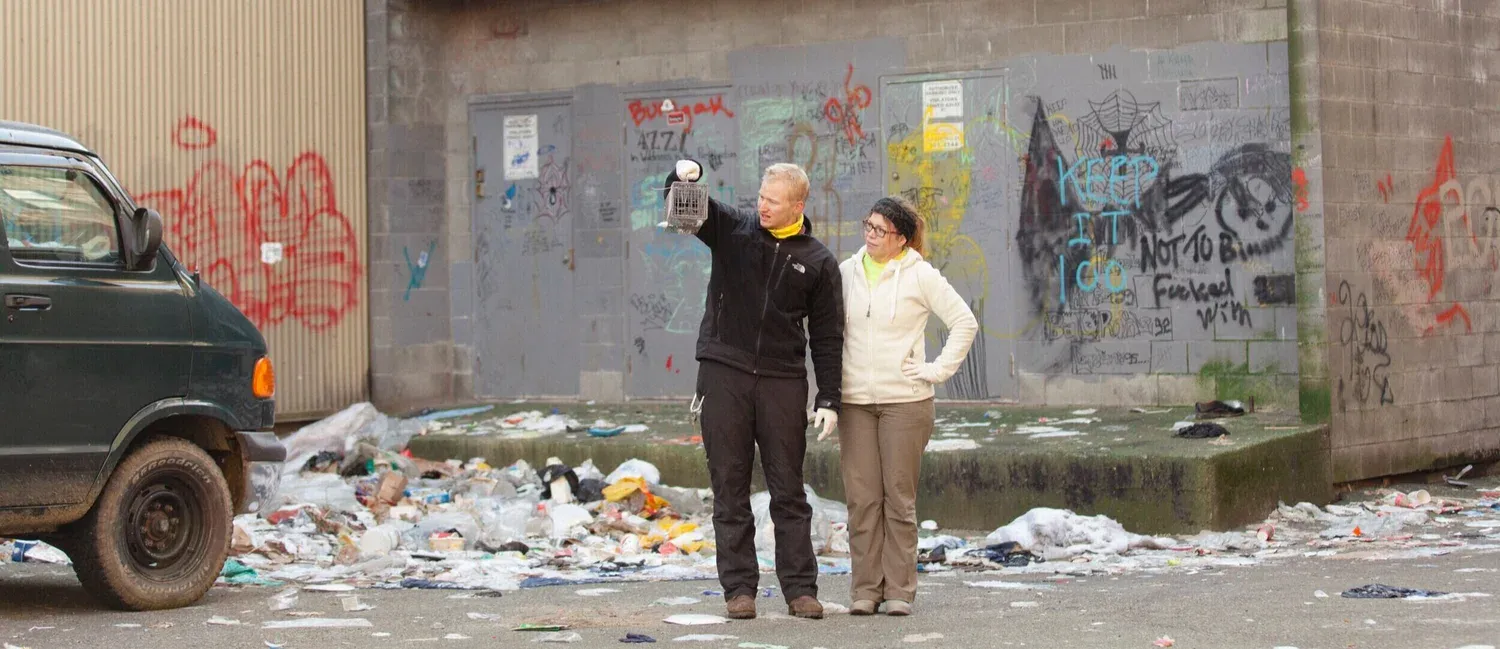
The Vancouver Rat Project is working to understand more about rats in cities, what risks they pose and how to manage them. Photo: Vancouver Rat Project
A rat infestation in an abandoned house is probably not as harmful as a rat infestation in an airplane hangar, because the potential for harm of rats damaging aircraft is much greater than rats damaging an abandoned building.
If I have a limited number of resources, I want to address the rats in the airplane hangar first. You can apply that across a broad range of scenarios.
What are the benefits of rats?
This is a tough question to answer as there has not been much research on the benefits of rats compared to the harms. It has been postulated that rats may serve as a food source for native predators, although this might actually be a harm if those rats have been exposed to rodenticides, which can then poison anything that eats them. They may also play a role in soil turnover, seed dispersal and removing waste from the landscape.
What’s your go-to, fun fact about rats? Maybe your icebreaker at a party?
Rats in the wild only live for a year. Why don’t we see dead rats everywhere?
We were looking at the livers of rats from Vancouver and we saw they all had this parasite called Capillaria hepatica. The only way for a rat to get infected is basically to eat another rat’s liver. So, rats, in the secrecy of their underground homes, are engaging in the practice of cannibalism. I guess a dead rat is another food source. You don’t want to have your dead friends and family accumulating in your house. It’s a way to sort of clean up.
So they’re eating their dead.
That’s our suspicion.
Okay. Wow. If this was your fun party fact, I would stay to keep talking to you. Can you make the case on behalf of the rat why we should not fear them this Halloween?
Rats have been our strange bedfellow since the dawn of civilization, and as such, we have a very complicated relationship with them. I understand the many ways in which we have been programmed to fear them. It makes sense, but ultimately that fear is hindering us having an effective and efficient response to our rat problems.
So I would say engage in the cultural fear of rats for Halloween, but on Nov. 1, go back to recognizing they are species of wildlife that need to be managed and proceed as such.
My last question is: are rat kings real?
That is a holy grail for a rat researcher. I think our best titled paper ever was called, “The Secret Life of the City Rats”, because it’s astonishing that although they exist beneath our feet, their goings on are still a mystery to us. Whether they all get stuck together by their tails is another mystery to add to the lore.
The Narwhal’s reporters are telling environment stories you won’t read about anywhere else. Stay in the loop by signing up for our free weekly dose of independent journalism.
From The Narwhal | News on Climate Change, Environmental Issues in Canada via This RSS Feed.