

[Content warning: Racism, child sexual abuse]
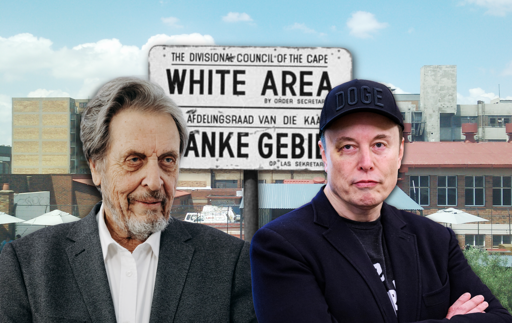
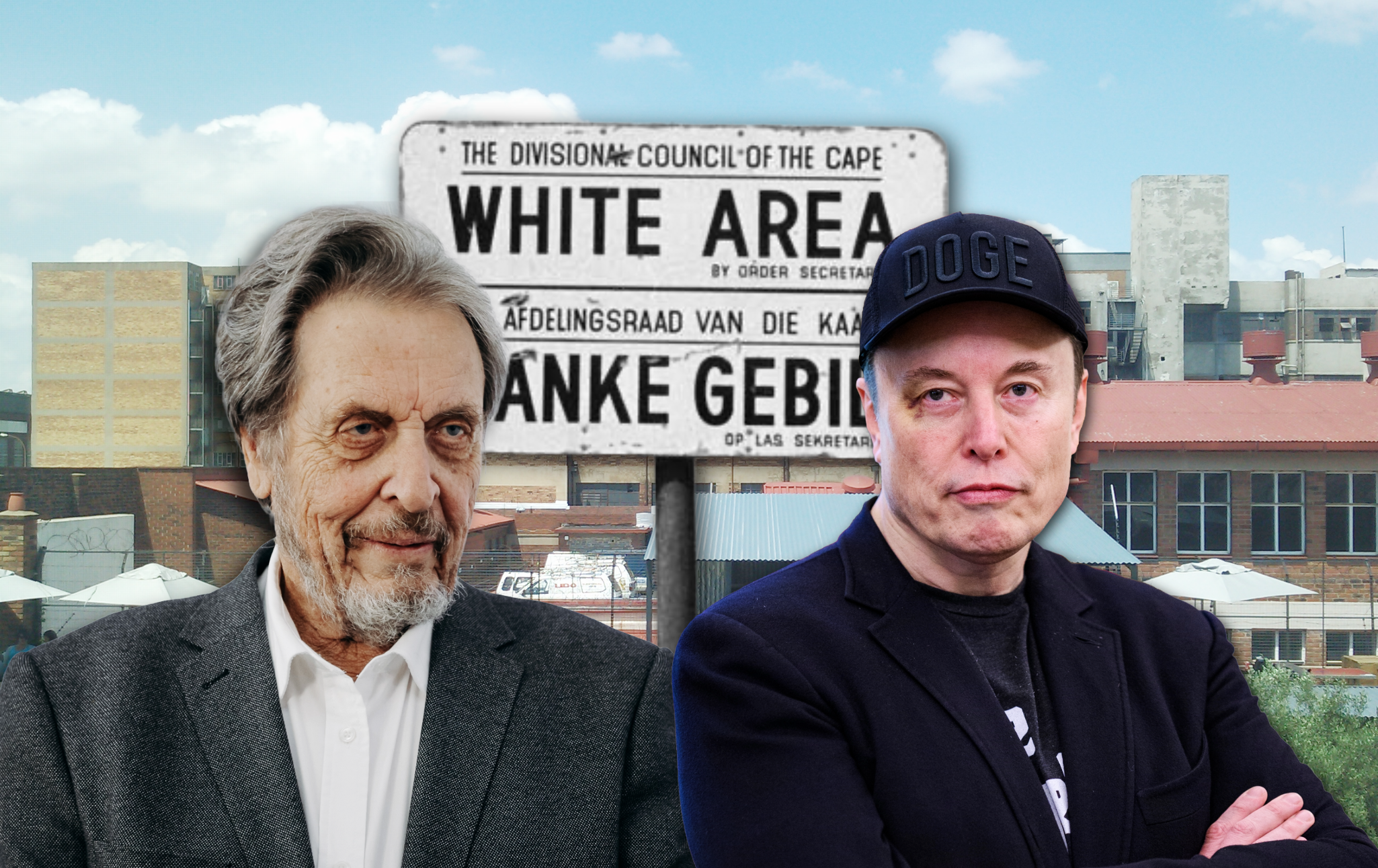
At 80 years old, Errol Musk, father of Elon, has the look of a demonically aged Hugh Grant. When he speaks of South Africa, he doesn’t waver on the main point: “we never saw this oppression you’re talking about.” Actually, “we gave them [Black South Africans] work. We fed them.” So, over the course of the 20th century, they “grew from a tiny little group into a massive group.”
The storytelling style of apartheid lives on long after the system has passed away. The benevolence of the better races: it was the theme of government television from my own childhood in South Africa, revivified on YouTube in Errol’s archive of interviews and meditations. Errol’s garrulousness brings back something painful and half-forgotten, but above all something which seemed to be as obsolete as Soviet propaganda. Some South Africans celebrate the Musks for their success, unconventional methods, and apparent candor in an age of political correctness. But many more of us, I suspect, hear more than an echo of past oppression, and we have more than a suspicion of what they are bringing back.
It’s a rule of human nature that the dominated are students of the dominators, and in any case our memories are longer. During the apartheid era, South Africans of Indian ethnicity had plenty to study. We grew up under laws which not only denied us the vote but kept us out of most cinemas and libraries and beaches, off certain streets in the city centers, and out of an entire province. Indians, regarded with particular suspicion, had to apply for permission from a cabinet minister to spend a night inside the bounds of the Orange Free State. I remember my father speeding along the highway so we wouldn’t be caught inside the provincial boundaries after dark.
Errol’s pronouncements, delivered deadpan on YouTube, bring back the horrible comedy of the old white South Africa. It was based, above all, on the dubious generalization. To the Spectator, Errol speaks in the same alternately halting and rapid-fire speech and with the same preternatural confidence as his son: “amongst the blacks I don’t believe statistics are kept.” To Middle East Eye: “A country is as good as the white population that lives there.” In the future, he predicts that “all the white people in the world, in 80 years’ time, are all going to be living in Russia,” an idea Errol may have learned from Vladimir Putin during their “brief but memorable” meeting.
In recent years, Errol has become a star of the international right. He seems to enjoy the standing of father of the world’s first trillionaire, starring on the “Dad of a Genius” YouTube channel: “I am probably the best father ever, based on what people have told me.” The self-praise is untempered by the allegations of child sex abuse, regarding his own children and stepchildren, which appear and vanish from the news without obvious consequence. The sins of the father are his own, but his style is now the house style of the world’s richest man, and everybody’s concern.
Elon Musk’s success, along with his overbearing presence on social media, his abrupt removal from Pretoria to Saskatchewan at the age of 17, and the uncertain national attachments of the tech elite, have obscured the influence of his father. The establishment view, as set out by celebrity biographer Walter Isaacson, notes the school bullying and the ambient violence, but assimilates the Musks, despite the latitude, to something like a suburban, lower middle-class, troubled household of the Midwestern United States. A South African is less likely to make the same mistake. If both countries are saturated in violence and domination, I would still argue that there is an essential distinction. Think about the late-life machismo of Jeff Bezos compared with the much stranger phenomenon of Elon, his children, his self-pity, and his concubines.
As is well-known, all of the so-called “PayPal mafia”—Musk, Peter Thiel, Roelof Botha, and David Sacks—spent some part of their childhoods in southern Africa in the 1970s and 1980s. But Botha and Sacks are conventional business figures, something which cannot be said for Musk. Nor for Thiel, who advertises his fear of the Antichrist (manifested in the form of Greta Thunberg), expresses disinterest in the continuation of the species, and venerates the literary theorist René Girard. Musk and Thiel are not just the first among equals however. In his recent, uneven book on Muskism, Quinn Slobodian fits Musk into an ill-suited conceptual structure by presenting him as the leading figure in the global privatization of state infrastructure. True enough, but indistinct.
Elon himself, a squid with a large reservoir of ink, does his part to sow confusion about his origins. He claims to have no knowledge of an emerald mine which underwrote his family’s wealth, but Errol reveals that he obtained a regular supply of emeralds from “Katanga mine in Zimbabwe,” and that Elon helped to sell them.
The Musks were acquisitive, and money came easily in a segregated and exploitable country. According to Errol, “we had our own airplane. We had our own ocean-going yacht. We had our own bush lodge. We had our own airstrip.” His reminiscences turn to the Rolls Royce which took Elon and his brother Kimbal to their school, the showjumping horses ridden by both boys in what was then open space around Pretoria, and the spare beach house near the Oppenheimers, presumably on Milkwood Lane in Durban, where Errol would stash an estranged wife, along with the “ocean-going yacht” he sold for a partial stake in Elon’s early ventures. There was a lake house, tennis court, and ski boat. Decades later, as father of the richest man in the world, Errol would summarize his values: “I have a Rolls Royce in the garage. I have a Bentley here. These are things which matter to me.”
Errol’s own parents were on shakier financial ground. His father served as a cryptographer in the Second World War, but, according to Errol, was “totally wrecked” by the experience. He became an alcoholic, and made his way from Britain to the sunshine and possibilities of Johannesburg. Errol’s mother was a seamstress who supported the family by her work with a prominent furrier.
Elon’s maternal grandfather was the glamorous predecessor. Joshua Haldeman, born in Minnesota, raised in Saskatchewan, cowboy, pilot, and technology enthusiast, was a futurist: “Let us wake up to the physical possibilities of a greater living.” He was also a fascist, promotingThe Protocols of the Elders of Zion and leading an authoritarian party with its typical style of salutes and uniforms, admiring of its German counterpart. In 1940 Haldeman was detained in Canada on account of his political leanings. A decade later he moved to South Africa as a freefloating supporter of white supremacy, worked as a chiropractor, and searched the Kalahari desert for a lost city. South Africa, with its relative wealth, advanced industry based on mining, and absence of regulation and morality, was a promised land of sorts. Haldemans and Musks could give free rein to their eccentricity, pursue a kind of Mad Max technicism, and adopt the posture of political innocence and race crankery. The limits were natural, not social. In 1974 Haldeman died at the age of 71 when his light plane struck a power line.

The insistence on hierarchy runs deep. In an interview, there is no pretense from Errol or Elon at conversation among equals. Instead, there is a ready resort to hostility, naked assertion, and badgering in the face of questioning. Almost every sentence Elon or his father utters is intended to maximize utility, either to glorify the speaker or promote his financial or supposed ethnic interests. To speak in that way, I suggest, it helps to grow up in a place where each encounter is a chance to wield language as an instrument of exploitation—to bark orders or issue reprimands. I mean a place like apartheid-era South Africa—or the small, insular world of New York real estate dealings. Errol saw the parallel immediately: “Trump. He’s just like us. I looked at Elon and Kimbal and I said, ‘he’s the same as us.’”
Who is “us”? It is the Musks, the Haldemans, the Trumps, not me, most likely not you. Yet I grew up in South Africa around the same time as Elon. We may have been in the same places, and we shared certain interests like, for example, computer programming. I had a ZX Spectrum, a hobbyist’s computer which plugged into a television and stored programmes on a music cassette. Elon, according to Errol, had a Commodore Vic-20 and later a powerful and very expensive IBM. Characteristically, at the age of 11, he managed to monetize his coding skills by publishing the test of a game he had created, “Blastar.”
Naturally there were significant differences. The segregation of beaches, schools, and parks was one, along with the designation of separate shopping streets for different races in the center of town. Libraries and movie theaters began opening to all in the mid-1980s. I sometimes seemed to be the only person in the city of Durban attracted to the science fiction and fantasy shelves of the central library, and to the almost deserted morning shows in the arthouse cinema in the main business district. Together they carried the Golden Age and New Wave titles Elon cites as inspiration. Star Trek II: The**Wrath of Khan was a supposed guide to the activities of DOGE in 2025. Stranger in a Strange Land and The Hitchhiker’s Guide to the Galaxy relate to his chatbot Grok. Elon refers to Dune in connection with his social media activity (“who controls the memes, controls the universe”). As a way of representing his entire career and its galactic significance, he turns to Isaac Asimov’s Foundation series, picturing himself as a kind of Hari Seldon figure charting the future path of humanity.
In the world of school science and technology, physics and math Olympiads, computer shops, and science fairs, I may even have crossed paths with Elon, but there wouldn’t have been a connection. You sense from Errol the privileged isolation of the Musks and Haldemans. They weren’t connected to their own communities, which is something of a paradox given the depth of their ethnocentrism. In his 20s Errol laid the foundation of his fortune with a private engineering company, but to judge by his own reflections, money and a conviction of his own talent created a great deal of isolation. “The more brain you have,” as Errol later put it, “the harder it is.”
It was harder on those around him. Maye, Elon’s mother, by her own account, “came back from the honeymoon bruised and pregnant.” Her former husband denies it but, like their eldest son, he asserts a certain seigneurial privilege. When pressed decades later on marrying his own stepdaughter, Errol saw the situation in a grander context: “For the ordinary folk it might be a bit out of the ordinary[…] but as you move in society, as I say, if you move up to the Royal Family they do weird things.”
Coldness was a constant. It is evident in the kinds of stories Errol relays in his role as biographer to his son: “This little boy [Elon’s classmate] actually discovered his father hanging [the man had died by his own hand]. Which is pretty rough. But in South Africa it’s pretty normal.” Errol’s deadpan is the mask of a certain kind of comedian: “Elon made the mistake of saying to this little boy, ‘your father was stupid.’”
This nerd machismo, father and son milking disturbing material for shock and laughter, intensified in the decades after the 1994 elections which brought Nelson Mandela to the presidency. In his interactions with foreign journalists Errol likes to tell the story of a 1998 home invasion. He claims to have fought off many attackers with a shotgun: “As soon as they saw me, they started shooting at me. They opened up on me. I killed three.” The rest, he says, “started running; I think they’re in Cairo now!”The punchline sets up a charged reverie about the gruesome scene: “One bullet went through two of them. I took the first guy out through the head. The police found him with the top of his head missing.” Finally Errol introduces the presence of his young daughter who, during the exchange of fire, has been “standing behind the bathroom door without any clothes on.”
In relating his stories Errol, like his son, is attracted by the most sensationalist possibility: “I was told the likelihood was that they [the intruders] would have used her for muti.” He means the practice of killing for magical purposes, using body parts in traditional rituals, which has sometimes victimized albino and other vulnerable children and women. The frequency of such killings is a contested question, but there are no documented incidents involving white children.
The sinister storytelling style of the Musks has a source in the dark soil of racial rumor: muti murders, grooming gangs, antisemitic propaganda. In South Africa the stories circulate inside racial communities. They don’t necessarily enter public discourse. But if this kind of sinister rumor sounds familiar to American readers, it’s not by coincidence. In 2016 and again in 2024, Donald Trump brought the half-hidden pool of racial legend into the light with his stories of Mexican outlaws and Haitian pet devourers: “they’re eating the dogs, they’re eating the cats of the people that live there.” Trump’s refrain was immediately turned into a hit song by the alt-right DJ and South African race provocateur, The Kiffness. Game, as they say, recognizes game. Proceeds from “Eating the Cats” were appropriately dedicated to the SPCA in Springfield, Ohio. No doubt the Haitians braced themselves for what was coming.
The contemporary ascendancy of the Trumps and Musks may have other causes, but their shared passion is this dark narrative style, rooted in group animosities. In 2023, a Twitter user claimed that “[Jews] have been pushing the exact kind of dialectical hatred against whites that they claim to want people to stop using against them.” Elon’s reply: “You have said the actual truth.” Many such cases. And in waving off charges of his son’s antisemitism, Errol is pleased to say that “Netanyahu is like a family friend of ours.” A dark triad.
In 2025 the New York Times reported on three decades of alleged child sexual abuse by Errol. According to The Times:
The earliest accusation was in 1993 when Errol Musk’s stepdaughter, then 4 years old, told relatives he had touched her at the family house. A decade later, the stepdaughter said she caught him sniffing her dirty underwear. Some family members have also accused Errol Musk of abusing two of his daughters and a stepson[…] as recently as 2023, family members and a social worker attempted to intervene after his then 5-year-old son said his father had groped his buttocks. Three separate police investigations were opened, according to police and court records, as well as family members. Two of the inquiries ended, while it’s unclear what happened in the third.
The details are unconfirmed and no charges have been filed, most likely because considerable effort has been made to shield the family, but there has been little apparent remorse from any of the Musks. On YouTube,Errol sketches a portrait of the Musk men living without the need for a superego in matters of sex and reproduction: “Kimbal said, ‘oh, it’s nothing, it happens.’ He had a child with one of the girls who worked in his restaurants. I mean, you know, while he was married. So these kinds of things happen.” After all, the “only thing we are on Earth for is to reproduce.” Generous payments for silence mean that much about Elon’s procreative strategies is uncertain, but it is clear that he has at least 14 children, involving the liberal uses of technologies such as IVF and surrogacy. Many women have received offers and legal agreements offering $15 million upfront and $100,000 monthly payments in child support in exchange for confidentiality. Success, on Elon’s scale, has many fathers, but it also has many sons.
At the same time, and in some contradiction, Errol maintains a vivid conception of the corrupt sexuality of other races. “So many people here have got AIDs,” he told an interviewer in 2025, after DOGE cut funding to treat the disease, “because apparently, I’m told, if you want sex here in South Africa, you just see somebody walking along and say ‘Hey! In a bush here with me!’ So now they’ve all got AIDs. So I don’t see why Americans, who sometimes have to have two jobs, must work to pay the tax for these people’s treatment.” Errol’s projections about sexuality are a good example of how oppressive perspectives defend themselves with offhand quips and absurd exaggerations. Given the Musks’ own promiscuous conduct, they’re also highly ironic.

Like Trump, Errol’s way of speaking is engaging because of his lack of interest in presenting himself as benevolent. Nobody escapes censure. On Australian radio Errol explains that Elon “is 50 now and I still think of him as a little boy. But he’s 50, I mean, that’s an old man.” He had once believed that his son could be “retarded.” He notes Elon’s overweight appearance on a yacht, recommends his son use diet pills, and calls his younger son Kimbal his “pride and joy.” Nonetheless, Errol benefits from the proximity to Elon. He looks forward to supporting research into “spacetime travel” at the prospective Musk Institute in Dubai. As he puts it, “We have to go on with the rockets.” The criticism is mutual, as Elon has called his father a “terrible human being”—and yet the intimacy and similarity of father and son is only underlined by the occasional outbreak of animosity.
Broken marriages and children from many mothers, claims of Asperger’s and child sex abuse, unembarrassed lying and racial stigmatization, painful to watch on account of their grandiosity and self-dealing—it is tempting but inaccurate to describe the Musks, Trumps, Haldemans, and their fellow travelers as dysfunctional. In fact they are the supreme operators of the age, like an alien species growing in our midst.
South Africa has long been a funhouse mirror for the United States. The apartheid mindset of my childhood was destructive but also small-scale, squalid, and, as they used to say, backwards. The Musks, father and son, fuelled by the centralized rewards of tech markets and the general ascendancy of the super-rich as well as the fierce group identities of the social media era, project the same corruption onto a global canvas. The alliance with Trump and Vance bolsters transnational white identity politics even further. An equally lasting consequence may be something which American moguls like Bezos, Gates, and Zuckerberg have been too well-socialized and dependent on reputation to achieve: the openly feral billionaire.
It’s difficult to convey the physical and moral wreckage the apartheid system left behind, and even to remember what seemed to be, at the time, its irresistible technical and economic power. In one duo of father and son, Errol and Elon, that destructive power has revived and multiplied. South Africans know what it did to our small country. We should put considerable effort into avoiding the disaster it is bringing on the globe.
Imraan Coovadia is an author and essayist from South Africa, who currently works at the University of Cape Town. His books include The Institute for Taxi Poetry, Tales of the Metric System, and A Spy in Time.

From blog via This RSS Feed.