

Caracas, October 29, 2026 (venezuelanalysis.com) – Venezuelan Acting President Delcy Rodríguez has instructed the Foreign Ministry and the Attorney General’s Office to advance diplomatic and legal efforts to recover 31 tonnes of Venezuelan gold held by the Bank of England’s vaults for more than six years.
The freeze on the reserves, currently valued at around US $4 billion, dates back to the United Kingdom’s refusal to recognize Nicolás Maduro’s 2018 reelection. A year later, opposition leader Juan Guaidó formally asked British authorities to prevent the Venezuelan government from accessing the gold.
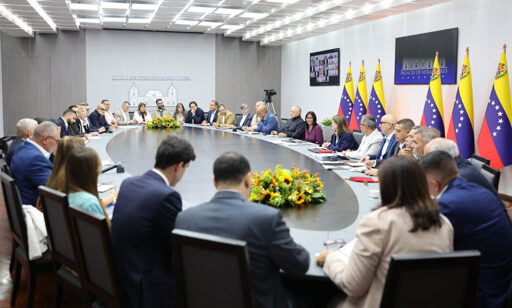
During a cabinet meeting on Wednesday, Rodríguez described the ongoing freeze as a theft.
“It is a mockery, but one aimed at illegitimately appropriating Venezuela’s gold reserves. We want no more excuses. Even the irrational lawsuit pursued by opposition factions was withdrawn by the very same people who brought it,” she said.
Rodríguez added that she “will not give up” on the claim and recalled that “there is an agreement among Venezuela’s political sectors” to secure the gold’s return.
The Venezuelan government and an opposition sector representing the defunct 2015 National Assembly have been engaged in a US-backed dialogue process. On October 21, the delegations agreed to establish a joint commission to engage with London and seek the return of the reserves. The parties announced that the funds would be destined for post-earthquake reconstruction efforts, though Rodríguez has also pledged to use it to bolster public services and the electricity grid.
The acting leader had previously written to King Charles III requesting the release of the gold. In September, London and Caracas likewise began a diplomatic rapprochement and announced plans to appoint ambassadors to their respective missions.
According to reports, the Venezuelan gold is set to be transferred to the US Federal Reserve in New York, where its sale or use as collateral for loans would be contingent on the Trump administration’s approval and subjected to foreign audits.
Wednesday’s cabinet meeting additionally saw Rodríguez announce the arrival of 41 heavy machinery units to southeast Bolívar State to strengthen the Venezuelan Mining Corporation’s (CVM) operations at the Chocó plant.
The acting president said the delivery was part of a comprehensive state plan to acquire 544 pieces of equipment, including surface and underground machinery, drilling equipment, and mobile units.
“More than 60 percent of this purchase will have arrived before the end of the year. What does that tell us? More gold production in 2027,” she affirmed. The Venezuelan executive has pushed a pro-business overhaul of mining legislation in recent months in a bid to court foreign investment. In September, New York-based Heeney Capital and commodities trader Mercuria Energy received a 30-year concession of the Chocó 10 mine in Bolívar State.
Rodríguez also promised short-term relief from electricity outages, often lasting up to 12 hours a day in certain parts of the country. However, she criticized the recurrent protests against blackouts
“I have not seen a single megawatt added to the national electricity system, which has been battered by the blockade, as a result of burning a tire (…) Soon, you will see relief in a country that has been hit so hard by the sanctions demanded by radical sectors,” she said.
Venezuelan authorities have pledged to restore 1,300 MW of generation capacity before the end of the year to mitigate a current deficit of around 4,500 MW. The Venezuelan National Assembly is close to approving a reform that will open electrical generation, transmission, distribution, and commercialization to the private sector.
Caracas has also turned to multinational corporations in a bid to recover the electrical grid.
However, GE Vernova CEO Scott Strazik stated that the company had already selected its contractors and completed the planning work but had not begun repairs because it has yet to be paid. “This is not an environment in which we are going to act without receiving payment upfront,” he said.
Meanwhile, popular organizations and trade unions staged demonstrations in Caracas and other cities on Tuesday. Through the newly formed “Blackout Victims Committee,” activists criticized the government for prioritizing the oil industry to satisfy US interests at the expense of rationing electricity throughout the country.
Edited by Ricardo Vaz in Caracas.
The post Venezuelan Gov’t Demands Return of UK-Held Gold, Eyes Production Increase appeared first on Venezuelanalysis.
From Venezuelanalysis via This RSS Feed.