

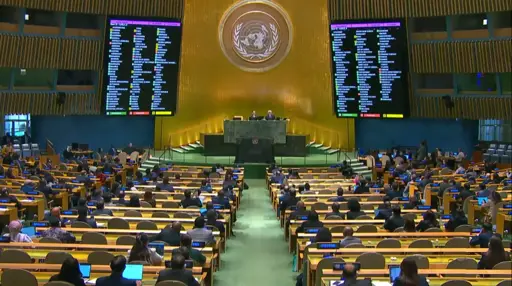
On Wednesday, for the 34th time, the United Nations General Assembly (UNGA) rejected the economic, commercial, and financial blockade imposed by the United States against Cuba. The draft resolution, titled “Necessity of ending the economic, commercial and financial embargo imposed by the United States of America against Cuba,” was approved with 130 votes in favor, 17 against, and 25 abstentions. The UN’s highest deliberative body has spoken out against this unilateral policy with full support for Cuba every year that the resolution has been proposed since 1992.
The vote took place after a debate in which most delegations agreed that the White House’s economic war constitutes the main obstacle to the island’s development and affects the rights of its population.
On the outcome of the vote, Cuban President Miguel Díaz-Canel said on social media: “The world has once again spoken out overwhelmingly against the blockade, even above the most gross pressures and blackmail by the US to change the course of this vote.”
Vote and positions
The approval came in a context of intensified US aggression. According to the text presented by Cuba, between March 2025 and February 2026, the damage attributed to the blockade amounted to US $8.0833 billion, 7% more than in the previous year.
The document also estimates that accumulated damage over six decades totals more than US $178.7 billion at current prices. These figures were included in the Cuban report presented to the United Nations as part of the argument in favor of the resolution.
Most of the states participating in the plenary condemned the continuation of the measure. The Global South backed the Cuban proposal in solidarity and forcefully, with nations from Asia, Africa, and Latin America playing a leading role, along with world powers such as Russia and China.
Venezuela’s delegation could not vote because it is a blockaded nation and cannot participate, as it does not meet the economic commitments required for UN membership. Since 2015, unilateral and illegal coercive measures have been applied against Venezuela which, among other serious damage, exclude it from the international financial system. Because of this, it is not allowed to pay its dues, and its right to vote as a founding member has been suspended.
The vote took place despite US diplomatic pressure, condemned for weeks by Cuba’s Foreign Ministry, which stated that Washington exerted blackmail to coerce other countries and force them to change their traditional solidarity with Cuba and rejection of the US blockade.
This victory of the Cuban people in defense of their right to a dignified life was not without moments of tension and audacity. Lacking arguments to sustain its policy of asphyxiation, the Trump administration resorted to lies to try to blame Cuba for the lack of fuel, the acute shortage of medicines and food, and the prolonged power outages caused by the US criminal blockade.
Cuban Foreign Minister Bruno Rodríguez Parrilla showed that the US representative, Mike Waltz, was lying to the General Assembly and offending the dignity of his people and government. With his determination, the Cuban diplomat forced the chair to enforce the Assembly’s rules.
While Cuba stood up to the White House’s arrogance, a US official filmed Cuban diplomats with intimidating intentions, which prompted a response from Richard Tur de la Concepción, first secretary of Cuba’s Permanent Mission to the UN. Hours later, Waltz boasted to US media that Secretary of State Marco Rubio had ordered the expulsion of the Cuban diplomat.
Effects on the population
During the debate, Minister Rodríguez maintained that US policy has direct consequences on the daily lives of the population. “No people deserves the abuse and suffering that is being imposed on us today,” declared the head of Cuban diplomacy, referring to the economic and human losses attributed to the blockade.
Rodríguez stated that the hostile measure affects essential areas such as food production, access to medicines, transportation, health services, and the supply of water and electricity. He also referred to the reported increase in infant mortality in Cuba, which according to his speech exceeded five percentage points due to the intensifiction of the US blockade under the Trump regime and the naval encirclement of Cuba throughout 2026.
The blockade is not a diplomatic abstraction but a policy with concrete effects on the living conditions of millions of people, noted the Cuban foreign minister. The approved resolution included, for the first time, a reference to the energy blockade and the collective punishment against the Cuban population.
Intensification of aggression against Cuban families
Since January 2026, Washington has applied a policy of oil asphyxiation while Cuban commercial operations are blocked. The island’s delegation denounced that these actions seek to cause damage and destabilize the country through the deterioration of economic and social conditions.
In the run-up to the vote, the US threatened sanctions to pressure other sovereign states. These pressures included the possibility of applying eventual punitive tariffs, visa restrictions on officials and their families, and warnings about possible effects on electoral processes and international trade.
International context
The UNGA resolution is non-binding, but it constitutes an indicator of the majority position of the international community. Since 1992, the General Assembly has annually debated the end of the economic, commercial, and financial blockade imposed by the United States against Cuba, with votes that have varied according to the political context.
The document reaffirms principles such as the sovereign equality of states, non-intervention in internal affairs, and freedom of international trade and navigation. It also calls on states to refrain from applying laws and measures with extraterritorial effects that contravene those principles.
With Wednesday’s vote, the international community reiterated its majority position in favor of lifting the blockade. The resolution recorded the rejection of a unilateral policy that continues to affect economic development and the Cuban population’s access to basic goods and services.
(Telesur)
Translation: Orinoco Tribune
OT/JRE/SL
From Orinoco Tribune via This RSS Feed.
The USA blockades Cuba because it’s a “communist” country and communism “always fails”.
But Cuba is failing because of the decades long sanctions and the recent blockade.
Sure seems like a case of “quit punching yourself”.
