

Bullets:
The War on Iran, and the subsequent closure of the Strait of Hormuz, forced energy buyers to source crude oil and refined products from the United States.
But US exports of crude to Asia have since collapsed, and are plumbing multiyear lows.
Oil transport costs have skyrocketed, making American oil shipments to Asia non-competitive.
Industry insiders strongly suspect that the increased oil flows through the Persian Gulf are a result of oil suppliers quietly paying Iran for safe passage through the Hormuz.
Middle East suppliers are also selling oil on a “delivered basis” to buyers in China and India, thereby assuming all the transport costs and insurance risks.
Inside China / Business is a reader-supported publication. To receive new posts and support my work, consider becoming a free or paid subscriber.
Report:
Good morning.
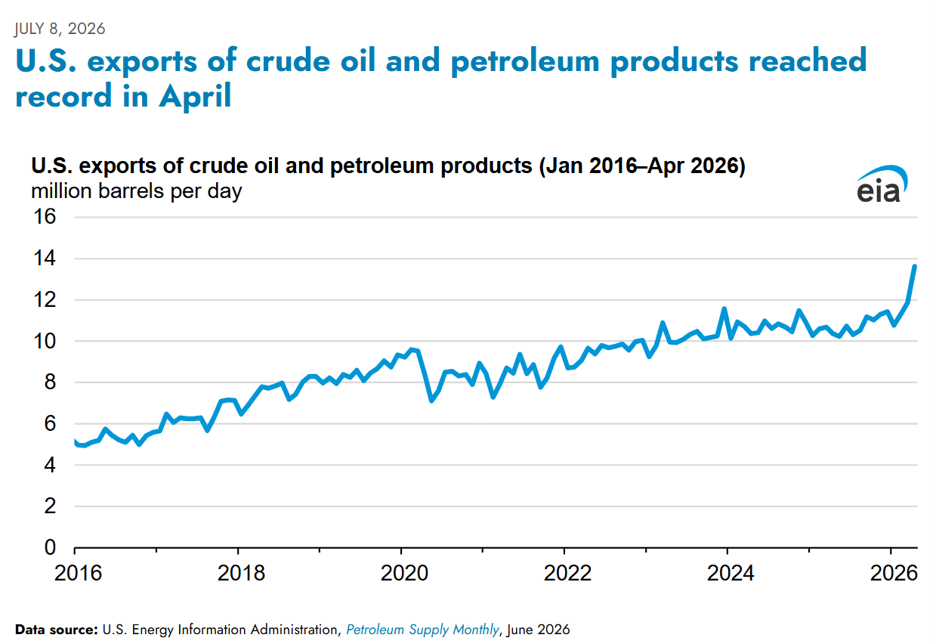
In the early days of the war on Iran, and the closure of the Strait of Hormuz, exports of energy from the United States hit record highs. In April, exports of crude and refined products were 13.6 million barrels per day, over a million barrels per day higher than in March, which was the previous record.
But supply chains adjusted, and did so in very unexpected ways. It’s six months later, and severe shortages of oil tankers, and the new energy market work-arounds, mean that American crude oil is simply not price-competitive in the rest of the world. This seems counterintuitive at first, given that US oil price benchmarks are still lower than almost anywhere else. The problem is the cost of everything else. Leasing an oil tanker from the United States to Asia now costs nearly $80 million, and refineries in Asia are ironically paying a lower all-in price to get energy from suppliers in other markets.
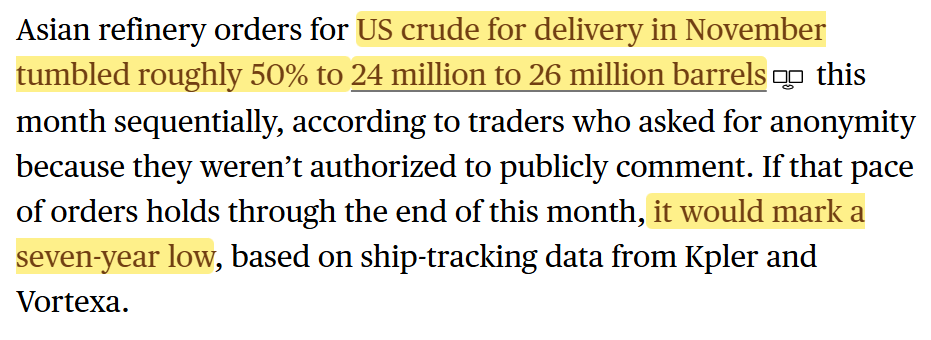
Crude oil shipments from the US to Asia for next month—these are for November contracts—are at the lowest point in seven years. Overall, US oil exports are far off those record highs earlier in the year.
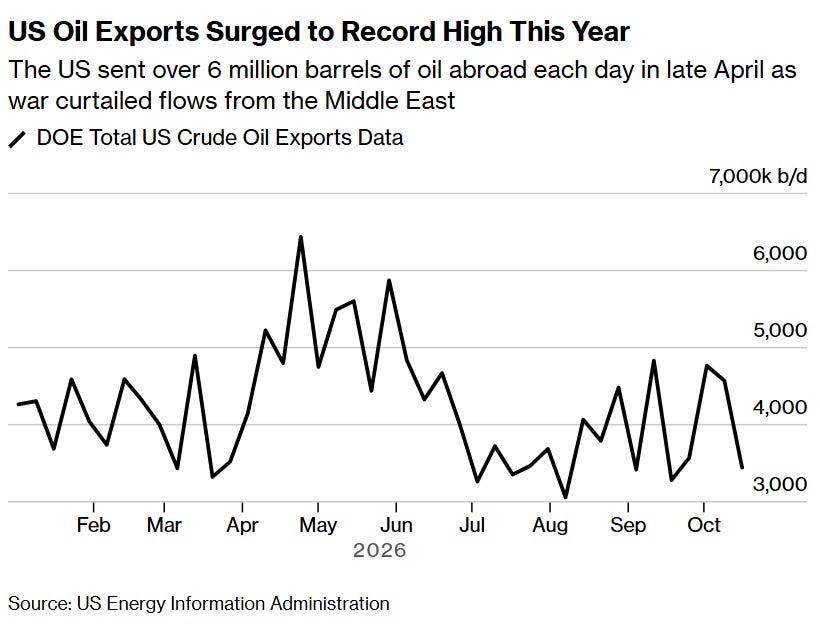
(Quick point: the previous chart is for crude oil plus petroleum products, and this immediately above is for crude exports only)
And again the problem is an acute shortage worldwide of oil transport. The higher shipping costs translate immediately into higher landed costs to the buyers, so refineries in Asia are spending over $30-$40 per barrel just to haul it from Texas or Louisiana. Last year, that number was about $4 per barrel.
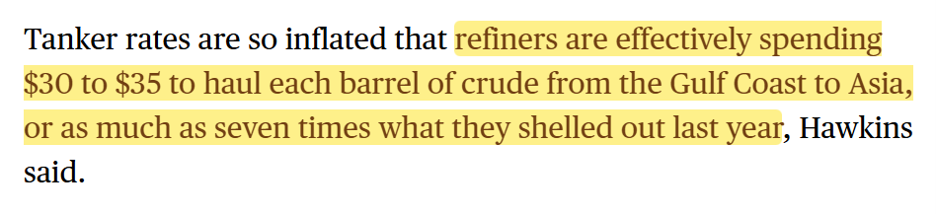
The reason that fewer oil tankers are available to make the long haul from the US Gulf Coast to Asia, is that many more of them are needed for the complex operations to get oil from the Persian Gulf.
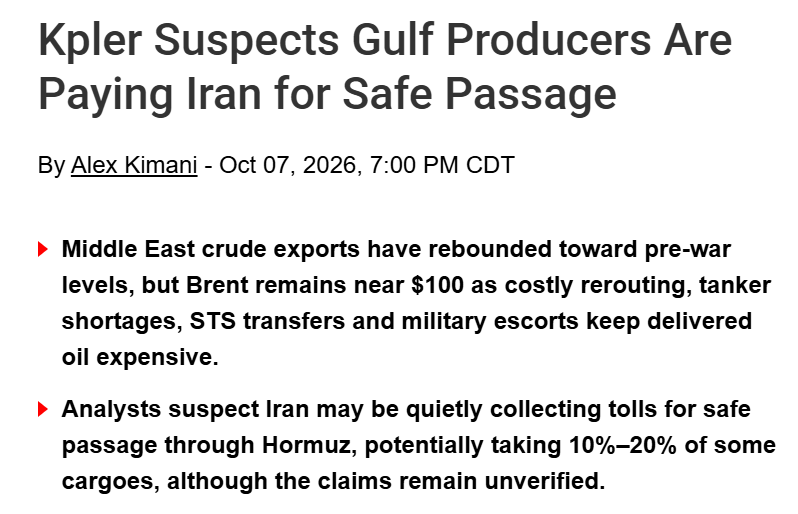
This above is speculative—it comes from Kpler. Analysts there believe that Iran is collecting tolls from some ships in exchange for safe passage through the Hormuz. If they’re right, Iran is getting 10-20% of the total cargo values from vessels who pay in advance, and those costs are passed along to final buyers.
We’ll repeat that this is not confirmed, but it does help explain a lot. Given that the shipping cost from the US to Asia is running over $30 a barrel, oil producers could quietly pay Iran $20 a barrel, and the final cost to oil buyers in Asia would still be lower than sourcing the crude from the US.
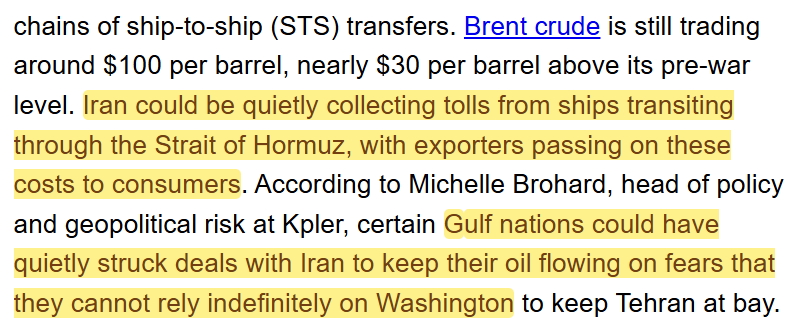
It also explains the surge in the oil flows outbound the Persian Gulf. The Pentagon claims that the Hormuz is open, and that the US Navy is successfully herding oil shipments out of the Persian Gulf. But the VLCC’s—the very large crude carriers—are still reluctant to go through. Oil transport companies use small tankers to get them through the Hormuz, then are loaded onto VLCC’s outside the Gulf for final delivery to Asia.
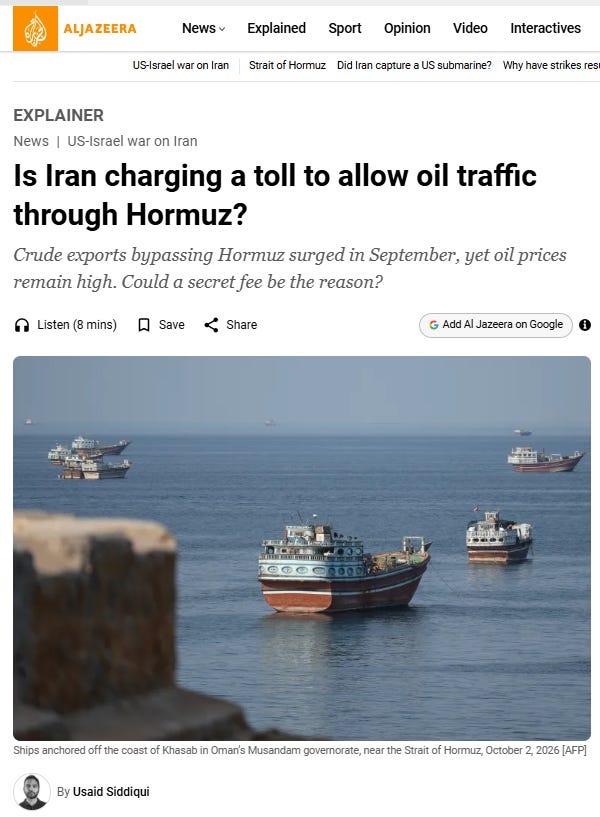
Analysts suspect instead that oil producers know that the United States cannot guarantee the safety of every ship, so it’s just easier to pay Iran and let the US Navy take credit for safe passage.
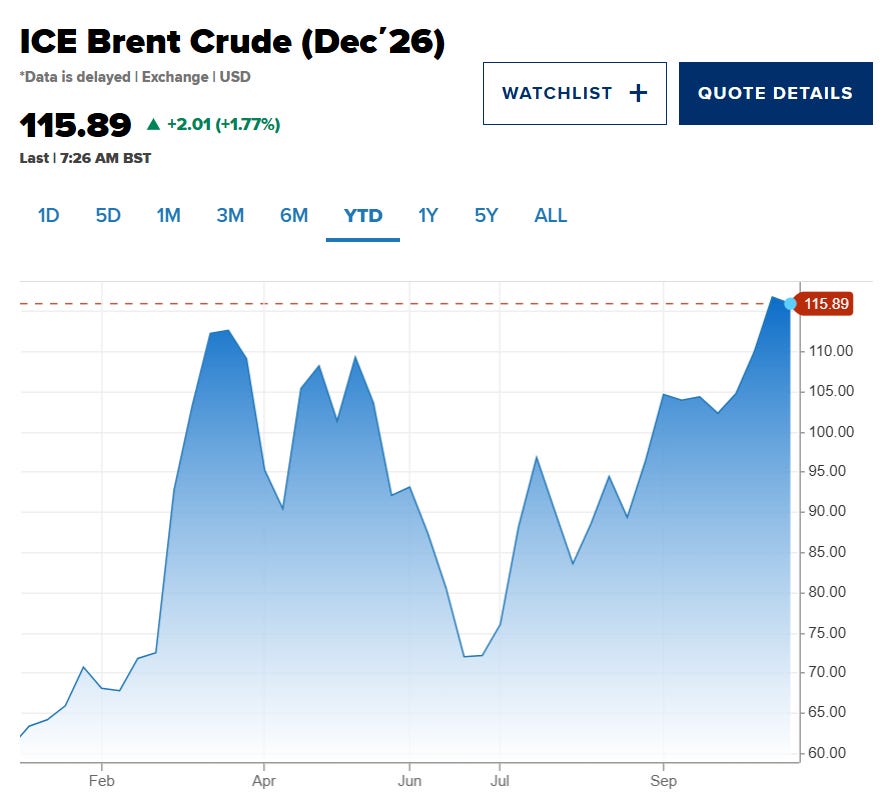
That also comports with where oil prices are. If oil shipments were normal, crude prices would also be normal; lower, or at least falling. Instead, they’re rising. This is Brent Crude—the European benchmark—for December 2026 delivery. There was a giant spike in the futures price in March, then a decline through the end of June, when it looked like oil flows were returning to normal.
Speculators who bought the December contract in early July and are still long their position have realized 50% gains, so far—now we’re a month from actual delivery, and the market is pricing in a higher price than in the first days of the war, and to say again, this is at a time when the traffic through the Hormuz is about 80% compared to before the war, and a big spike in exports through overland routes and pipelines.
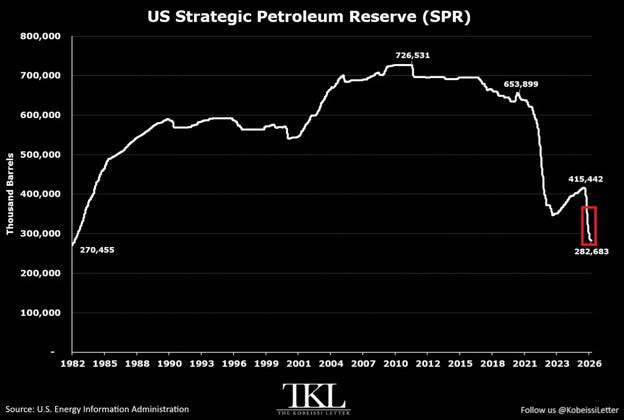
And this is also at a time when the United States and Europe have been draining their strategic oil reserves, and have released hundreds of millions of barrels of crude onto the market. That’s to say that oil prices should be much lower than they are, and the reason they are not, is because Iran is probably getting paid $10-20 per barrel just to agree not to launch rockets and drones at the ships who pay.
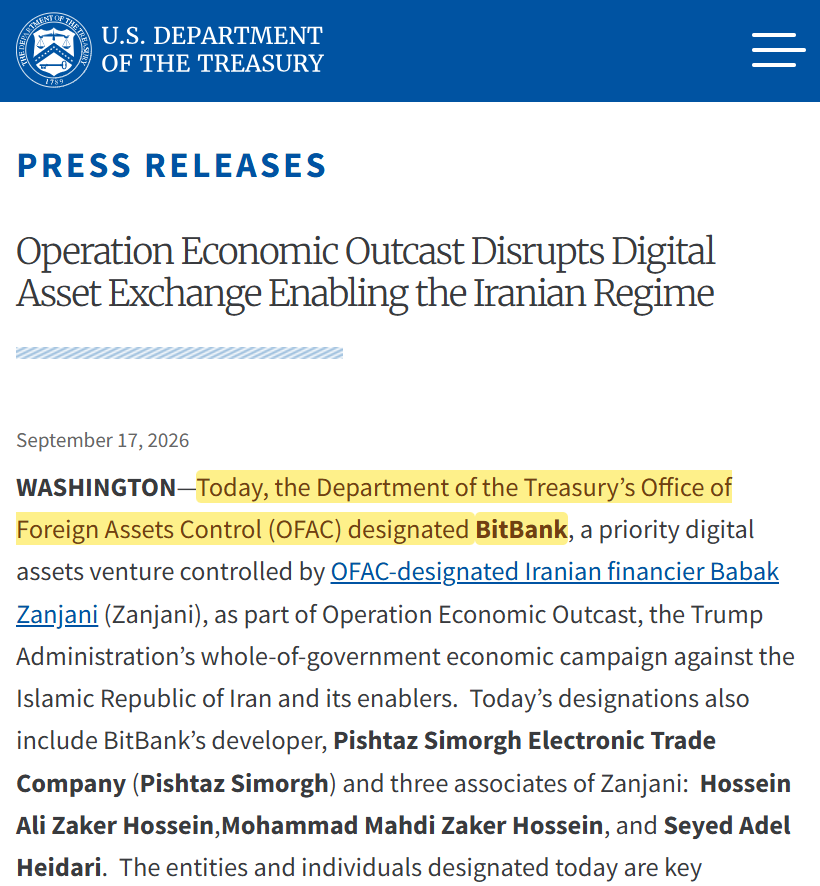
In September, the Treasury Department sanctioned BitBank, which they accuse of collecting fees for Iran, which is perhaps another acknowledgement that this “toll system” is in place:
Straits Live is an up-to-the-minute tracker of activities in the Hormuz, and for them the toll system is a given, and explains that shipping companies and Asian buyers are better off just paying Iran the toll, instead of spending the extra two weeks sailing around Africa.
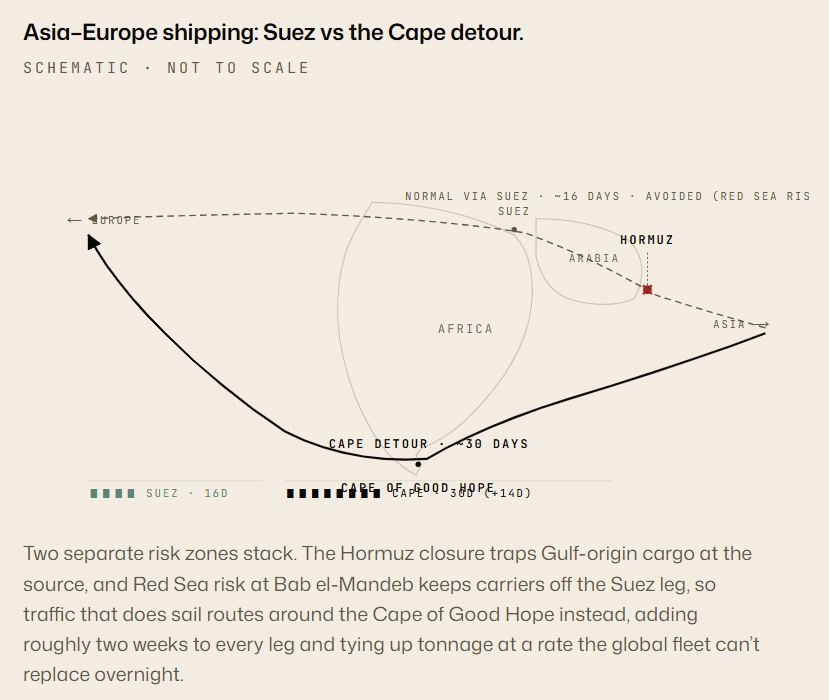
They also explain why VLCC’s aren’t used for the transit through the Hormuz: smaller ships pay less in fees, and can make repeated trips. Smaller vessels also cost less to insure. So ships seeking passage apply in advance, and get loaded and sail through only after Iran issues a permit and a transit schedule.
If we assume that every barrel of oil sailing past Iran comes with a higher cost built-in, another major cost driver is the complicated “shuttle services” and the ship-to-ship transfer systems to get the oil out of the Persian Gulf. Those tie up a lot of ships, and makes the so-called “shadow fleet” of tankers key to keeping oil prices far lower than they otherwise would be.
There is a new development that is also crucial: Abu Dhabi and Saudi Arabia are selling oil cargoes on a delivered basis to China and India. Typically oil producers sell on an FOB basis: the price paid is based on the oil price at the loading port. But Gulf countries are selling oil cargoes on CIF terms. That means they are taking on all the risk of the insurance and freight charges, and that relieves Asian buyers of the responsibility—and risk—of paying the Iranians directly, through a financial intermediary that might be sanctioned at any moment by Washington.
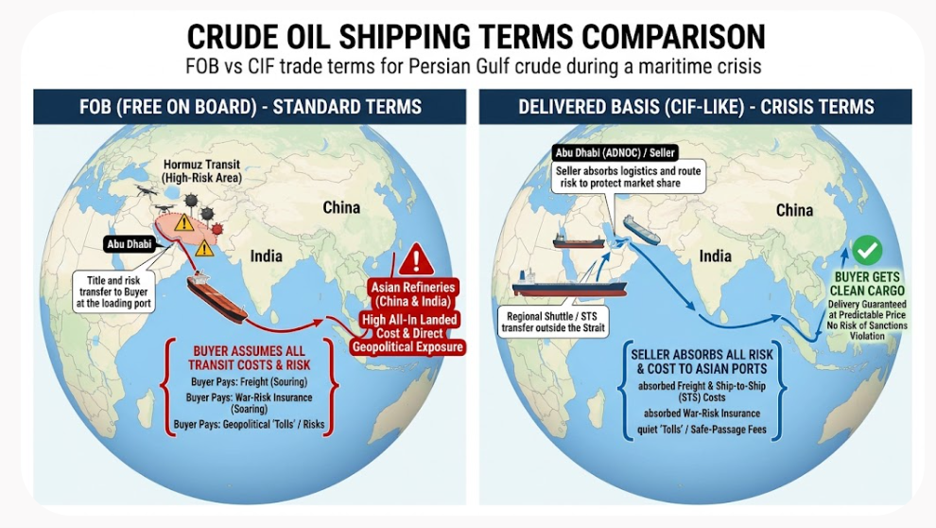
Middle East energy producers are guaranteeing the delivered price to Asia, absorbing all those high transport costs, just to guarantee they don’t lose market share to the United States, or to other suppliers in Africa or South America.
This situation will be very difficult to get unstuck. That’s what all these charts mean, and these forecasts for higher-for-longer oil prices from industry insiders. Iran may be shut off from exporting their own oil, but they are collecting massive tolls from almost every ship that floats by. There is probably not a lot of urgency on their part to stop that arrangement.
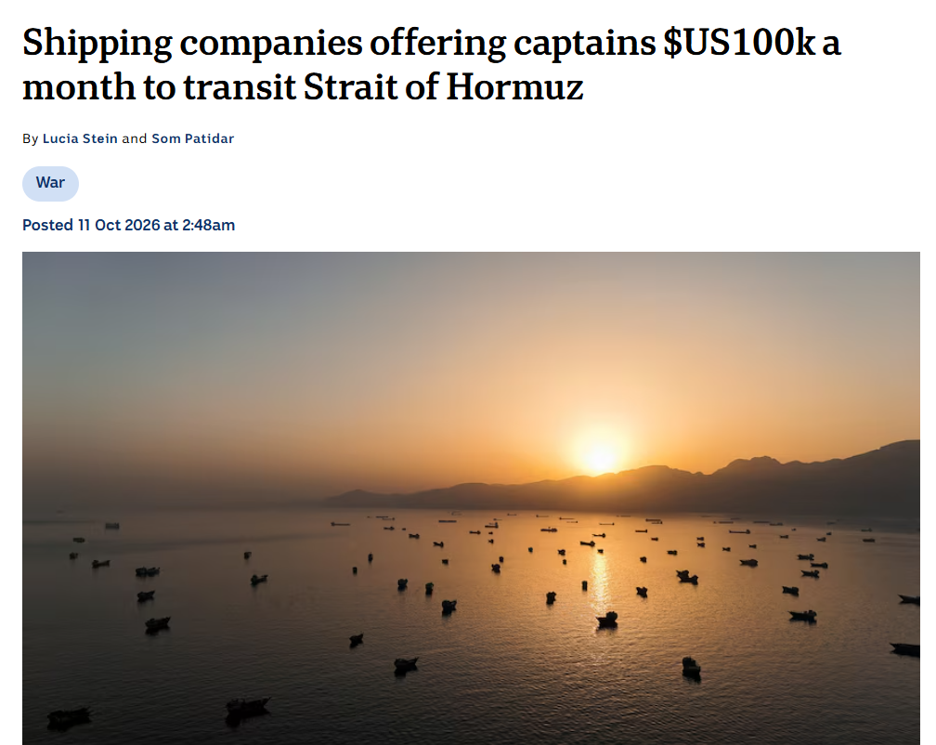
Oil shipping companies are also booking record profits, and their crews are making more on a single trip through the Hormuz than they used to earn in a whole year—so they also may be satisfied with the way things are, right now.
Be Good.
Resources and links:
U.S. exports of crude oil and petroleum products reached record in April
https://www.eia.gov/todayinenergy/detail.php?id=67825
$80 Million Tanker Bills Are Crushing US Oil Exports to Asia
https://www.bloomberg.com/news/articles/2026-10-22/oil-tankers-plying-the-us-china-route-command-60-million-it-s-crushing-demand
Asian refiners use smaller tankers, buy delivered crude as freight rates soar
https://www.reuters.com/business/energy/asian-refiners-use-smaller-tankers-buy-delivered-crude-freight-rates-soar-2026-10-20/
Kpler Suspects Gulf Producers Are Paying Iran for Safe Passage
https://oilprice.com/Energy/Crude-Oil/Kpler-Suspects-Gulf-Producers-Are-Paying-Iran-for-Safe-Passage.html
Is Iran charging a toll to allow oil traffic through Hormuz?
https://www.aljazeera.com/news/2026/10/5/is-iran-charging-a-toll-to-allow-oil-traffic-through-hormuz
The Strait of Hormuz transit fee.
https://straits.live/strait-of-hormuz-transit-fee
Oil Tankers Earn $1 Million a Day as War Leaves Ship Shortage
https://www.bloomberg.com/news/articles/2026-09-14/oil-tankers-earn-1-million-a-day-as-war-leaves-ship-shortage
Supertanker chartered from Gulf Coast to China for $76 million, 10 times higher than pre-war level
https://www.cnbc.com/2026/10/07/supertanker-from-us-to-china-chartered-for-76-million-source.html
Operation Economic Outcast Disrupts Digital Asset Exchange Enabling the Iranian Regime
https://home.treasury.gov/news/press-releases/sb0632
Over a thousand “dark fleet” tankers sell sanctioned oil. And nobody really wants them to stop.
Shipping companies offering captains $US100k a month to transit Strait of Hormuz
https://www.abc.net.au/news/2026-10-11/sailors-offered-bonuses-to-cross-strait-of-hormuz-in-iran-war/107248044
Ship captains and crews transiting the Strait of Hormuz make so much danger pay that they’re ‘almost being viewed as mercenaries’
https://fortune.com/2026/10/10/ship-captains-crews-strait-of-hormuz-danger-mercenaries-tankers-freight-rates/
Kotak raises FY27 crude oil price forecast to $100 amid 8-month supply disruption
https://timesofoman.com/article/178524-kotak-raises-fy27-crude-oil-price-forecast-to-100-amid-8-month-supply-disruption
China Refiners Tap African, Brazilian Oil as Freight Rates Fall
https://www.bloomberg.com/news/articles/2026-10-28/china-refiners-tap-african-brazilian-oil-as-freight-rates-fall
Inside China / Business is a reader-supported publication. To receive new posts and support my work, consider becoming a free or paid subscriber.
From Inside China / Business via This RSS Feed.