

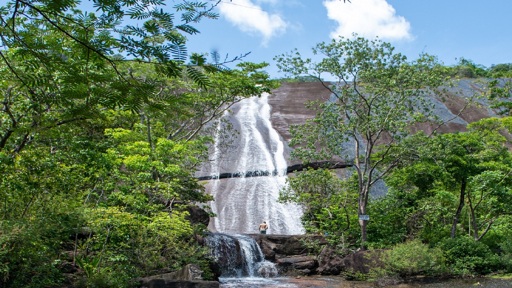
BOA VISTA, Roraima — “For those who live off the river, water isn’t just scenery: It is also a road, work and income.” That is how tour guide Fredson Guedes, known as “Tarzan,” learned to view the natural world around him over the course of his 55 years. “I work entirely with nature and depend heavily on it. Just the other day, I was at Serra Grande [an ecotourism destination in the municipality of Cantá, Roraima], working at the Véu de Noiva [bridal veil, in Portuguese] waterfall, but now there is no waterfall anymore. It dried up.” In the Amazonian region of Serra Grande in Brazil, about 50 kilometers (31 miles) from the state capital, Boa Vista, the seasonal waterfall known as Véu de Noiva usually draws visitors from May through early September during Roraima’s rainy season. That changed in 2026. By late July, the water that defines the landscape had already vanished. Fábio Wankler, a geologist and professor at the Federal University of Roraima (UFRR), points to a “super El Niño” as the driver behind the disruption. The phenomenon, unusually intense this year, has triggered a series of shifts in weather patterns that, across various parts of the country, “have caused longer and more intense periods of drought,” he said. The effects are felt daily. The waterfall, whose cascading flows resemble the delicate lace of a wedding gown, sits along one of the primary routes traveled by Guedes, who navigates the Branco River to reach it at least twice…This article was originally published on Mongabay
From Conservation news via This RSS Feed.