

In the words of the biggest name in the outside elections-spending game, “Being pro-Israel is good policy and good politics.”
This midterms cycle, however, the American Israel Public Affairs Committee’s strategy seems to suggest the opposite. Contrary to its signature slogan, AIPAC’s name has become anathema to voters across the political spectrum repulsed by Israel’s genocide in Gaza and frustrated by Washington’s outpouring of military aid for a foreign government while domestic costs soar.
So it’s going underground. As The Intercept reported in December, AIPAC entered the 2026 midterms by returning to its strategic roots — funding other groups and uniting donors, rather than focusing on direct-to-candidate spending. Now, AIPAC has announced that it will no longer officially endorse or contribute directly to candidates.
Though progressives welcomed the announcement as evidence of AIPAC’s retreat, it’s far from a sign that AIPAC is backing down. The group is expected to continue spending heavily on elections through its super PAC, which took advantage of campaign finance loopholes to conceal its involvement in several races this cycle until after elections had already passed. To Lara Friedman, president of the Foundation for Middle East Peace, AIPAC’s opting for obscurity shows that “its brand has become politically radioactive.”
But how much has really changed? As AIPAC shifts strategy, a new project by The Intercept reveals the hundreds of candidates still taking its cash, plus how the money paid off for them. The data suggests that though the pro-Israel lobbying giant may be weakened, it’s still dominant.
The Intercept tracked how much the group and its super PAC spent on elections to put pro-Israel candidates on the ballot in this year’s midterms — including the money it tried to keep out of the public eye. While AIPAC makes use of a series of new pop-ups and pass-throughs, it still poured millions directly into 2026 midterm races. Its candidates usually still win.
[
Related
AI Tried to Buy the Midterms — Then the Lobby Learned Everyone Hates AI](https://theintercept.com/2026/10/29/midterms-election-money-ai-super-pac/)
The new data builds on a 2024 project in which The Intercept documented just how AIPAC shaped the last congressional class. At the time, Donald Trump was preparing for his return to the presidency as Kamala Harris ran a campaign hamstrung by public disillusionment over the Biden administration’s unflinching support for Israel’s genocide in Gaza. To critics of Israel desperate to stop the violence, the two parties looked equally bleak, and the pro-Israel lobby’s grip on Congress appeared unshakeable.
It’s been different this cycle. Primaries across the country saw candidates win after vowing to cut off or restrict military aid to Israel, and incumbents signed on to legislation blocking weapons transfers in an attempt to keep their seats. But the shift should not be overstated: AIPAC still waded into nearly three-quarters of races, and its candidates still won far more often than they lost.
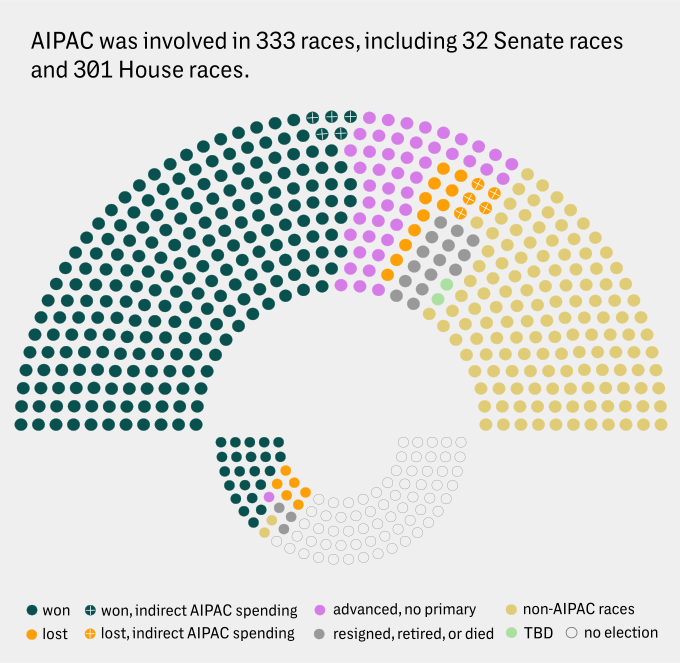
In total, AIPAC or its super PAC, United Democracy Project, spent on 333 of the 473 seats up for election this year.
Graphics: Stella Ioannidou
These are the dollars AIPAC and UDP spent directly in races. The former makes contributions to candidates, while the latter, as AIPAC’s leading super PAC, makes independent expenditures, like buying ads. They made up the bulk of the pro-Israel lobby’s known elections spending — $53.3 million from AIPAC and $66.7 million from UDP, compared to$53.7 million and $41.4 million last cycle. Simultaneously, the groups took up another tack: making it harder to tell which races they were actually involved in. The group’s donors poured money into races where AIPAC didn’t officially endorse a candidate. AIPAC’s board president hosted a fundraiser for a candidate who swore the group wasn’t backing her. And in a series of races, no one knew for certain that AIPAC had spent on the election until after it was over.
[
Related
The Most Expensive Democratic Senate Primary Has a Winner](https://theintercept.com/2026/08/05/michigan-missouri-primary-results-el-sayed/)
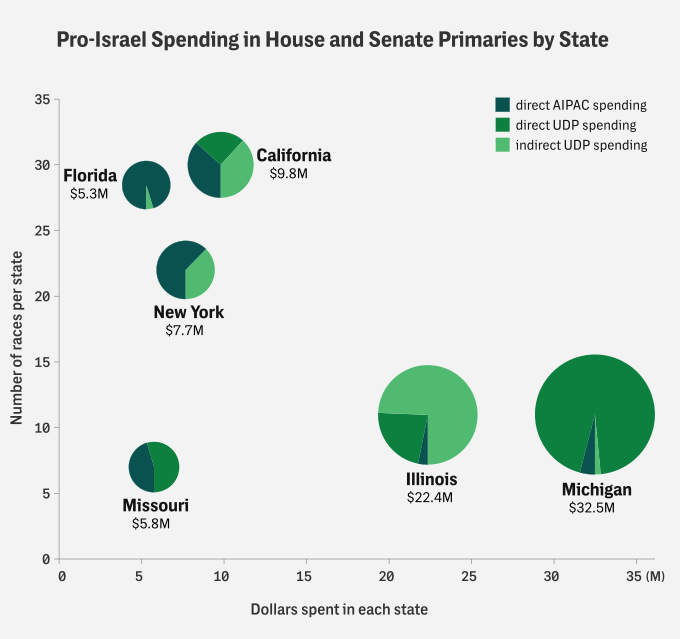
The group tested different strategies in different states, spending directly in the Michigan Senate race, for example, while concealing its spending in several other primaries. In those races, UDP gave money to other committees, including a series of “pop-up PACs,” groups that registered just before primaries, allowing them to delay disclosing their donors until after the election passed. Several of those groups took money from AIPAC’s super PAC, spent on ads against candidates critical of Israel, and then disappeared.
The pop-ups and pass-throughs represent AIPAC’s most talked-about new tactic, but the lobbying group and its flagship super PAC still sunk the bulk of their spending into key races and high-priority states. The Intercept analyzed where AIPAC employed which strategy, how UDP dollars flowed through pop-up PACs, and which candidates received the most AIPAC and UDP cash in their primaries.
The Direct Spending
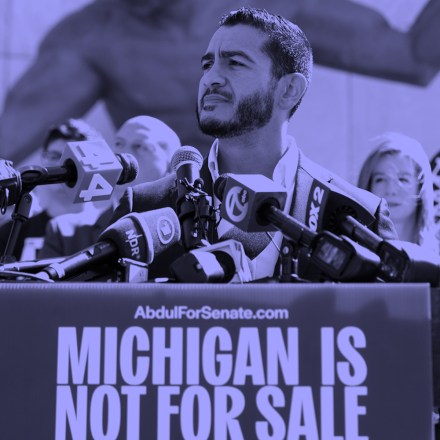
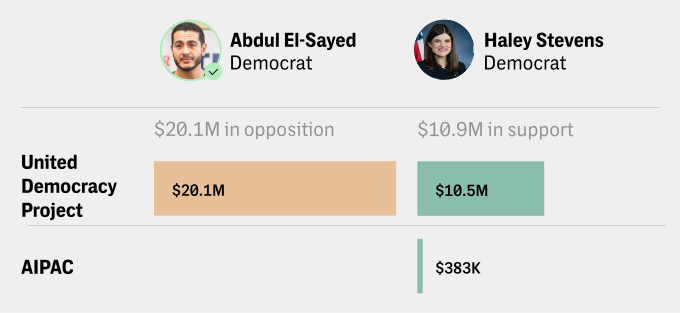
The pro-Israel lobby’s biggest investment in the primaries turned out to be a disappointment. UDP spent more than $30 million on ads attacking Democratic candidate Abdul El-Sayed in the Michigan Senate race or backing his opponent, Rep. Haley Stevens. Now that El-Sayed is the Democratic nominee, UDP is also battling El-Sayed in his general election contest with Republican Mike Rogers, spending just over $500,000 so far.
Graphics: Stella Ioannidou
Thanks in part to the deluge of spending, the El-Sayed–Stevens contest was one of the marquee primaries of 2026, pitting a vocal critic of the pro-Israel lobby who could become the first Muslim U.S. senator against an enthusiastic AIPAC cash recipient who famously said: “Israel comes to me in my dreams.” It’s one of the key races where we’re breaking down the money AIPAC and UDP spent in favor of one candidate and against a clear opponent. We’re skipping Democratic House candidate Adrian Boafo, who benefited from $5.7 million in UDP spending, because his Maryland primary included 23 other candidates.
Graphics: Stella Ioannidou
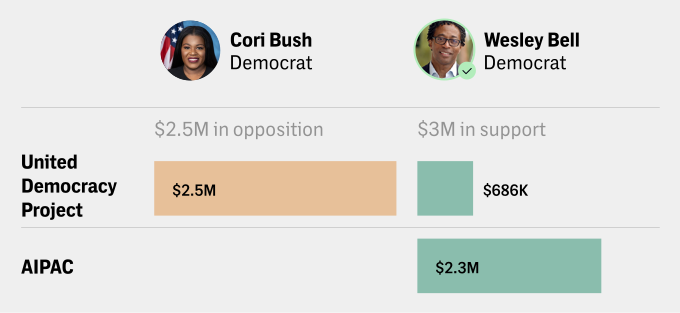
After Stevens and Boafo, the top AIPAC and UDP recipient from this year’s primaries was Rep. Wesley Bell, a moderate Democrat from Missouri who fended off a challenge from former Rep. Cori Bush to return to the House (AIPAC spent millions to oust her last cycle). When UDP spending is excluded, Bell received more AIPAC funding in the primaries than any other Democrat.
Graphics: Stella Ioannidou
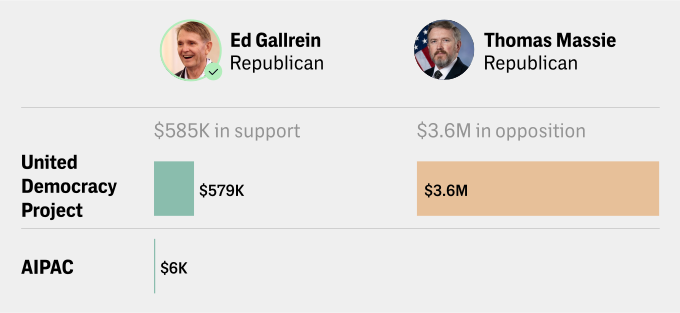
On the Republican side, the top beneficiary was Ed Gallrein, the Trump-backed challenger who unseated Rep. Thomas Massie in Kentucky. Massie, a libertarian critic of all foreign aid — including to Israel — was the relatively rare Republican incumbent AIPAC and UDP opposed.
Often, the pro-Israel groups backed Republican incumbents. Two more top recipients were Sen. Tom Cotton, who easily won his primary in Arkansas, and John Cornyn, who lost to state attorney general Ken Paxton in Texas.
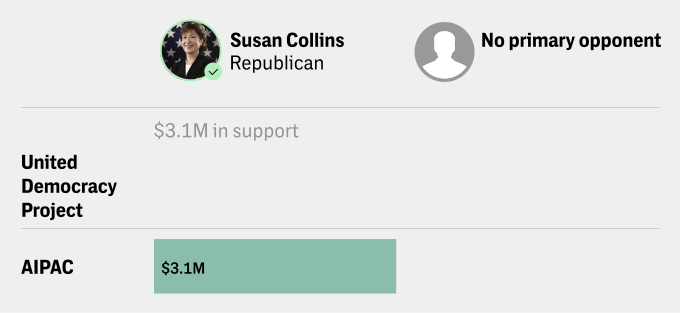
But the greatest Republican recipient of AIPAC largesse — ahead of Gallrein, when UDP is excluded — did not face a primary opponent.
Graphics: Stella Ioannidou
Republican Sen. Susan Collins of Maine, now facing a tight general election contest against Democratic candidate Troy Jackson, has been a longtime beneficiary of campaign cash aligned with the pro-Israel lobby. Asked by Zeteo last year for her comment on Americans killed by the Israeli military, Collins shook her head and said only: “I am pro-Israel.”
The Pop-Ups
On top of the $53.6 million it spent directly on races this cycle, United Democracy Project poured another $13.1 million into Democratic primaries by giving money to other committees whose names or stated agendas indicated no connection to Israel policy. That $13.1 million, more than triple the $3.5 million United Democracy gave through other groups last cycle, helped fund at least three pop-up PACs that formed this year.
[
Related
Who’s Spending in Your Congressional Election? We Tracked the Front Groups Fueling the 2026 Midterms.](https://theintercept.com/2026/05/18/super-pac-election-spending-midterms-aipac-ai-crypto/)
The groups’ names offered little insight into their political agendas, as The Lever recently highlighted. UDP spent the most on popup PACs in a series of Democratic primaries around Chicago, where groups with names like Elect Chicago Women, Chicago Progressive Partnership, and Affordable Chicago Now! used their funds to attack candidates running on rejecting AIPAC money or ending U.S. military support for Israel. Several of the groups also received funding from major United Democracy Project donors, and three of them shut down after the primaries and gave their money back to United Democracy Project.
Graphics: Stella Ioannidou
In other cases, United Democracy Project funded long-established political action committees with ties to current or former House Democratic leaders, like Bold America, which was formed by former members of the Congressional Hispanic Caucus. That group got almost a quarter of the $12.2 million it reported raising this year from UDP. The UDP share, $2.8 million, was nearly equivalent to the $2.9 million Bold America spent against Darializa Avila Chevalier, a democratic socialist and pro-Palestine activist who defeated incumbent and Congressional Hispanic Caucus Chair Adriano Espaillat in New York.
The super PAC EDW Action Fund was similar. Former Democratic Congressional Campaign Committee Chair Cheri Bustos and former Rep. Annie Kuster formed that group in late 2023 as an offshoot of the political action committee Elect Democratic Women. Like Bold America, EDW Action got about a quarter of its funding from UDP. It also provided more than 80 percent of the funding for Pro-Choice Majority Action, a new PAC that formed in May and spent in 12 primaries. The group presents itself as supporting Democratic women, but Pro-Choice Majority Action notably spent against pro-Palestine candidates like Melat Kiros, who ran a primary challenge against Rep. Diana DeGette, D-Colo., and won.
In a statement to The Intercept, Pro-Choice Majority Action spokesperson Lenny Young dismissed reporting characterizing the group as a pop-up PAC and said it had backed 23 candidates with a range of views on Israel across the primaries and general election.
“To suggest that we would deny a Democratic woman from being elected to Congress because of her position on Israel, on either side, misses the whole point,” Young said. “We want more Democratic women in Congress because we believe it would improve the lives of women and families. Period.”
Bold America did not respond to The Intercept’s request for comment. Emails to Elect Chicago Women, Chicago Progressive Partnership, and Affordable Chicago Now! bounced back because the groups have shut down.
UDP gave another $2.65 million to groups that did not spend directly on ads in Democratic primaries this cycle.
In August, United Democracy Project gave $1.65 million to a group called SD PAC, also known as Save Democracy PAC, which registered in 2020 and has supported Democratic candidates in past general elections. The group did not directly conduct any outside spending in Democratic primaries this year, but it funneled money to affiliate groups that did — some of which funded attacks against progressives.
The other recipient of money from UDP, Palmetto Action, formed in May and only spent in South Carolina’s Republican Senate primary. The group backed Sen. Lindsey Graham before his death in July, then received a cash infusion from UDP and started supporting Graham’s sister, Darline, ahead of a special Senate primary. The group did not report any additional spending in its last filing due before the general election.
Palmetto Action, Save Democracy PAC, and EDW Action Fund did not respond to The Intercept’s requests for comment.
[
Related
Nancy Pelosi’s Pick for Her SF House Seat Takes Anti-AIPAC Pledge](https://theintercept.com/2026/07/21/connie-chan-san-francisco-aipac-pelosi/)
If last cycle AIPAC proved that it could leverage its financial advantage to target critics of Israel, its performance this cycle suggests that its money has become a faltering superpower.
New pro-Palestine groups have sprung up to spend against AIPAC — though their pockets aren’t nearly as deep. When candidates went head-to-head this cycle in primaries defined by U.S. military support for Israel’s genocide in Gaza, pro-Palestine candidates often came out on top.
For decades before it started spending directly on elections, “AIPAC operated in the shadows,” Friedman, of Foundation for Middle East Peace, said. Its endorsements were once “clear but unofficial,” she added, and its funding operated through “informal understandings with big donors and allied but ostensibly independent PACs.”
Today, “AIPAC is trying out a sort of middle road,” Friedman said. “It will return in part to the shadows — no direct endorsements, no direct donations — but it will also continue to flex its power directly in elections, via tactics it has been testing and honing these past four years.”
If anything, next cycle could see an expansion of the recent pop-up PAC strategy, making it harder to tell when AIPAC is involved — until it’s too late.
The post AIPAC Isn’t Retreating. Here’s How It’s Already Shaping the Next Congress. appeared first on The Intercept.
From The Intercept via This RSS Feed.