

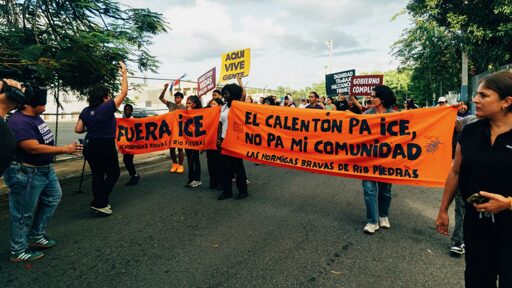

Masked Immigration and Customs Enforcement (ICE) agents carrying long guns swept through working-class neighborhoods in San Juan, Puerto Rico between October 22-25. About a dozen workers, largely Dominican immigrants, were reportedly detained from Río Piedras, Capetillo, Villa Palmeras, Villa Capri, and Barrio Obrero. Local leaders and community members have expressed outrage over the ICE deployment to the island. Protests have also broken out, demanding ICE out of Puerto Rico and elevating calls for independence from the United States.
During the operations, federal agents claimed that they were detaining criminals, but locals say they were all hard working people, many with families.
Elected officials speak out against ICE deployment
The Dominican Republic sits about 50 miles from Puerto Rico. Dating back to the pre-Colombian era, the Caribbean has always been closely linked by migration and maritime mobility. There has never been a time where the islands existed in isolation.
That might help explain why immigration arrests and deportations are being met with such deep rejection.
Puerto Rico’s Senate opposition spokesman, Luis Javier Hernández Ortiz and the mayor of San Juan, Miguel Romero have all condemned the ICE raids.
Romero ordered the municipal police to not assist federal agents with any ICE operations. The island’s American Civil Liberties Union (ACLU) branch also condemned the raids and characterized the operations as a pattern of violence and intimidation.
“We strongly reject the massive deployment of ICE agents who, in a threatening manner and armed with long guns, continue occupying the streets,” said Annette Martínez Orabona, executive director of the ACLU of PR, in a statement.
ICE had no judicial warrant for anyone they arrested, said the legal director of ACLU of PR, Fermín L. Arraiza-Havas, speaking to El Grito Media.
Local officials blame the island government’s alleged “voluntary handover” of data for making the sweeping operations possible.
Puerto Rican government collaborates with ICE
The ACLU of PR says the Puerto Rican government gave ICE the personal information of thousands of immigrant drivers, in violation of a 2013 confidentiality law. The information was handed over by Transportation Secretary Edwin González and Governor of Puerto Rico Jenniffer González-Colón.
“The laws in Puerto Rico protected that information,” said ACLU’s Arraiza-Havas to El Grito Media.
In a statement provided to The San Juan Daily Star, ACLU’s Martínez Orabona accused the governor of facilitating the federal immigration raids by “providing residential addresses and confidential information belonging to more than 6,000 immigrants residing in Puerto Rico.”
“Both the federal and state governments are responsible for the escalation of violence that we are seeing from ICE,” Martínez Orabona said.
The ACLU of PR held a press conference on October 15, where they made public the mass data sharing between the Puerto Rican government and ICE.
Border czar Tom Homan then visited Puerto Rico on Oct 21-22 to review immigration enforcement efforts and operational challenges, according to The Washington Post.
ICE raids began the next day.
Locals confront federal agents as raids sweep Dominican neighborhoods
Various videos have circulated online, where community members can be seen surrounding ICE vehicles and confronting agents, most of whom spoke English, as they arrested individuals. One restaurant worker reportedly refused to let agents enter as they tried to follow a man they claimed was a criminal. The agents eventually left.
ICE agents can also be seen in various videos threatening community defenders with pepper spray and tasers for legally recording their operations, as community members yell “Don’t touch me!” and “They’re taking hard working people from here, what a shame!”
In at least one account, a Puerto Rican citizen (all Puerto Ricans are US citizens by birth) was stopped by a group of ICE agents who demanded his ID.
The arrests have raised questions about racial profiling, citizen’s rights, as well as questions about the political direction of Puerto Rico.
Colonialism or independence?
Protests broke out in the neighborhoods targeted by ICE on Monday, October 26. The Fire Ants of Rio Piedras led a march, holding a banner that read “Heat for ICE Not for My Community” and “ICE Out!” Large groups of children and youth participated in the march.
In a statement, the Feminist Collective PR, also part of the protests, said, “We reject this pathetic, collaborationist government that loves to bend its knees to Washington in exchange for nothing.”
They argued that the same government that collaborates with the feds to hand over their Caribbean brothers and working people is also selling off the country piece by piece to foreigners coming to displace the Puerto Rican people. The group asserted that the foreigners that need to be removed are not Dominicans, but people like the Reuben Brothers – two British billionaires developing a multi-billion dollar resort and residential megaproject on the southwest coast.
“The US has no moral integrity to stand on to come tell us here who can be our neighbors and who can’t.”
Mounting resistance has also brought the call for Puerto Rican independence back into the spotlight.
“ICE raids in Puerto Rico are colonial terrorism,” said Boricuas Unidos en la Diáspora, in a statement released on X.
The group declared that ICE activity is part of the colonial status quo. The only two political options from here are: statehood, which they argue would only strengthen and perpetuate US federal control over Puerto Rico, and independence.
“If you don’t want ICE roaming the streets of Puerto Rico, you have to support our nation’s independence,” the group said.
“It’s that simple.”
From BT News via This RSS Feed.
Honestly? Valid. The US is a shitshow and they shouldn’t have to put up with their backpedaling system let alone their racist gestapo.