

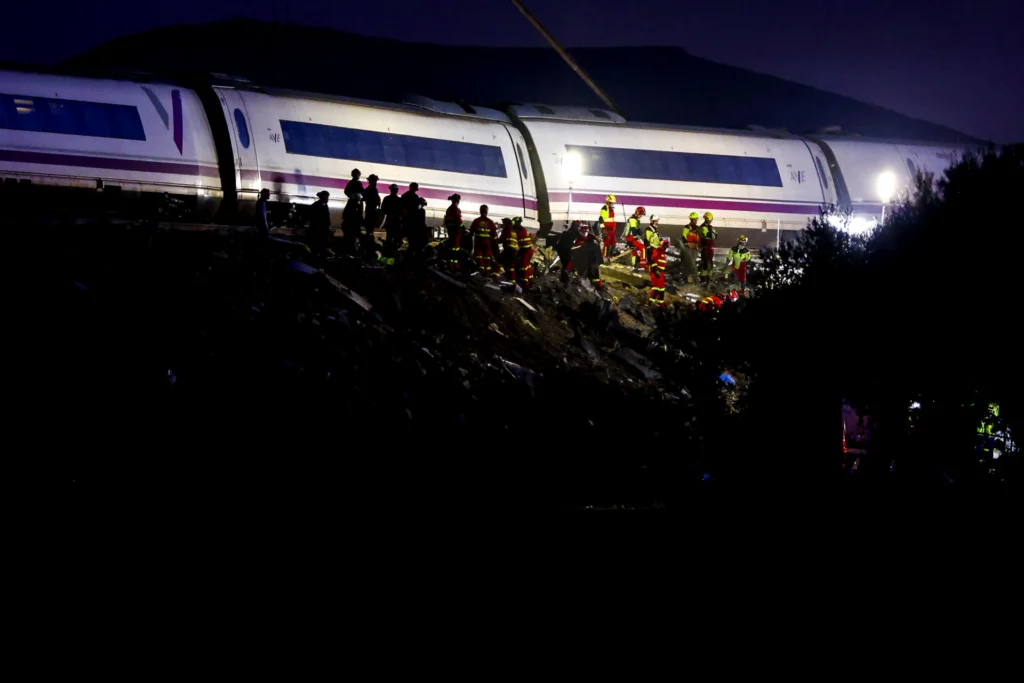
The Spain’s government has declared three days of national mourning, from October 29 to 31, for the 64 people killed in the collision of two passenger trains on October 28 in the province of Toledo.
The Spanish government declared three days of national mourning, to be observed on October 29, 30 and 31, 2026. The order requires flags to fly at half-staff on public buildings and military installations across the country during the three days.
Pedro Sánchez announced the measure in memory of those who died in the rail collision in the province of Toledo, in the autonomous community of Castilla-La Mancha.
RELATED: High-Speed Train Collision in Spain Leaves 50 Killed And 179 Injured
The impact occurred at 8:54 A.M. local time near the municipality of Urda. A high-speed AVE train, operated by state-owned Renfe, hit the rear of a train operated by the private company Iryo, which was stopped on the tracks. The collision derailed the last two cars of the Iryo train and sent several units down a ravine.
Following a deadly train crash near Toledo, Spanish PM Pedro Sánchez declares 3 days of national mourning and demands strict safety measures: “It is unacceptable for Spain to suffer two high-speed rail accidents in the same year.” pic.twitter.com/IeiKNHndtf
— euronews (@euronews) October 28, 2026
The crash involved two operators that share Spain’s high-speed network. Renfe, which is state-owned, runs the AVE, while Iryo, which is privately owned, operates the train that was struck from behind. Both companies carry passengers on high-speed corridors.
64 people died in the crash, according to the President of Castilla-La Mancha, Emiliano García-Page. There were 544 passengers aboard the two trains at the time of the impact: 397 on the AVE and 147 on the Iryo, including a baby.
Emergency Health Response
The rescue operation involved 100 members of the Military Emergencies Unit. The Civil Guard’s Major Disasters Team also took part. The search for bodies continues, meanwhile the injured remain in hospitals.
Official activity was suspended in the central government and in regional administrations while emergency teams continue their work at the crash site.
Sánchez traveled to Toledo to assess the response at the scene. King Felipe VI set aside his official engagements after speaking with the prime minister about what had happened. Both cleared their public schedules.
For her part, Health Minister Mónica García suspended her scheduled activities and merged state medical resources with the regional administrations of Madrid and Castilla-La Mancha to assist victims of the disaster in Urda. The order pulled national capacity and local response into a single coordinated operation.
Signaling and safety failures on the high-speed network are the focus of the technical investigation. Transport Minister Óscar Puente went to Atocha station in Madrid to review those systems. He also examined the factors surrounding the collision between the two trains.
‼️Accidente tren
🚨 La Guardia Civil ha desplegado en la zona personal de Seguridad Ciudadana de la provincia de Toledo, OMAC (Oficinas Móviles de Atención a la Ciudadanía) así como agentes del SEPRONA y de la Jefatura de Tráfico.
✔️ También se desplazan a la zona en este… pic.twitter.com/5UxspxBARH
— Guardia Civil (@guardiacivil) October 28, 2026
Text reads: “The Civil Guard has deployed personnel from the Citizen Security area of the province of Toledo, OMAC (Mobile Offices for Citizenship) as well as agents from SEPRONA and the Traffic Headquarters.”
The January Precedent
The Urda disaster follows a wreck that Spanish investigators still struggle to explain. In January 2026, on the Madrid-Andalucía route near Adamuz in Córdoba province, an Iryo train departing the capital derailed and struck another unit serving the Huelva-Madrid corridor.
That collision produced no immediate answers and the track had been renovated shortly before. The first train cleared its technical inspection only four days earlier, moving between 200 and 210 kilometers per hour. Minister Óscar Puente described the crash as a highly unusual event.
The consequences spread fast. Rail service toward the south of the country stopped temporarily while experts examined the wreckage. Atocha station, Madrid’s main rail terminal, absorbed massive cancellations as passengers rebooked or abandoned their journeys.
Months later, the cause remains open. Renovated track, a freshly inspected train, and routine high speed, none of it explained the collision. That unresolved record shaped the public mood when the news from Urda arrived.
Two railway disasters within a single year have now tested Spain’s emergency systems twice. January demanded a forensic response, an effort to understand an accident that defied easy explanation. Urda has demanded a medical one.
Spanish authorities have not yet released a complete account of the Urda disaster. Investigators will face the same task that followed Adamuz, determining what failed and why. The January wreck left a toll of 39 dead and more than 100 wounded, and the questions it raised remain unresolved as the country confronts a second emergency on the same network.
The national mourning decreed by the government will last until October 31. Technical teams will determine the causes of the crash and the condition of the signaling systems on that stretch of the network, as well the recovery of the hospitalized injured completes the authorities’ immediate agenda.
From teleSUR English via This RSS Feed.
Distract distract distract!
