

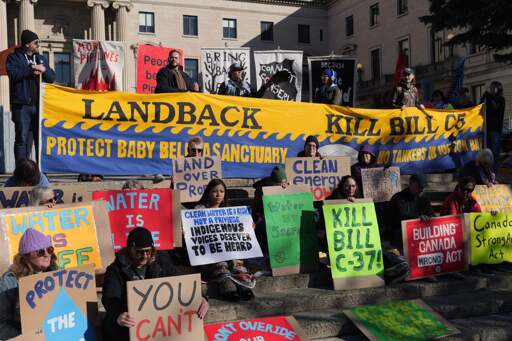

About 100 people attended a demonstration outside the Manitoba legislature on Saturday, ahead of Monday’s First Nations – First Ministers’ meeting where Bill C-39 was on the agenda in Ottawa. Photo by Crystal Greene
Indigenous people in Manitoba are protesting against proposed federal legislation that aims to fast-track resource development — saying it undermines their rights and sovereignty over their lands.
Activists point to several pieces of legislation that they worry would cause more harm to their territories, which are already impacted by climate change and the biodiversity crisis. They also have safety concerns over “man camps” created by industry and potential harms to vulnerable Indigenous women and girls.
Both Bill C-5 and Bill C-39 are set to fast-track major infrastructure projects in “Canada,” by designating them to be of “national interest.” C-5 was passed in 2025, and C-39 is in its third reading. Meanwhile, the proposed Bill C-37 — under review after a second reading — has heightened concerns over First Nations water rights.
One such project of “national interest” is Churchill Plus. It would see a pipeline and terminal built to internationally export LNG through the Port of Churchill on Hudson Bay. The arctic deepwater seaport would also handle increased mining exports out of Manitoba, eventually including the Ring of Fire.
About 20 people gathered outside of the Manitoba Legislature on Monday rallying against the legislation and in response to the First Nations-first ministers meeting in Ottawa, which was part of similar solidarity events that happened across “Canada.”
It was one of a few protests in Manitoba in late October against the bills and the extractive projects being pushed through by colonial governments despite opposition.

People who once stood together in the same spot – the Manitoba legislature – during Idle No More, are standing together again to oppose the fast tracking of major infrastructure projects. Photo by Crystal Greene
Alex Wilson of Opaskwayak Cree Nation, a professor in the Faculty of Education at the University of Winnipeg, and an organizer with Idle No More, was at Monday’s rally outside the legislature
Wilson read a collective statement from Idle No More founders that said “the conditions that gave rise to Idle No More in 2012 are confronting us again.”
Wilson said that includes “sweeping legislative changes, threats to environmental protections, and government decisions affecting Indigenous territories without respecting the authority of the people who belong to those lands.”
Wilson told IndigiNews that there’s been “a constant erosion of treaty rights of Indigenous sovereignty and legislation that protects land, water and the sky.”
“The bills that are proposed are kind of galvanising our understanding that this is an agenda that is continually harming First Nations, Indigenous peoples and our environment.”
At another earlier rally at the Manitoba legislature, on Saturday, Indigenous activists and allies spoke against Bills C-39 and C-37. It was a finale of the Arctic Crossroads Tour in Manitoba that visited Churchill, Nisichawayasihk, Thompson, Brandon, and Winnipeg.
Anishinaabe water protector Taylor Galvin who works closely with Manitoba First Nations that are impacted by hydro projects on their lands, attended the event.

Taylor Galvin spoke during Saturday’s event to oppose Bills C-37 and C-39 outside the Manitoba legislature. Photo by Crystal Greene
“Have we not lost enough? We are living in a ticket time bomb, and our lands and our waters don’t have time, and in Manitoba, our sturgeon relatives don’t have time,” said Galvin, who is from Baaskaandibewi-ziibiing (Brokenhead Ojibway Nation).
“Our fish and our waters are already sick, traces of life-threatening metals like mercury, lead, arsenic, and cadmium are being found in those fish and in those waters.”
Galvin spoke of political greed and “a broken system” that has harmed the environment and continues to extract from it.
“We have a broken system and yet they want more, Bill C-39, removing Indigenous rights, and trying to move forward at a very quick pace for projects of ‘national interest,’” Galvin said.
“Why aren’t the people considered national interests? What aren’t the animals considered national interests? Why are they talking about these things without protecting anything?”

Environmental activists and land defenders came together to oppose Bills C-39, C-37 and C-5, outside the Manitoba legislature on Saturday, Oct. 26. Photo by Crystal Greene
‘We are deeply concerned’
IndigiNews spoke to provincial minister of environment and climate change Mike Moyes on Monday outside the legislature.
Moyes said he recognizes Indigenous Manitobans have concerns about Bill C-39, and the province will continue to hear them out despite their lack of jurisdiction on the proposed federal legislation.
“I would advocate that they speak with their MPs and with the federal government,” Moyes said.
“We’re going to continue to talk to lots of nations because we know that relationship is important and we want to make sure that we are hearing directly from them.”

Pimicikamak Elder Jack Osborne questions Mike Moyes, Manitoba’s environment and climate minister on Monday. Photo by Crystal Greene
During an Assembly of Manitoba Chiefs’ press conference in Ottawa on Saturday, David Monias, chief of Pimicikimak Cree Nation north of Winnipeg, called for the withdrawal of Bill C-39.
“We are deeply concerned that this legislation could accelerate major project approvals, allow construction to begin before assessments and consultations are complete, especially, the free prior, and informed consent,” he said.
“It creates regions where important safeguards could be weakened and permit changes to conditions to previously approved agreements like the Northern Flood Agreement.”
Monias’s community was part of the 1977 agreement made with Manitoba Hydro that was supposed to compensate hydro-affected communities for the damage caused by hydro dams and diversions of waterways.
“You cannot call it a true partnership if the most important decisions that are to be made for our nations are not meaningfully heard,” he said.
“You cannot call it reconciliation if governments continue to recognize in principle, while their answers undermine those rights in practice.”
A Government of Canada press release about the introduction of Bill-39 said the legislation “will reshape the regulatory approvals process.”
“Our government is bringing speed, certainty, and predictability to how we build,” said prime minister Mark Carney in the press release. “So investors know that when Canada says it wants something built, Canadians will get it built.”
A First Nations – First Ministers’ meeting was held in Ottawa on Monday, bringing together federal, provincial and First Nations leadership to talk about Indigenous priorities. Afterwards, Carney told reporters the government was “open to suggestions on amendments to C-39.”
“The core of C-39 is to organize the federal government to be more effective,” he said. “It puts a timeline on what the federal government’s response needs to be, to certain things, but it’s not a timeline on Section 35 consultations.”
Carney also said Monday that he would “instruct” his minister of finance to work with the Assembly of First Nations and First Nations financial institutions to co-develop new revenue sharing mechanisms, including a “potential” First Nations Sovereign Wealth Fund.
He also said the First Nations Fiscal Management Act would be amended to enable First Nations to invest in major infrastructure projects, which includes mining, pipelines and LNG.
“In major projects we’re also working together to recruit, train and hire, First Nation workers will actually build them,” Carney said.
“Informed by the insights of this meeting, the government of Canada will act with new measures, both today, new investments today, and in our upcoming federal budget.”

Prime Minister Mark Carney holds a combined First Ministers’ Meeting and Assembly of First Nations meeting in the Diefenbaker building, in Ottawa. 26 October 2026. Photo by Daniel Pereira, Office of the Prime Minister of Canada
Concerns about ‘man camps,’ violence
Kakeká ThunderSky, the northern and rural co-ordinator for Climate Action Team Manitoba, joined Saturday’s rally outside the Manitoba legislature.
“We came together on this tour to build solidarity and to tell our stories because our rights and our territories, our lands, our waters and skies are under attack by these pieces of legislation that so-called Canada is trying to fast-track,” ThunderSky said.
ThunderSky is of the thunder bird clan, with family roots in Poplar First Nation, an Anishinaabe community north east of Winnipeg.
“They’re trying to put our livelihoods, our territories, our lands, our water, our sky, our women, our girls, our Two-Spirit relatives’ lives on the line for national profit, whose interests are they keeping in mind?” ThunderSky asked.
“We are here on this tour to say ‘that’s not right’ and that ‘enough is enough.”
ThunderSky added that fast-tracking resource extraction projects wouldn’t only accelerate the climate crisis, but warned that it would accelerate social implications for Indigenous communities, as “man camps” are known to bring violence to Indigenous women and girls.
“When will we be brought into consideration when implementing these pieces of legislation and these projects?”
Lisa Hart Currier of Nisichawayasihk Cree Nation traveled with ThunderSky and other panelists on the Arctic tour as an “auntie.”
“We’ve already seen what Manitoba Hydro has done to our communities, We’ve already experienced the violence,” she said. “We don’t want to deal with pipeline man camps, we don’t want RCMP militarized police in northern Manitoba, protecting a pipeline.”

Pictured are members of the Arctic Crossroads Tour, (left to right): Drew Harris, Ramon Kataquapit, Kakeká ThunderSky, and Lisa Hart Currier. Photo by Crystal Greene
Maxwell Burke, spoke at the Arctic Crossroads Tour stop in Churchill, a town of 800, on the southwestern shore of Hudson Bay. Burke, a lifelong Churchill resident, works as a guide, who gives beluga tours and takes people out to spot polar bears.
The federal and provincial governments want to expand the Port of Churchill with its proposed Churchill Plus project. It would include a Liquid Natural Gas (LNG) terminal, receiving LNG from a pipeline going across the north, and destined for international markets via the Hudson Bay.
The Bay is where a beluga whale sanctuary sits and polar bears live, their habitats are already under threat from climate change.
Burke recalled being in the same room last year where Manitoba premier Wab Kinew had proposed the Port of Churchill Plus project, as part of a broader plan, the Western Energy Corridor.
“He came to us, dressed as a leader, talking like a leader, but what came out of his mouth was a sales pitch.” Burke said.
“What I saw was a buyer, a desperate buyer, because he wasn’t offering to sell us something, he was offering to buy something from us, what he was offering to buy from us, was everything, and he didn’t name a price.
“He is asking for us to sell our community. He is asking for us to sell our land, our water, our bears, our belugas.”
Burke said pushing back against development, however, is “not a hopeless pursuit.”
“I’ve met with people who’ve successfully negotiated with power, I’ve met people who’ve managed to, at every step of the process, from the beginning to all the way to the end, cancel these things,” Burke said.
“There is always a way to say ‘no.’ And Wab Kinew is actually right, because when he looked at me when I asked him how to say ‘no,’ he said, ‘it’s up to you,’ and unfortunately, it is up to us. “
A policy analyst questions the decision-making
In Ottawa on Monday, people gathered outside the First Nations – First Ministers’ meeting, including Mohawk policy analyst Russell Diabo, Idle No More, a delegation from Onion Lake Cree Nation in Treaty 6, and land defenders who came from near and far to have their say with the government.
“Our people need to be involved in all of the decisions now, especially, since they’re trying to bring in this legislation Bill C-37, which we call the ‘the denial of water rights act,’ or Bill C-39, what we call the ‘building Canada wrong act,’ they’re going to continue pushing that legislation,” said Diabo in a Facebook live video
“I think we’ve made our point here today, if we weren’t here, the media would’ve said the First Nations are agreeing with the Carney approach and the premiers.”
Diabo said Indigenous leaders had the chance to explain to government representatives that they oppose Bill C-39 and “we oppose the fact that as rights holders, we’re not included in decisions.”
“We know they don’t have a right to sign on our behalf, they’re going to do it anyway, and we have to react to it and then figure out what our next steps are,” Diabo said.
”I hope we continue on and build this movement to something bigger.”
The post In Manitoba, community protests legislation that would fast-track resource projects: ‘Have we not lost enough?’ appeared first on Indiginews.
From Indiginews via This RSS Feed.