

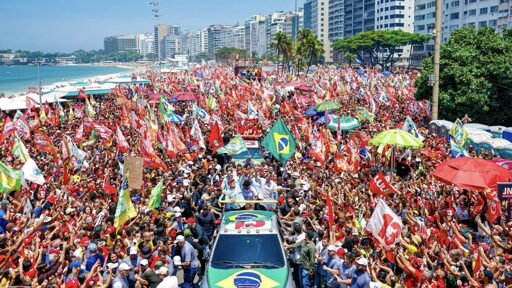

On October 25, Brazil’s three-time and current president, Luiz Inácio Lula da Silva, surprised the entire world by overcoming an electoral setback in the first round (in which he was defeated by the far-right candidate Flávio Bolsonaro) and securing victory and the presidential seat in Brasília.
Lula, the legendary union leader during the dictatorship, secured 51.79%, equivalent to 64,256,232 votes, while Bolsonaro (son of the detained former president Jair Bolsonaro) received 48.21%, or 59,826,041 votes.
What is truly surprising about Bolsonaro’s defeat (given that most pollsters had predicted a very likely victory for him) is the enormous number of votes Lula managed to gain during the three weeks between the first and second rounds of voting. In that first round, Bolsonaro took first place with 48.21% (more than 56 million votes), and Lula came in second with 45.15% (just under 54 million votes).
Many believed that the nearly 9 million votes obtained by all the other candidates combined in the first round would be distributed in a way more favorable to Bolsonaro, since most of those votes were cast for right-wing and center-right candidates. This seemed even more evident after many of the leaders of those parties endorsed Bolsonaro.
Added to this question was the high probability that, in a society highly polarized between the two candidates, many voters who either cast blank or invalid ballots or abstained from voting in the first round would support one of the two candidates.
Indeed, both of these circumstances played out. According to available data, more than 14 million Brazilians who had voted for other candidates, cast invalid ballots, or abstained from voting participated in the runoff, supporting either Lula or Bolsonaro.
And this is precisely the key factor in understanding Lula’s victory. Assuming that very few voters would have switched their support from Lula to Bolsonaro or vice versa, it is important to note that of those 14 million votes that were redistributed, Lula managed to secure 10.37 million more votes than he received in the first round, while Bolsonaro managed to gain just under 4 million votes. This was enough for Lula not only to close the gap against his opponent but also to surpass him by a comfortable margin.
What happened in Brazil?
Faced with this surprising turn of events, hundreds of analysts in Latin America and around the world have rushed to present countless charts, hypotheses, and analyses in an effort to fully understand the reasons behind this victory. And the reasons have to do not only with the clearly impressive comeback by Lula’s Workers’ Party and its allies, but also with the fact that he appears to have put a halt to a seemingly unstoppable string of victories by the far right in Latin America.
Given this, the question seems clear: How did Lula manage to convince such a staggering number of people to vote for him in the runoff who had not done so in the first round? In response, technical reasons have been put forward (such as campaign strategy, the use of social media, and mass mobilization), as well as political ones (fear of a far-right government, social-class alliances, the formation of a broad-based coalition, etc.).
Among the technical reasons, Lula’s tremendous effort to turn the runoff campaign into a genuine, nearly constant mass mobilization (in both large cities and small towns) has been highlighted. The former union leader once again demonstrated his great charisma and ability to rally people before thousands of PT activists and members of other allied parties who fought day and night without stopping to overturn the result.
Added to this is the PT’s digital strategy; the party had repeatedly accused major social media platforms of boycotting the presidential campaign by hindering or reducing the visibility of Lula’s ads – but not those of Bolsonaro. In response, André Janones proposed a change in strategy.
Lula’s WhatsApp channel grew from 3.7 million subscribers to more than 10 million in the span of 12 days. Through this channel, users were instructed to post certain messages, search for information online, comment on specific posts, and so on. In other words, to circumvent an algorithmic system that, they claimed, was deliberately sabotaging Lula’s campaign.
The result was astonishing: despite the alleged media blockade on social media, the platforms were flooded with messages, images, and videos (many generated by AI) featuring Lula and attacking Bolsonaro’s candidacy, which undoubtedly had a major impact on the political communication strategy of the PT’s campaign, led by re-elected Governor Rafael Fonteles. For example, online interactions about Lula increased from 41% to 65% during the runoff election.
But Lula also took the risk of bringing about tangible changes in people’s lives, and he sent what may have been his final message during the runoff election, when his party and allies succeeded in passing legislation to end the six-day workweek. The move was celebrated by the country’s workers and clearly gave Lula’s campaign a pro-worker tone. That is why he gained so many millions of votes in the second round of the election in the working-class suburbs of major cities.
Read more: Brazil’s Congress ends 6×1 work schedule
And yet, there remains a certain suspicion that if this set of measures had been applied in any other similar situation, something would have been missing to set it in motion and give deeper meaning to the purely political campaign – with its communication, marketing, and other tactical decisions. And that something is Lula.
At times it seems that only someone with his political stature, his charisma, and the historic place he has already carved out in the history books could have won an election in Latin America against the far right, which enjoys the support of the most influential imperial powers of our time and an international oligarchy.
The “warrior of the Brazilian people
Lula achieved this, as already mentioned, thanks to a series of changes in his campaign strategy and concrete improvements in people’s lives. But it must be said without fear of contradiction: he did so by blending two dimensions that might seem contradictory, yet which a figure like him could bring together.
The first is that, as some of his campaign strategists recount, he began to speak extensively about Brazil’s future despite having already served as president three times. In this way, he moved away from nostalgia for the past and began to speak of hope for the future.
And second, Lula insisted throughout the campaign that this future was threatened by the Bolsonaros, whom he constantly linked to a submissive attitude toward US interests. In this way, Lula also employed a discourse of fear and danger, personifying it in Bolsonaro, who, as is well known, had reportedly left Brazil for the United States.
But Lula did not do so in a pitiful or apocalyptic way; rather, he presented himself as the only one capable of halting that advance. And more than just capable, as the only one who, without a doubt, would do so. In other words, Lula established himself, at the age of 80, as a “warrior of the Brazilian people,” just as his supporters chanted in the streets.
Then, in the debates (which undoubtedly had a huge impact on the runoff election) it seems Lula had had enough of the far right always appearing to be on the offensive, while the left and progressives always seemed to be waiting for the next blow. Lula put on his boxing gloves and began playing the game the far right had set for him … and won by knockout.
And for that very reason, Lula, his followers, and many of those who supported him (not necessarily because they believe in his agenda, but because they feared a new far-right government, as the numbers show) must realize that, with a hostile legislature and an opposition united around a single family, Lula’s fourth term will likely be the most difficult of his life.
Lula will have to seek ways to overcome the clear obstacles that the right and the far right will place in his path in order to achieve what he called “the best government in Brazil’s history.” For now, he has managed to prevent another Bolsonaro from reaching the presidency, but that does not mean the remainder of his term will be a “Brazilian pax.”
In this regard, there is a Japanese proverb that Lula should keep in mind: “When you’ve won a battle, tighten your helmet.”
From BT News via This RSS Feed.