

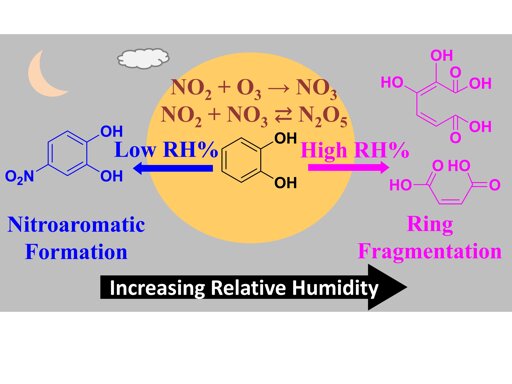
What happens to smoke particles after sunset can depend strongly on something as familiar as the amount of water in the air. New research from Md. Sohel Rana and Marcelo I. Guzman at the University of Kentucky shows that relative humidity can redirect the chemical pathways involved in the nighttime oxidation of catechol, a phenolic compound associated with biomass burning.
From Earth News - Earth Science News, Earth Science, Climate Change via This RSS Feed.
You must log in or register to comment.