

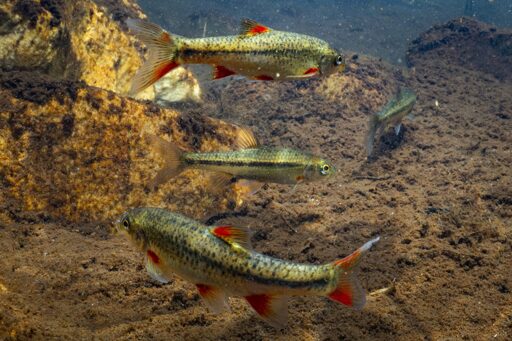
An ambitious effort to eradicate invasive spotted bass from South Africa’s Breekkrans River has unfolded about two hours north of Cape Town. Removing the bass has helped give the critically endangered doring fiery redfin (Pseudobarbus doring) a fighting chance against extinction. “Spotted bass were introduced into the river system in the late 1930s,” Martine Jordaan, a faunal ecologist at Cape Nature, a provincial conservation authority, told Mongabay in a video call. “The main reason was to have a species that was good for angling. What makes bass a good angling fish makes it a bad invader. It really goes after the small fish, and most of our native fish are 12 centimeters [4.7 inches] and smaller.” Jordaan said that after the bass species had been introduced, it spread as far as the habitat allowed, only stopping when encountering natural barriers such as waterfalls. “Often you find that native fish populations [are restricted to] streams where bass cannot invade,” Jordaan said. That was the case with the doring fiery redfin. “The Breekkrans River has the largest remaining population of doring fiery redfin with probably a few hundred adults,” Jeremy Shelton, a freshwater conservation ecologist working at the Freshwater Research Centre (FRC), told Mongabay by email. “The species also exists in another river, but in very low numbers.” Prior to the spotted bass eradication, the doring fiery redfin were confined to a 2-kilometer (1.2-mile) stretch of the Breekkrans River that remained bass-free. The Breekkrans River Restoration Project is run by the FRC…This article was originally published on Mongabay
From Conservation news via This RSS Feed.