

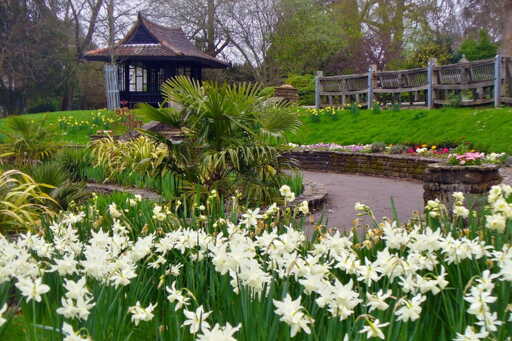
Stoke Park is a natural haven in a busy British town. Centered in Guildford, Surrey, its rolling fields pop with wildflowers in the spring; birds sing and ducks paddle serenely in a pond beside ornamental gardens; and the sun casts dappled shade on the grass from oak, spruce and beech trees, scattered across 52 hectares (130 acres) of green. Yet as residents and visitors stroll, jog and lounge across Stoke Park’s green reaches, it’s doing even more for them than they realize: According to two recently-published studies, its green areas reduce heat, pollution and noise — and have benefits that extend beyond the park’s borders. Parks have a well-documented benefit to urban areas, particularly given the rising heat of climate change: Many previous studies have established that parks are much cooler than the surrounding area, and that they also tend to reduce air pollution and noise. These previous studies also found that air and surface temperatures were lower for tens or even several hundred meters around green spaces, depending on the park. However, “most of the work in this field has been focused around one benefit — so either you see just health benefits, or how they affect air pollution, or overheating,” Prashant Kumar, professor at the University of Surrey, co-director of the university’s Institute for Sustainability and director of its Global Centre for Clean Air Research, said in a Zoom interview with Mongabay. “You hardly see studies which look holistically at the multiple benefits of the plants [or] the…This article was originally published on Mongabay
From Conservation news via This RSS Feed.