



Richard Arlin Walker
Special to ICT
Former lawyer Harry Levant leaned in toward the microphone and told the U.S. Senate Indian Affairs Committee the hard truth: He’s a gambling addict.
He remembers well the dopamine rush triggered by the uncertainty and thrill over whether each wager would pay off. Even when chasing the action becomes chasing losses.
He remembers well when his own funds were depleted and he embezzled $2 million from his clients to feed the beast. And he remembers when he made his last bet — on April 27, 2014 — and that the same night he attempted suicide.
In a Pennsylvania courtroom on Feb. 13, 2015, in the presence of his three young children and the clients he ripped off, he pleaded guilty to 13 financial crimes. He was sentenced to up to 23 months – served immediately on parole – and up to 10 years of probation on the condition he undergo addiction counseling, a casino ban, and make restitution payments.
Now in recovery, Levant has dedicated his life to helping people avoid the trap he fell into. But online gaming and the sudden growth of prediction markets such as Kalshi and other platforms puts even more people — of all ages — at risk of getting caught up in addiction, he told the Senate committee on Aug. 4.

An ad for the prediction market app Kalshi is displayed on a mobile phone. Credit: AP Photo/Erin Hooley, file
Levant is director of gambling policy at Northeastern University School of Law’s Public Health Advocacy Institute in Boston, leads a recovery support group and advocates for stronger consumer protections against predatory industry tactics.
He said addiction is easier to fall into today than when he gambled. All someone needs is a smartphone and credit or debit card. Just press a button on an app – any time, any place, during your 9-to-5 day at work, or at 2 a.m., when you should be asleep. Online gaming and prediction market trading occur at light speed and access never stops, according to Levant.
“On that day of my guilty plea, as I was being sentenced for my felonies, I made a pledge,” Levant told the committee. “The pledge that I made to the court and in the presence of my children was that if I could get well, I would dedicate my future to helping prevent others, particularly younger adults, from suffering a similar fate.”
Online betting is now taking on new forms that state and tribal gaming regulators say are dangerous and that sidestep their regulatory authority. One form is the prediction market, in which participants wager on an event’s outcome: Will congressional salaries be increased? Will the Democrats win control of the U.S. House? Will the Steelers beat the Bills?
The result could be billions of lost dollars for tribal nations and states.
Looking to the futures
Prediction platforms say what they offer isn’t gambling but a futures contract, not unlike what a farmer buys to hedge against fluctuations in the price of feed or fertilizer.
The Trump administration agreed, and in 2020 recognized Kalshi’s prediction offerings as financial derivatives rather than traditional wagers. DraftKings, FanDuel and Polymarket soon followed.
State and tribal gaming regulators say trading sports and event contracts is functionally identical to sports betting, and is a wager based on chance. Sports wagers, in fact, make up between 85 and 90 percent of the total trading volume on prediction market sites, according to research at Santa Clara University.
Because they fall under the jurisdiction of the federal Commodity Futures Trading Commission, prediction markets are able to skirt gaming regulations established by state and tribal governments.
And they are able to skirt taxation, too. The American Gaming Association — an organization of state, tribal and commercial gaming officials and regulators — estimates that prediction markets alone have cost state governments over $1 billion in missed tax revenue.
“These products are marketed as financial instruments, purported commodities, derivatives, or swaps,” Jamie Hummingbird said at the Senate hearing. He is a citizen of the Cherokee Nation and chairman of the National Tribal Gaming Commissioners & Regulators Association.
“But let’s be clear here today and call them by their true name: When you wager something of value on the outcome of a sporting event, it’s sports wagering,” Hummingbird said. “Relabeling the wager as an event contract or a prediction market or derivative does not change what it is.”
State and tribal gaming regulators also say online betting and prediction platforms lack protections such as know-your-customer protocols, anti-money-laundering safeguards, integrity monitoring requirements and accountability, responsible gaming requirements, and age verification.
Backbone of tribal economy
The Indian Gaming Regulatory Act of 1988 launched an era of economic empowerment for tribal nations, with 537 casinos on tribal lands as of 2024, according to the latest data from Statista, a global data company with an extensive collection of statistics, reports and insights from 50,000 sources in 170 industries.
Those enterprises netted more than $46 billion in fiscal year 2025, and states and local governments receive revenue in the form of taxes and revenue-share payments.
“Every dollar generated by Indian gaming goes to fund healthcare and education for our children, housing for our elderly, and public safety and infrastructure,” Mark Macarro, chairman of the Pechanga Band of Indians and president of the National Congress of American Indians, told the Senate committee.
Indian gaming also generates jobs – more than 682,000 jobs for rural American families in 2025, he said.
“These jobs provide stable income and a path to the middle class for tribal citizens and non-members alike,” Macarro said. “In areas where these jobs would not exist otherwise, we’ve worked under IGRA’s framework for over 40 years, carefully negotiating agreements with states to strictly regulate gaming. Prediction markets threaten these rural jobs and revenue generated for tribes’ and state governments’ budgets.”
Tribes invest more than $450 million each year on gambling regulation and employ more than 6,000 regulators, Macarro said.
“Every tribe engaged in gaming maintains strict age requirements,” he said. “We invest in problem gambling programs that include treatment, education, self-exclusion, and staff training.”
The Yaamava’ Resort & Casino, owned by Yuhaaviatam of San Manuel Nation, trains its employees to recognize when a guest may have a gambling problem and direct them to resources and options that can help them.
Gaming is part of the experience, Yaamava’ officials say, but not the whole experience. Resort hotels often showcase Native art, dining might include traditional foods, and other amenities often include stores, swimming pools, theaters, live music, dancing, and concerts by world-renowned performers.
By comparison, Kalshi and other online platforms employ VIP hosts who, according to lawsuits, cultivate personal relationships with vulnerable bettors, offering gifts, tailored bonuses, and private communication lines that can deepen compulsive gambling habits. One gambling addict told Al Jazeera news organization that when she asked her host about a loan to help her cover her mounting debts, the host gave her credits to continue gambling.
State and tribal lawsuits allege online platforms use deceptive promotions and intrusive tactics to target vulnerable users and exploit compulsive gambling addictions.
“Prediction markets are gambling, but they call themselves a financial product or an investment, which is incredibly dangerous,” said Michael Hoenig, Yuhaaviatam’s vice president and associate general counsel for gaming. “It’s crazy the way that they’re taking gambling and trying to repackage it as some kind of responsible financial product, as opposed to what we all know it is, which is a form of entertainment that has to be taken seriously.”
Nevertheless, online betting and prediction markets are experiencing significant growth.
U.S. Sen. Lisa Murkowski, R-Alaska, chair of the Senate Committee on Indian Affairs, said some online platforms claim more than 5 million monthly active users in the U.S. to generate billions of dollars.
Online betting generated $10.74 billion in 2025, a 27.6 percent increase over the previous year.
In the prediction markets, DraftKings projects net revenue of $6.5 billion to $6.9 billion in 2026; Kalshi, $4 billion; BetMGM, $2.9 billion to $3.1 billion; Robinhood, $1.3 billion; Polymarket, $1 billion; and FanDuel, $300 million.
Online betting and prediction market figures are different sets of numbers. Online betting uses a house-banked sportsbook that sets the odds, and bettors play against the house. Prediction markets function like a stock or futures exchange, and participants trade directly against other users.
In defense of sovereignty
The Senate Indian Affairs Committee hosted the Aug. 4 roundtable discussion, “Tracking Prediction Markets’ Exponential Growth: Tribal Implications and Beyond,” with state and tribal officials calling on Congress to close loopholes that allow prediction markets to bypass gaming regulations and state-tribal compacts.
They also called on Congress to pass Senate Bill 4160 — the Prediction Markets Are Gambling Act — and urged federal regulators to ensure that new rules for online betting and prediction markets do not preempt established state and tribal gaming authority.
Tahassi Hill, chairman of the Oneida Nation and vice chairman of the Indian Gaming Association, participated in the roundtable discussion.
“We are strongly opposed to prediction markets that have manipulated a weak regulatory agency to offer nationwide online sports gambling to kids as young as 18,” Hill said. “Prediction markets target young people and those in jurisdictions where sports betting is prohibited. … Every teenager with a smartphone can now lose their shirt without leaving their house or their dorm room. We’re only starting to see the devastating impacts of our kids’ mental health and their finances.”
According to data from the National Council on Problem Gambling, about 16 percent of online sports bettors meet the criteria for disordered gambling, a recognized mental health condition defined by “repeated, uncontrollable gambling behavior that causes significant distress and negative life consequences.”
An additional 13 percent show signs of compulsive behavior.
And problem gambling rates among online gamblers are up to five times higher compared to traditional non-online formats, according to reports at the National Library of Medicine. Users aged 18 to 21 traded roughly $5 billion on Kalshi during the first part of the year, making up about 3 percent of its total trading volume, according to reporting by CNN.
“No one voted for this,” Hill said. “Congress did not pass a law. This is happening because one person has declared that online sports gambling is legal in every state, including Hawai’i and Alaska, and on every Indian reservation.”
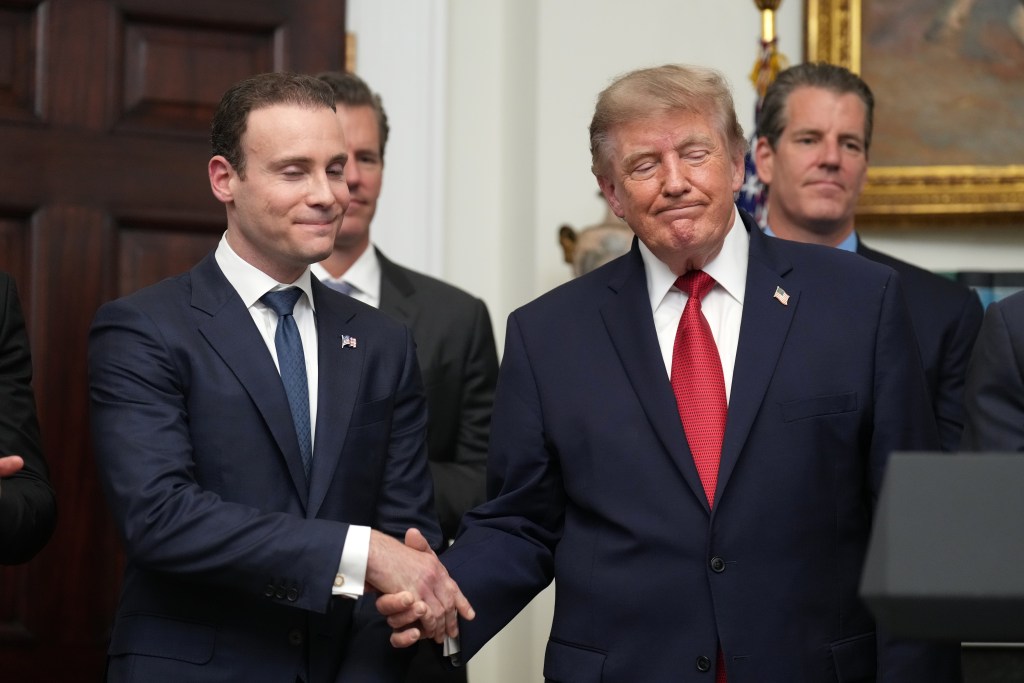
President Donald Trump shakes hands with Commodity Futures Trading Commission Chairman Michael Selig during a meeting with technology leaders in the Roosevelt Room of the White House on Aug. 19, 2026, in Washington, D.C. Credit: AP Photo/Jacquelyn Martin
Hill was referring to Commodities Trading Futures Trading Commission Chairman Michael S. Selig, formerly a corporate lawyer for cryptocurrency firms and prediction market platforms, including those in which Donald Trump Jr. has active financial and advisory ties. Selig is the only commissioner; four other positions remain vacant.
“Tribes hold exclusive jurisdiction over gaming on Indian lands, operating within a framework built through decades of negotiation among tribes, states and the federal government,” Macarro, the Pechanga Band chairman told the committee.
“For over 30 years, that framework has worked,” he said. “Tribes and states have negotiated compacts that protect consumers, ensure regulatory accountability, and affirm and strengthen tribal sovereignty.”
Looking ahead
Numerous lawsuits, meanwhile, have been filed in various courts by states and tribal governments seeking court rulings enforcing their laws, and by the commission and prediction platforms seeking to block the enforcement of those laws.
Dan Little is chief intergovernmental affairs officer for Yuhaaviatam of San Manuel Nation.
“We want to make sure the courts understand that tribes regulate gaming that happens on Indian lands pursuant to the Indian Gaming Regulatory Act,” Little said. “These prediction markets infringe upon state or tribal sovereignty and the tribe’s ability to regulate and determine who does and doesn’t get to do gambling on their lands.”
The post Prediction markets could cost tribes, states billions in gaming income appeared first on ICT.
From ICT via This RSS Feed.