

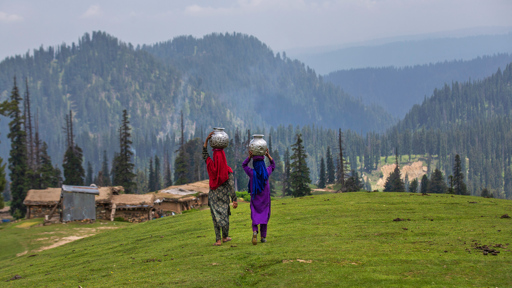
Shafeeqa, a 40-year-old resident of Cherwan village in Ganderbal district, north of Srinagar in Kashmir Valley, remembers a spring that once flowed with enough force to make diverting its water toward agricultural fields a difficult task. During her teenage years, she recalls, the water rushed so powerfully that her brother was once carried along by the current. Over the past 5-6 years, however, Shafeeqa said the spring’s flow has diminished step by step. What was once a dependable source of water has become a reminder of how much the village may be losing. “Nature has blessed us with a great source, but it is we who have destroyed it with our own hands,” she said. Shafeeqa says she believes climate change has contributed to the spring’s decline. Research in the Sindh Basin lends support to her concern, although the reasons springs lose their flow can vary from one location to another. The answer may lie some distance uphill, beyond the spring’s visible outlet and in the landscapes where rainwater and melting snow seep into the ground. Springs are an essential water source for communities in the Kashmir Himalaya, particularly in mountain settlements where rivers run through deep valleys and are difficult to access. Their water supports households, livestock and agriculture. But changes in spring flow can threaten all three. A Kashmiri Muslim man prays beside a stream on the outskirts of Srinagar, 2020. Image by AP Photo/Mukhtar Khan. A 2023 study in Environment, Development and Sustainability by researchers at the…This article was originally published on Mongabay
From Conservation news via This RSS Feed.