

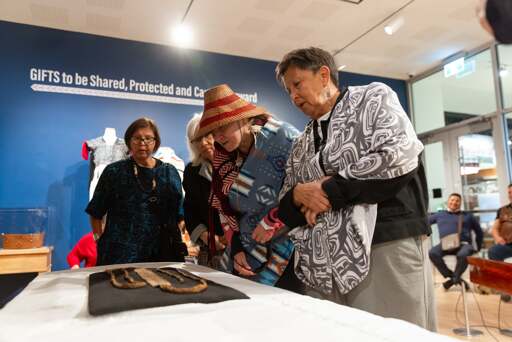

On Sept. 14, a ceremony at the Museum of North Vancouver welcomed a tumpline from Sen̓áḵw back to Sḵwx̱wú7mesh territory. The tumpline was collected in 1898 during the Jesup North Pacific Expedition. Photo by Alison Boulier
Sḵwx̱wú7mesh master weaver Chief Janice George had visited New York’s American Museum of Natural History (AMNH) before.
George and her husband, Buddy Joseph, had previously travelled to the museum to examine their collection of Coast Salish weavings.
But when the couple returned in 2024, to research an exhibition George was co-curating at the Burke Museum in “Seattle,” they were surprised to be shown something they hadn’t seen during prior visits.
Among the pieces brought out for them to view was a tumpline — a woven belt used to carry heavy loads. It was beautiful, she remembers thinking, and she admired its master craftsmanship as Joseph searched the museum’s records for information about its origins.
And then he found it. The tumpline was from Sen̓áḵw, the ancient Sḵwx̱wú7mesh village currently being reimagined for 21st century living — and where George was working as a cultural advisor at the time.
“It was just mind-blowing,” George said.
George describes the tumpline as a “woven jewel,” pointing to the fineness of the wool, its vivid colours and the care taken with every detail.
She experiences the tumpline not just as a master weaver, but as a hereditary chief and curator. “It makes me feel emotional to even think about it,” she said.
Rushing to find somewhere to connect the call with her colleagues, she said she felt like the encounter was a message from the ancestors, affirming that she and Joseph were on the right path.
She excitedly shared what she found — and began working to bring the tumpline back to Sḵwx̱wú7mesh.
At 73 and 69, respectively, George and Joseph have spent years travelling to museums and collections across the world in search of Sḵwx̱wú7mesh weavings. “My relatives call us teenagers because we’re always on the run,” she laughed.
The more belongings the couple are able to locate and bring home, the more future generations can learn from the knowledge, histories and cultural practices carried within them.
“The energy comes with the work,” George said, recalling her husband’s words. “This is work that we’re meant to do.”
After a long journey home, the tumpline is now on temporary display in George’s latest exhibition, Gifts to be shared, protected and carried forward, at the Museum of North Vancouver (MONOVA) until March 2027. But while its return to Sḵwx̱wú7mesh territory marks a significant milestone, what happens to the weaving after the exhibition closes remains uncertain.

The Sen̓áḵw tumpline, a woven strap traditionally used to carry baskets of harvested foods, is on display at the Museum of North Vancouver until March 2027. Photo by Alison Boulier
‘It’s unlike anything we’ve seen before’
A tumpline is a long, narrow woven strap used to carry bundles of harvested foods, such as berries, herbs or seafood.
Tied to either side of a basket, the strap rested across the forehead, allowing the wearer to carry the load on their back. Among Sḵwx̱wú7mesh and other Coast Salish peoples, women often made and used tumplines to carry whatever they gathered.
The Sen̓áḵw tumpline was recorded in the AMNH collection in 1898, during the Jesup North Pacific Expedition. Led by anthropologist Franz Boas, the expedition collected Indigenous belongings across the North Pacific region, reflecting a colonial-era approach to studying Indigenous peoples and their cultures.
Visible repairs suggest the tumpline had already been used for some time before it entered the museum’s collection, potentially dating it to the early 19th century or earlier, said George.

Master weaver and hereditary chief Janice George and her husband, Buddy Joseph admire the Sen̓áḵw tumpline during its welcome ceremony at the Museum of North Vancouver on Sept. 14. Photo by Alison Boulier
George believes it was woven from mountain goat wool, possibly spun with hair from woolly dogs that Sḵwx̱wú7mesh and other Coast Salish peoples bred for their fibre. The practice dates back at least 5,000 years, but eventually disappeared as colonialism disrupted Coast Salish communities and cultural traditions.
Depending on when the tumpline was made, its wool may have been dyed with natural materials such as alder or combined with red yarn unravelled from commercially made garments.
“It’s unlike anything we’ve seen before,” said George, who was struck by the fineness of the wool, the vivid colours and the intricate braiding at the ends, where the strap would have been tied to the basket. She had the tumpline mounted in the exhibit so visitors could appreciate the artistry.
“You can tell how much care went into making it,” she said. Women often made tumplines for their own use, said George. “So they are designs you know they really love.”
For Zoe Mackoff de Miranda, MONOVA’s director, having the tumpline on loan from New York is “a pretty big deal.”
She doubts the loan would have happened without George’s involvement. “It’s here because of Chief Janice,” she said.
But securing the loan took persistence. George requested the tumpline for Woven in Wool, the exhibition she co-curated at the Burke Museum in “Seattle”, which ran from September 2025 to August 2026.
George hoped that getting the tumpline to Seattle would bring it closer to home — and eventually to Sḵwx̱wú7mesh territory. With the Burke and MONOVA backing the request, she asked the AMNH to extend the loan to “North Vancouver.” The museum initially refused, citing concerns about the tumpline’s fragility and the risks of further travel.
So George wrote a letter explaining what it would mean for her community to see the weaving returned, even temporarily, to Sḵwx̱wú7mesh lands. She wanted local weavers to be able to study the work of their ancestors and take pride in its intricacy.
Eventually, the museum agreed.

Zoe Mackoff de Miranda, director of the Museum of North Vancouver, attends a ceremony welcoming the Sen̓áḵw tumpline to Sḵwx̱wú7mesh territory on Sept. 14. Photo by Alison Boulier
It’s unclear whether AMNH ever displayed the tumpline publicly. Only a small fraction of a museum’s collection is typically on display at any given time, Mackoff de Miranda said. Some objects may never be exhibited, either because they don’t fit a particular exhibition or because the collection is simply too vast.
The New York museum holds more than 30 million items, according to its website, describing them as “one of the most important scientific collections in the world.”
The records accompanying Indigenous belongings collected during the Jesup expedition were not always detailed. The expedition, funded by Morris K. Jesup, then president of the museum, amassed cultural belongings from Indigenous communities across the North Pacific, but the surviving documentation leaves gaps in the histories of individual pieces.
“It depended on who wrote it and who collected it,” said George. And for women’s crafted belongings, even less information was gathered.
“That’s kind of the sad part of it,” George said. “But we do the best we can to make sure everybody feels ownership for it.”
George understands how precious it is to spend time with the belongings of her ancestors, particularly one as unique as the Sen̓áḵw tumpline.


Chief Janice George speaks at a Sept. 14 ceremony welcoming the Sen̓áḵw tumpline to Sḵwx̱wú7mesh territory. She believes bringing ancestral belongings home is vital to passing cultural knowledge on to future generations. Photos by Alison Boulier
For George, the tumpline carries deeper significance after generations of First Nations people endured the residential “school” system and what she describes as “legislated poverty.” Its return to Sḵwx̱wú7mesh territory, even temporarily, feels like a gift from the ancestors.
“They reveal themselves when they think the time is right,” she said.
Finding the Sen̓áḵw tumpline at the museum just minutes before a meeting about the artwork for the new Sen̓áḵw village was one of those moments. “It’s all just pretty amazing,” said George.
‘It’s why I do this work’
At a ceremony at MONOVA on Sept. 14, Sḵwx̱wú7mesh weavers and singers gathered to welcome the tumpline back to the territory.
Peter Baker, director of Territory and Culture Services at Sḵwx̱wú7mesh Úxwumixw, was also in attendance. The exhibition marks the first time the department has funded a museum exhibition. According to Mackoff de Miranda, that decision reflects a growing interest in connecting language, culture and territory in ways that reach the broader community.
“He could see what it meant to the people,” said George. “Seeing how everybody felt so connected and proud and so emotional about having our ancestors’ work here. It’s why I do this work.”
IndigiNews reached out to Baker, but did not receive a response in time for publication.

Community members gather with the Sen̓áḵw tumpline during a ceremony welcoming the ancestral weaving back to Sḵwx̱wú7mesh territory. Photo by Alison Boulier
Mackoff de Miranda doubts the loan would have happened without George’s persistence. But she also credits MONOVA’s Class A exhibition space, which meets strict climate-control standards that allow museums to borrow fragile objects from other collections.
Sḵwx̱wú7mesh Úxwumixw doesn’t have its own Class A facility, Mackoff de Miranda said, making collaborations with institutions like MONOVA essential piece of the puzzle in bringing cultural belongings home.
“We would definitely have to have proper storage and display,” said George.
George hopes to bring more belongings back to the territory through what she describes as a “repatriation taskforce” that she’ll lead for the nation.
“We’re going to be looking at belongings all around the world,” she said.
As a hereditary chief, George sees this work as “the most important thing” she can do. She said she may eventually need to step back from, or delegate, other responsibilities to focus on bringing belongings home.
Mackoff de Miranda said the museum is “largely supportive of the concept of belongings returning to where they came from.” But under the terms of its loan to MONOVA, the tumpline is due to return to the AMNH in March 2027.
MONOVA is currently drafting a policy to guide the return of belongings in its collection. The policy will set out how the museum should respond when communities request a belonging, as well as how it can proactively identify objects in its collection that have no direct connection to “North Vancouver” and may be better held elsewhere.
Mackoff de Miranda hopes the policy will be finalized and made public in 2027.
George and Joseph are already putting what they learn from the tumpline into practice. The pair have been commissioned to create a triptych of the tumpline for sméṅhem (Tower Two) at Sen̓áḵw, adapting the ancestral design into a larger-scale weaving for a contemporary setting.
Studying the original helps them understand how its maker structured the design — knowledge George said is invaluable for weavers today.

tl’eltl’élnup (Tower One, right) and sméṅhem (Tower Two, left) at Sen̓áḵw, where Janice George and Buddy Joseph have been commissioned to create a triptych replicating the tumpline for display in Tower Two. Photo by Amy Romer
When she and Joseph began teaching, many of the older weavers had passed away. They had to work out how to recreate designs without the guidance of those who had made them, a process George describes as “reverse engineering.”
Now, she hopes the next generation won’t have to do the same.
“Buddy and I both come from leadership families, and understand that it is our responsibility to help the next generation,” she said.
Now, she sees young people taking up that work themselves. Their interest in weaving and cultural knowledge gives her hope that future generations won’t have to piece together what was lost.
“I feel like it’s such a cultural renaissance happening right now with our people,” she said. “I feel so positive about the future.”
The post After a ‘mind-blowing’ encounter at a ‘New York’ museum, a Sḵwx̱wú7mesh weaving returns home appeared first on Indiginews.
From Indiginews via This RSS Feed.