

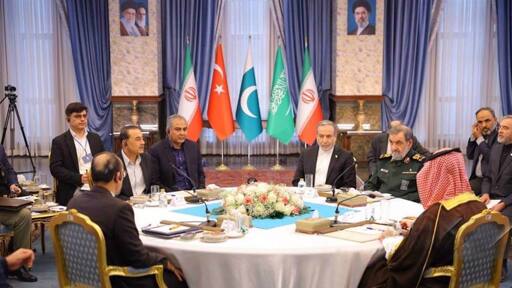

The constituents of the recently created Mecca Defence Alliance held their maiden meeting with Iran in Tehran on Monday, October 26, seeking ways to end the ongoing conflict between Saudi Arabia and Yemen and a larger understanding over regional security.
The participants agreed “to continue the dialogue to strengthen cooperation among the four regional countries, including for peace and security in the region,” a brief joint press statement, issued after the meeting said.
Saudi Arabia, Pakistan, and Türkiye created the Mecca Pact in August amidst the ongoing US-Israeli war on Iran and the growing fear of Israeli expansionism. The members have claimed the pact is based on the principle of collective security and was defensive in nature. Some of them have also hinted they are seeking to expand its membership.
On Monday, Defense Minister of Saudi Arabia Khalid Bin Salman, Pakistan Army Chief Asim Munir, and Türkiye’s National Intelligence Organization Director Ibrahim Kalin met with the head of Iran’s Supreme National Security Council (SNSC) Mohsen Rezaei and Foreign Minister Abbas Araghchi.
The Mecca Pact officials also met separately with Iranian President Masoud Pezeshkian earlier in the day.
The meeting came at a time when there is a growing speculation about the renewal of US-Israeli aggression on Iran which has ceased since August. It also coincides with escalation in Saudi Arabia’s conflict with Ansar Allah in Yemen.
Saudi Arabia has faced increased retaliatory attacks from Ansar Allah forces in Yemen after it violated a 2022 UN-sponsored ceasefire and attacked Sanaa International Airport in July. Ansar Allah seeks the end of Saudi interference in the country and the lifting of over a decade-long Saudi blockade on the country.
Pakistan and Türkiye have since announced the deployment of their forces in Saudi Arabia.
Citing unknown Pakistan officials, Reuters claimed that the negotiations between the four countries also featured fresh proposals to end the US-Israeli war on Iran.
Regional cooperation on peace and security
Informing about the meeting, Esmail Baghaei, official spokesperson of Iran’s Ministry of Foreign Affairs had earlier said that it could be a prelude to establishing endogenous security in the region.
“From our perspective, the fact that regional countries are seeking to establish, or at least consider, regional security mechanisms based on their own interests and concerns is a welcome development,” Baghaei said, underlining that Iran has long advocated for ending external reliance and building a regional security mechanism.
Iranian resilience against the joint US-Israeli aggression has “shown that sustainable and reliable security in our region can only be achieved through building trust and cooperation among regional countries,” Baghaei had claimed.
After the meeting, Rezaei announced that all the participants have agreed that “the security in West Asia must be endogenous and that any foreign interference must be prevented.”
SNSC’s Deputy Secretary Bagheri Kani also claimed that though there were differences in priorities and approaches, the quadrilateral meeting “reflected a shared understanding among the four parties of the need for cooperation,” Press TV reported.
Reacting to the development, Trita Parsi of the Quincy Institute claimed that though the meeting had the immediate objective of the Mecca alliance seeking Iranian help to resolve the ongoing conflict between Yemen and Saudi Arabia, it also reflects a changing security dynamic in the region.
Contrary to “Washington’s conventional wisdom,” the countries in the region “are showing greater agency and taking responsibility for the region’s security themselves” as the US pulls back militarily following the humiliation faced in its eight-month-long war against Iran, Parsi claimed.
US is not a reliable partner
“Some regional countries once imagined that by aligning themselves with a major power like the US they could shield themselves from any threat. In practice, however, they discovered that this notion did not align with reality,” he said.
Saudi Arabia and Türkiye have several US military bases in the country. Pakistan has maintained a close military partnership with the US for decades.
Some of the US bases in Saudi Arabia were damaged during Iranian retaliation earlier this year. The US has reportedly refused to come to Saudi’s aid despite it seeking the same to counter Ansar Allah’s advances in Yemen.
The meeting on Monday was a result of the realization “that there is no alternative but to rely on regional engagement and to establish security based on cooperation and synergy among the countries of the region,” Kani said.
He also claimed that the members felt the urgency for the meeting as the Zionist regime has “demonstrated its savagery and an unbridled appetite for expansion” in recent years, indicating the ongoing Israeli genocide in Gaza and its aggression and occupation in other Palestinian territories, Lebanon, and Syria.
It was reported that all parties of the meeting demanded that Israel must end its genocide in Gaza and end its occupation in Lebanon and Syria.
From BT News via This RSS Feed.