

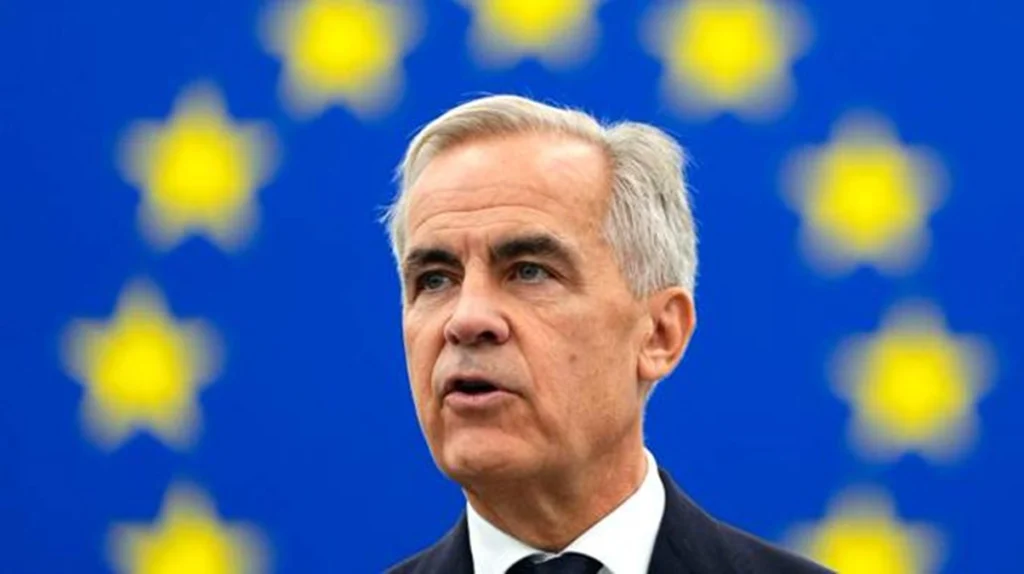
Von der Leyen, Carney, and Costa will discuss a new framework for Canada’s relationship with the European Union.
On Thursday and Friday, European Commission President Ursula von der Leyen, Canadian Prime Minister Mark Carney and European Council President Antonio Costa will meet in Montreal for the 21st European Union-Canada summit.
RELATED:
Canada: Alberta Voters Reject Independence in Referendum
They and other senior officials will discuss possible features of a status that would allow Canada to become an “associated member” of the European Union.
For the EU, the meeting will be an “important milestone” in relations between the two sides and will pave the way for an “even broader and deeper” political partnership and greater cooperation.
Specifically, European and Canadian leaders are expected to launch a “Partnership for the Future,” a framework for shared prosperity and economic security backed by new initiatives aimed at strengthening people-to-people ties, deepening economic relations and reinforcing their joint position on the world stage.
The summit’s agenda will cover a wide range of issues, from trade, digital affairs and critical raw materials to defense and security, as well as cooperation in education, research, innovation, and youth affairs.
Yves-François Blanchet sur Paul St-Pierre Plamondon et le sommet Canada-UE : « tu peux venir t’asseoir, mais t’as pas le droit de parler. »
Blanchet on Quebec’s premier at the Canada-EU summit: “You can come sit down, but you have no right to speak.” pic.twitter.com/O3rSPGTc5y
— Rebel News Québec (@RebelNews_QC) October 27, 2026
Associated Member State
EU sources said it was “clear” that one of the summit’s main topics would be a discussion of the proposal von der Leyen put forward last month — and which Carney welcomed — for Canada to become the EU’s first associated member state.
Currently, this status does not exist as a defined category in the European treaties. Therefore, its specific implications remain to be negotiated.
“This is somewhat uncharted territory, but I think what we want, together with our member states, side by side, and together with Canada over the next 12 months, is to have the ambition, confidence, creativity and vision to shape it together… It is the highest form of collaboration imaginable. For now, frankly, I see it as something very specific to Canada,” a senior EU official said.
“There is no doubt among the member states about their ambition for this relationship. All member states are clear that they want the closest possible partnership with Canada. So that is not in question,” another EU source said.
Nevertheless, some member states have reservations because this is uncharted territory. That is precisely the work that will need to be done in Montreal ahead of the next summit in 2027.
The senior official outlined three pillars for this membership: defining more joint policies on climate, energy, artificial intelligence, innovation, or security; having Canada participate more in EU programs, such as the Horizon Europe research program, or fully integrating it into Erasmus+; and, finally, bringing the institutions on both sides closer together to strengthen governance.
“The goal is to build a partnership that comes closer to membership than anything we have done before. It is clearly a partnership without membership (…), aimed at generating greater prosperity on both sides of the Atlantic,” the official said.
The EU was split today over whether to offer “associate membership” status to Canada, with several countries refusing to sign off on a statement containing that phrase just 48 hours before a summit between the two sides in Montreal.https://t.co/7hIHdoOeIw
— POLITICOEurope (@POLITICOEurope) October 27, 2026
Critical Raw Materials
Relations between Canada and the EU are already close in trade, security, defense, research and technological cooperation. Their main frameworks include the Comprehensive Economic and Trade Agreement (CETA), which has been provisionally applied since 2017, as well as recent progress in defense, digital trade and specific European programs.
They have long been strategic partners and share common values, including democracy, a commitment to a rules-based international order, and free and fair trade.
One of the key areas where the EU sees “enormous potential” is critical raw materials. Imports into the EU have already increased significantly and could rise further through the bloc’s “raw materials mechanism,” which focuses on facilitating connections between Canadian suppliers of these materials and European buyers.
Another idea under consideration is the possible joint stockpiling of critical raw materials, as well as the option of giving the EU priority access to Canadian reserves, EU sources said.
teleSUR/ JF
Source: EFE
From teleSUR English via This RSS Feed.