

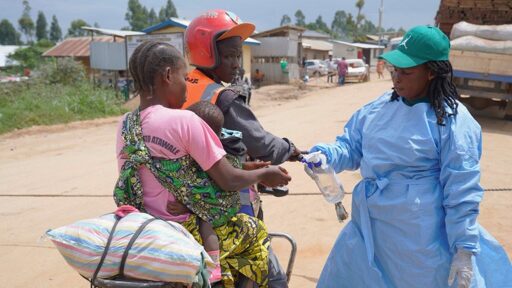

The risk of continental spread of Ebola looms as Nigeria becomes the fourth African country to report a confirmed case of the deadly virus since the outbreak was declared in the Democratic Republic of Congo (DRC) in mid-May.
Caused by the rare Bundibugyo strain of the virus, it has since become the world’s second-deadliest Ebola outbreak ever and the fastest-growing on record. It has killed 4,803 patients, nearly half of all the 9,876 confirmed cases in the eight provinces of DRC’s eastern region as of October 23
The real scale of deaths is likely much higher, since community transmission of the virus had already begun in DRC’s Ituri province by mid-February, three months before it was detected and officially declared an outbreak on May 15.
Neighboring Uganda, which is backing armed groups in Ituri, undermining the already delayed and severely underfunded health response, also reported its first case on May 15. However, after two deaths and 20 confirmed infections, the health ministry declared Uganda Ebola-free in late July. The WHO also certified this in late August, after no new cases were confirmed for 42 days.
However, its Ebola-free status has now come under question with the first case in Nigeria. The 42-year-old patient is a Ugandan national and Swiss citizen. She is the wife of a Swiss diplomat at its embassy in Nigeria’s capital, Abuja, where she resides.
After a two-and-a-half-week-long vacation in Uganda, she and her husband returned to Abuja on October 3. Four days later, she fell ill. Initially suspected of Malaria, she was treated at two private hospitals before being tested positive for Ebola and isolated on October 20.
Uganda makes a false claim
Soon after she was tested positive in Nigeria, the Ugandan health ministry claimed that the patient had traveled to the DRC.
However, the “information supplied to WHO did not include [her] travel” to any country other than Uganda, WHO representative in Nigeria Pavel Ursu said on October 22.
“So far, there is no validated information that this case traveled to DRC,” added Wessam Mankoula, the Head of Health Emergencies of the continent’s highest health authority, the Africa Centers for Disease Control and Prevention (CDC).
Then on October 23, the Swiss foreign ministry said explicitly that the patient had not traveled to the DRC, directly contradicting Uganda’s claim, indicating that she was infected in Uganda.
Uganda, meanwhile, still maintains that it has no confirmed Ebola cases. The WHO and Africa CDC are now examining a hypothesis that she may have contracted the virus at the airport in Uganda’s capital, Kampala, where a Kenyan businessman, infected during his travels in the DRC, was also present while she was boarding her flight to Abuja.
The Kenyan businessman had spent seven years in the DRC. While traveling on business, he had already fallen ill in September and was treated in multiple hospitals, but was not diagnosed with Ebola. Early symptoms of Ebola are often similar to other diseases in the region, including Malaria. He was reportedly provided antibiotics and sent home at one of the hospitals.
An illegal border crossing
The man in question traveled by road to Uganda from the conflict-ridden, mineral-rich, Ebola-affected province of North Kivu, parts of which are occupied by the Rwandan army and its proxy, the M23, which Uganda also supports, according to the UN.
It is unclear how the Kenyan businessman reached Kampala from North Kivu. Soon after the outbreak was declared, Uganda had closed the border with DRC, except for humanitarian trucks. Mankoula said he had crossed the border illegally.
In Kampala, he boarded a flight to Nairobi on October 3 from Entebbe Airport, through which the Uganda-born Swiss citizen who later tested positive in Nigeria was also passing that day to catch her flight to Abuja.
“Has there been any touch or contact between two cases [him and the case in Nigeria] at the airport at the same time?” This is one of the theories that is currently under investigation,” said Mankoula of the Africa CDC.
When the Kenyan businessman landed in Nairobi, he was already ill. The family member who picked him up from the airport drove him straight to the Nairobi Hospital, where he died two days later. Eight others who came into contact were also infected and isolated. They include four health workers and four family members, one of whom died later on October 23.
Even as health authorities examine whether he was also the source from whom the Nigerian case contracted the virus, virologist Marion Koopmans, who is also a member of the WHO’s Ebola emergency committee, has cast doubt on this theory.
“I think that is very speculative unless there is evidence of sharing the same space in a manner that could explain that. Random presence at the same location, a large airport, is not a supported epidemiological link by any standard of what we currently know,” she said.
If he was not the source, that could mean Ugandan authorities are either not revealing or are unaware of potential cases in the country. Even if he was the source, questions remain about Uganda’s Ebola-free status, as others he may have come into contact with – either in the airport or on his way to it in Kampala – could also have contracted the virus.
Nigeria at risk of community transmission
Either way, Nigeria is now at risk of community transmission. The Nigerian case landed on October 3 in Abuja, at one of the busiest airports in West Africa. Only on October 20, 13 days after developing symptoms, was she tested positive for Ebola and isolated.
Amid fears that the virus may have infected others who may have come into contact with her during this period, especially health workers, Nigerian Health Minister Muhammad Ali Pate said that authorities were tracing all 44 contacts. “We are trying to contain it so it doesn’t go out to the communities. Hopefully, it won’t get to that,” he added.
“When we identified at-risk countries, Nigeria was not part of this list. It is now. That list would have to be redrawn, and North and Southern Africa could also be at risk,” said Jean Kaseya, director-general of the Africa CDC, adding, “We need to consider that no one is safe today.”
From BT News via This RSS Feed.