

By William Serafino – Oct 22, 2026
Although it did not receive the attention it deserved, the launch of the Andes–Atlantic Corridor between the US and Argentina on September 23 has all the attributes of a turning point in the US policy of systemic domination in South America. This US policy was laid out in the 2025 National Security Strategy and constituted also in the Shield of the Americas.
Non-accidental coincidences
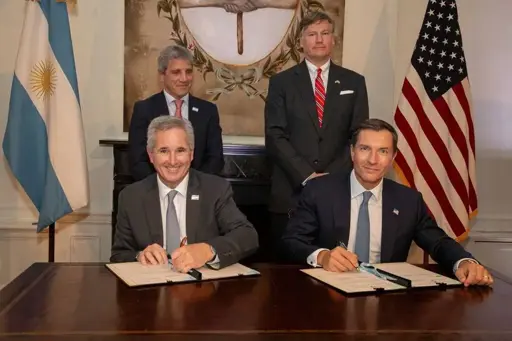
The corridor initiative was launched on September 23 in the context of the United Nations General Assembly in New York, led by US Under Secretary of State Christopher Landau and Argentina’s Foreign Minister Pablo Quirno, who spearheaded the announcement. According to the joint statement, the proposal seeks to “modernize the infrastructure that connects Argentina’s key economic sectors with major Atlantic ports and Western markets.”
The mention of key sectors ranges from the rich hydrocarbon deposits of Vaca Muerta—located in Patagonia, mainly in Neuquén, with extensions in Río Negro, Mendoza, and La Pampa—to critical minerals of high strategic value such as lithium and copper, where Washington seeks to strengthen its geopolitical and geoeconomic influence through the corridor.
However, the binational announcement was not made in a vacuum and can be intertwined with the meeting the previous day, September 22, between members of the Shield of the Americas. The most relevant aspect of the meeting was the written details in the official declaration. Contrary to what might be thought due to the security nature of the Shield, the declaration was did not contain a great deal of military terminology.
Rather, it begins by addressing the defense of the region’s economies, while references to US dominance over critical minerals, investments, and supply chains surpassed appeals to the US’s favorite fabrication, “narcoterrorism.”
The temporal synchronicity and the concepts used in both declarations allow one to decipher the role of the vessels between the Shield and the Andes–Atlantic Corridor. The corridor, for the US, is based on guaranteeing the security and protection “of the Western Hemisphere and its strategic supply chains.”
In this way, Trump’s Washington unifies military and economic control in a single state/corporate offensive aimed at the appropriation of strategic resources in the region, with the intention of displacing the People’s Republic of China and undermining its strong strategy in terms of minerals and hydrocarbons.
Description of the initiative and movements
In summary, it should be noted that the corridor is circumscribed to the “G7 Partnership for Global Infrastructure and Investment” created during Joe Biden’s tenure to compete with Beijing’s Belt and Road Initiative.
North American institutions involved in the project include the International Development Finance Corporation, the Export-Import Bank, and the Trade and Development Agency, which will be responsible for attracting capital and channeling investments into “railways, waterways, ports, pipelines, and energy generation and transmission infrastructure.”
Combining public and private investment, the US seeks to establish its role as a strategic partner of Argentina, generating loans, financial guarantees, and incentives for US companies to win bids in transportation, energy, and customs digitalization, which will theoretically allow for the extraction of geopolitical gains with the increase in the volume of hydrocarbon and critical mineral exports to the Western market via Argentina’s Atlantic coast.
In figures, the Andes–Atlantic Corridor comprises an investment of US $7 billion. According to the BBC, the Export-Import Bank will play a central role in the financing structure, serving as risk coverage and leverage for private investors.
One of its axes is the connectivity of Vaca Muerta’s immense hydrocarbon potential with Argentine ports through an extensive network of oil and gas pipelines. Washington, under a vision of state capitalism, seeks to gain significant influence in these projects by using state funds as a financing mechanism for private US companies.
According to Bastián Díaz of La Tercera, the Export-Import Bank “presented a financing proposal of US $6 billion. This money would be used to purchase US goods and services, which would develop infrastructure and production.”
It should be noted that the Trump administration is arriving somewhat late. The main gas pipelines under development already involve European, US, and Chinese banks and oil giants from the so-called Old Continent, such as Italy’s ENI, a player in the Argentina LNG pipeline, alongside the United Arab Emirates, and YPF, whose investment exceeds US $50 billion.
To shorten the path, the Andes–Atlantic Corridofr focuses on putting the necessary capital on the table to accelerate these projects and their associated logistical vectors in exchange for containing China’s attempt to expand its influence in Vaca Muerta through the telecommunications company Huawei and as a lender for projects.
Following the recent visit of libertarian Javier Milei to Washington, the US State Department bureaucracy set to work to bolster the initiative: the Argentinian president and Marco Rubio spoke by telephone, and a tour by Landau and Juan Pablo Segura, Under Secretary for Western Hemisphere Affairs, through Argentina and Paraguay was announced with a view to promoting the corridor.
The obsession with critical minerals
Beyond gaining greater geopolitical influence in Vaca Muerta, Washington’s strategic objective actually lies in critical minerals.
In this field, specifically in lithium, China has consolidated a significant position. As Indiana Ubelhartt indicates for Escenario Mundial: “Ganfeng Lithium holds a stake in Cauchari-Olaroz and developed other assets in Salta and Jujuy, while Zijin operates the Tres Quebradas project in Catamarca. Chinese involvement in Argentinian lithium, therefore, precedes the new US corridor.”
It is unlikely that the US will achieve China’s exclusion from these projects. However, through the corridor, it seeks to balance Beijing’s advantage in two aspects: production and commercial/logistical.
In 2025, the People’s Republic received more than 70% of Argentine lithium exports, and the trend of shipping through Chile, more efficient in terms of operating costs, is increasing. The US calculation consists of altering this logistical balance, decisively influencing the operability of the Belgrano Cargas, San Martín, and Urquiza trains, in addition to the Paraná–Paraguay waterway, to boost the export axis of the mineral towards the Atlantic and thus direct them to the North American market.
Simultaneously, the White House aspires to use the momentum of logistical reconfiguration to gain an advantage in new projects where China would be vetoed, under the umbrella of the Washington–Buenos Aires trade agreement signed in February of this year.
However, if in lithium, the US strategy is defensive, in copper, it is completely preventive. Even though the South American country does not have great development in the exploitation of this mineral, the prospects are encouraging given its great potential in San Juan, Catamarca, Salta, and Mendoza.
As China’s presence in this sector is beginning to grow, the Trump administration seeks to cut it short by sharpening the swords of the Andes–Atlantic Corridor.
Cuba Accuses US of Blackmailing Countries on UN Vote Against Blockade
Washington is racing against the clock and needs more than financing promises to dismantle China’s multilevel influence in Argentina’s strategic projects, and it is there that the conceptual links of the corridor with the Shield of the Americas could prefigure deeper maneuvers. In Argentina, the US has placed its hope on a subordinate government that is fragilely controlled by a president who today has a 56% disapproval rating, which seems insufficient for the US to achieve its objectives.
Translation: Orinoco Tribune
OT/JRE/SL
From Orinoco Tribune via This RSS Feed.