

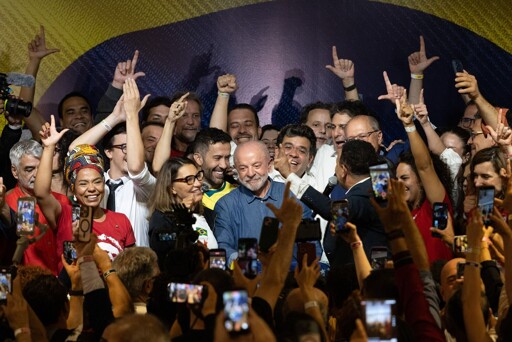
At 80 years old, Luiz Inácio Lula da Silva has once again made history, being elected president of Brazil for the fourth time. Lula won on a day charged with tension during the counting and announcement of the results. The president began with a lead over his opponent, Flávio Bolsonaro, but during the result count the latter took the advantage; the result later reversed again.
According to the Superior Electoral Court of Brazil (TSE), with 99.99% of polling stations tallied, Lula won 51.78% (64,255,124 votes), while Bolsonaro obtained 48.22% (59,825,488 votes).
With these results, Lula managed to overturn the scenario presented after the first round, held on October 4. In the first round, the Workers’ Party (PT) incumbent reached 45.16% of the vote (53,879,538), trailing the Liberal Party (PL) candidate, who obtained 47.03% of the ballots (56,104,503).
Lula also broke the so‑called ‘first round curse,’ a trend that had held since Brazil’s return to democracy in 1989. Since then, no candidate who finished second in the first round managed to reverse the result in the runoff.
“I want to thank the Brazilian people for their generosity,” Lula said, visibly moved, from his campaign headquarters after the final results were announced. The leftist leader was particularly grateful to young people, who “took to the streets to defend democracy.”
“This election was a defeat for denialism; it was a defeat for lies. I confess that every time I went to a debate, I felt uncomfortable. Because I have debated with many people, I have participated in many elections, I meet every year with the G20, with the BRICS, with the G7… but I never thought I would encounter a genuine representative of the country’s militias. I never imagined that a person could lie so much, with such brazen shamelessness. As if he had not a shred of humanity inside him,” he said about his opponent.
“What I saw in this second round in the elections, in all Brazilian states, and what I saw on the Avenida Paulista, was something I don’t think we have ever seen before, not only because of the size of the crowds, but because of the enthusiasm,” he added. In the framework of the mass demonstration, the Workers’ Party leader declared: “May our homeland be free or we will die for Brazil. Our country will not be anyone’s backyard.”
I have to govern for millions
In his speech, Lula gave special thanks to federal deputy for Minas Gerais, André Janones, who became a key figure in the PT candidate’s campaign. The Brazilian president highlighted the social media campaign Janones and his circle carried out.
“What really won these elections was a contest in which we had to defeat interference coming from outside to inside, through digital platforms. We will have to regulate them. It is not possible that we are unaware that crime in the digital world should be treated the same as a crime in real life,” he said.
Despite the victory, Lula recalled the responsibility his office entails. “Once again, I want to tell you that, to the extent that we win in the elections, we have no more adversaries: I have to govern for millions [of Brazilians], for all ages,” he added.
During the speech, the re‑elected president also committed to education policy, pointing to one of the challenges Brazil faces. “We are going to universalize full‑time schools up to secondary education,” he said.
From Caetés to trade unionist
Born in Caetés, then a district of Garanhuns, a small city in the state of Pernambuco in northeastern Brazil, Lula grew up in poverty. Later, seeking better opportunities, his family—comprised of his mother and seven siblings—moved to São Paulo, where he worked as a shoeshiner and in other precarious jobs. He was only 12 years old, but from the age of eight, he had already given up his childhood to help support the household.
In São Paulo, Brazil’s largest city, Lula began working in a screw factory at 14, driven by economic necessity. He left school, but chose technical training that allowed him to get a job in the metalworking industry. In 1964, a workplace accident cost him the little finger on his left hand.
At the end of that decade, while his country was governed by a military dictatorship, he became increasingly involved in union activity and in defending workers’ rights.
By 1975, he had been elected to union leadership positions and began to stand out for his open opposition to the regime, with actions including organizing mass strikes, which were harshly repressed by the military. Five years later, he founded the Workers’ Party (PT), an openly leftist organization that unabashedly proclaimed socialism.
The road to power
With the return to democracy, both Lula and the PT accumulated broad popular support. That allowed them to win seats in Congress and mayoralties in important cities, but it was not enough for the metalworker‑turned‑national political leader to win the country’s top office. He lost three times: once to Fernando Collor de Mello (1989) and twice to Fernando Henrique Cardoso (1994 and 1998).
The streak of defeats was broken in 2002, when he won his first presidency. During that period, he implemented a set of social programs aimed at combating poverty and inequality, accompanied by strong support for local industry, geopolitical alignment with other leftist leaders in Latin America, and a repositioning of the country on the international stage. Those governing directives secured his first re‑election in 2006.
Constitutionally barred from running for a third consecutive term, he handed the baton to his former chief of staff, Dilma Rousseff, who won the election and continued the political project.
In the mid‑2010s, the PT faced the mega corruption scandal of Odebrecht, which led to Lula’s imprisonment—later shown to be the product of a rigged judicial process. He returned to the political forefront and defeated the far‑right president and incumbent Jair Bolsonaro in 2022.
Lula Votes in Runoff as Transport Complaints Prompt Nationwide Extension; Lula Holds Narrow Lead
His third term was marked by the clash with Bolsonarism—which attempted a coup at the start of 2023—and by political and economic confrontations with the US. Lula did not back down and faced both situations: the courts prosecuted and convicted Bolsonaro for coup plotting, and he confronted threats and aggressive actions from Washington—which included the imposition of tariffs on most Brazilian products—with an openly sovereignist discourse. Sovereignty was a main focus of Lula’s campaign, which, together with his administration’s undeniable social achievements, has now guaranteed his fourth stay in the Planalto Palace.
Translation: Orinoco Tribune
OT/JRE/SF
From Orinoco Tribune via This RSS Feed.