

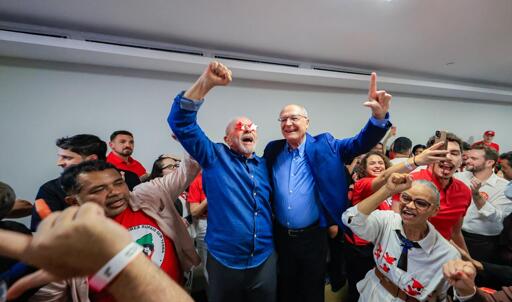

Brazilian progressive leader and incumbent president Luiz Inácio Lula da Silva made history last night, defeating far-right Flávio Bolsonaro of the Liberal Party in the second round after coming in second in the first round.
The results were awaited with bated breath after a judge ordered polls to be open for two more hours following complaints from voters who claimed they had been unable to reach polling places due to transportation problems. First the Workers’ Party (PT), and then the Liberal Party (PL), requested the extension, which paused the vote count until 7:00 pm in Brasília, the capital.
With 51.79% of the valid votes, the former union leader, metalworker, and head of the Workers’ Party staged a historic comeback against Bolsonaro, who lost the initial momentum he had in the first round and barely reached 48.21%. This is the first time a candidate who finished second in Brazil’s first round has staged a comeback and won the election in the runoff.
Bolsonaro entered the runoff with a relative – though significant – lead following his victory in the first round of voting on October 4, where he received 47.03% (approximately 56,104,503 votes), while Lula, to the surprise of many, came in second with 45.16% (53,879,538 votes).
In other words, there was a gap of nearly 3 million votes between the two candidates that seemed very difficult for Lula to overcome, especially considering that the remaining votes were split among candidates who were mostly from the right and center-right – a fact that led many to believe that Bolsonaro, the son of former president and currently imprisoned Jair Bolsonaro, would win the runoff.
But Lula, a true legend of Brazilian politics (a labor leader during the dictatorship who won the presidency three times), achieved the unthinkable. Between the first and second rounds of voting, he managed to gain more than 10 million votes compared to the first round – an astronomical figure, considering that Bolsonaro barely managed to gain some 3.7 million votes.
Lula’s victory
After it was clear that Lula’s victory was irreversible, the Brazilian streets were filled with people wearing the traditional red of the Workers’ Party. However, the victory was celebrated by a sort of broad coalition that had formed to overturn the result – one that spanned the political spectrum from classical left-wing parties and movements, to progressive liberals, and even some center-right groups that saw Bolsonaro as a threat to democracy.
In his speech marking his fourth presidential victory, Lula said: “I want to thank the Brazilian people – those who have stood by me for so long – and express my gratitude for the generosity of Brazil’s young people … We are going to change the way this country is governed … we are going to involve the people more. Digital communication will play a very significant role in this administration. I will deliver the best presidential term this country has ever seen.”
“Following our victory, we will have to discuss a new way of governing this country. The people’s participation in this campaign – the students, women, and workers who took to the streets – will compel us to find a new way of governing. This country will never be the same again,” said the reelected president.
Lula also stated that the debates against Bolsonaro and the PL campaign were riddled with lies and “denialism”: “I never thought a person could lie so much in this country, with such brazenness, as if there were not a single shred of humanity within him.”
Finally, he also addressed the problems his campaign faced regarding the dissemination of its messages on social media. The PT repeatedly denounced that the major social media platforms hindered or outright prevented the spread of its political messages, while Bolsonaro’s messages faced no such issues.
Is Meta meddling in Brazil’s elections? With Sunday’s runoff neck and neck, new reporting raises serious questions.
The pattern is hard to ignore: Lula’s campaign was blocked from boosting Instagram posts for nearly 24 hours, his ad account was previously restricted, and… pic.twitter.com/DVjDWJa7Xw
— BreakThrough News (@BTnewsroom) October 23, 2026
Hence, he suggested placing limits on the power of the major corporations behind social media platforms – a stance he has taken on other occasions and which has caused friction with tech giants: “We cannot fail to recognize that a crime in the digital world must be treated the same as a crime in real life. We cannot have monstrous companies of this size – which make billions without paying taxes to our country – trying to alter election results,” Lula said in his victory speech.
Bolsonaro’s reaction
For his part, far-right politician Flávio Bolsonaro said he “rejects” the election results and announced that he will seek to have the election annulled: “We are going to consult with our legal team; we are going to request that these elections be annulled. I will not accept that the rules of the game have been changed in the middle of the game – once again – by Lula’s friends on the Federal Supreme Court.”
Bolsonaro, who delivered his speech to his supporters, was referring to the extension of voting hours. According to his team, the extension was ordered after the polling stations had closed, which, they claimed, violates Brazilian electoral rules – even though the PL itself had also requested the extension.
This is not the first time that Bolsonaro’s supporters have rejected Lula’s victory. In 2022, it was Jair Bolsonaro who refused to acknowledge his defeat. Months later, during Lula’s inauguration, hundreds of Bolsonaro supporters violently stormed several government buildings, after which investigations were launched into an alleged attempted coup d’état. One of those found guilty in the case was Jair Bolsonaro himself, who is currently serving a sentence for that crime.
However, it will be difficult for Bolsonaro’s allegations to gain traction in Brazil’s immediate future. With the exception of Argentina’s far-right politician Milei, South American countries – through their heads of state and foreign ministries – have publicly congratulated Lula on his victory, which amounts to a de facto recognition of his win.
However, the Bolsonaros still have the Trump administration as a last resort, as it has publicly supported the PL candidate, just as it did with his father in the past. This is the first time since Trump began his second term that a candidate he supported in a Latin American country has failed to win, which still raises questions about what Washington’s stance will be regarding Lula’s historic victory – a victory in which, against all odds, he managed to defeat Washington’s candidate and thus halted a wave of far-right victories in Latin America.
From BT News via This RSS Feed.
Congratulations Brazil 🎉
Hopefully that’s the last we see of the Bolsonaro family in politics.
